The Times Australia
Google AI

Another Dog in The Family – What You Need to Know

  • Written by The Times


So, you decided your dog, cat, or pet family needs to get bigger. A new addition is always exciting, but it does come with a range of things to consider. Even more so if it’s not the first member of the family. If that’s the case, it’s not just about the toys, equipment, and meals. Whether to use mixed feeding, go for grain free dog food, or kibble... All those questions are still valid. But there’s one even more important.

Is my pet going to accept this new addition?

We’ll be honest here; it may take some planning, and it may take some patience. But in the end, it’s all worth it, right? Whether you're bringing in a puppy or an adult dog, the introduction process can have a big influence on the future relationship between your pets. Let’s go through the specific steps of the process together. Hopefully, it’ll make things easier for you – and your growing pet family!

Understanding Pet Dynamics

Pets, like humans, have their own unique personalities and territorial instincts. A sudden change (and a big one at that) can cause stress, anxiety, or even aggression. That’s the first thing you need to understand – change can be difficult, and the response to it can be negative. That’s just a fact. With that simple thought, you’ll see things more clearly, and certain behaviours from your pets are not going to take you by surprise. That’s also why it’s so crucial to make the whole introduction process gradual and controlled. The positive relationship and rapport among pets have to be built carefully; it cannot be forced.

Getting Ready for the Introduction

Here’s a handful of useful tips that can help you prepare: 

  • Health Check:Make sure both your new and existing pets are healthy by using preventive care like a natural flea treatment for dogs. Schedule veterinary visits to update vaccinations and discuss any concerns.
  • Create Separate Spaces: Designate safe zones for each pet. This way, you’ll give them enough personal space to retreat to and deal with any potential stress on their own.
  • Scent Exchange: Before the face-to-face meeting, exchange bedding or toys between the pets. It’s a non-threatening way to help them become familiar with each other's scent. This is also how you control the introduction process. No risk – big reward.

Introducing a New Dog to the Rest

  1. Neutral Territory Meeting: Arrange the first meeting in a neutral location, such as a park. Get your partner or a friend to help you out and take the dogs out separately on leashes. Why? It’s simple – safety. You (and your partner) control how close to each other they can get, and if things get heated, you can quickly react. With a neutral location, any territorial behaviour is far less likely. 
  2. Parallel Walks: Walk the dogs parallel to each other at a comfortable distance. Gradually decrease the distance as they become more relaxed. This activity promotes positive associations without direct confrontation.
  3. Positive Reinforcement: Reward calm behaviour with treats, like chicken jerky for dogs, and praise. If either dog shows signs of stress or aggression, increase the distance and proceed slowly. Takes some patience and careful observation.
  4. Home Introduction: After successful neutral territory interactions, it’s finally time to bring the dogs home. Let them roam around the yard together before you all enter the house. Inside, supervise their interactions closely and provide separate areas for each dog initially.
  5. Monitor Resources: To prevent resource guarding, feed the dogs in separate areas and remove toys or treats during initial interactions. Gradually, reintroduce shared resources as they become more comfortable with each other.

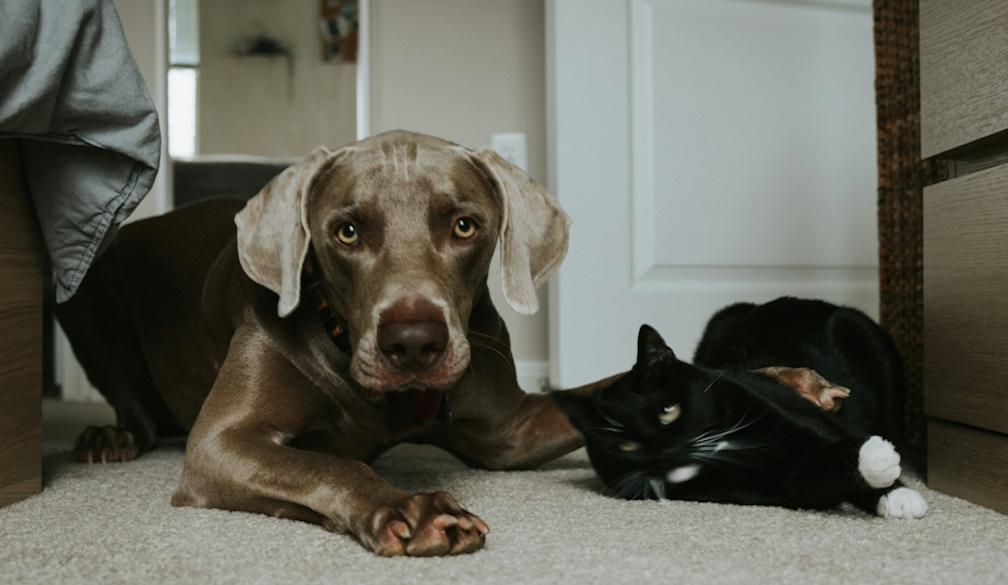
New Dog & Cats

There’s no rule here, as each dog and cat is unique and has its own personality, but this configuration tends to be a bit more intense.

  1. Separate Spaces: At first, keep the new dog and resident cat in separate rooms. This allows the cat to adjust to the new scent and presence without direct contact.
  2. Scent Familiarization: Swap bedding or use a soft cloth to transfer scents between the cat and dog. This helps them become accustomed to each other's smell.
  3. Controlled Visual Introduction: After a few days, allow the pets to see each other through a baby gate or slightly open door. Watch their reactions and provide positive reinforcement for calm behaviour.
  4. Leashed Meetings: With the dog on a leash, you can test out some supervised interactions. Make sure the cat has an escape route, such as a high perch or a separate room, to retreat if it starts feeling threatened.
  5. Gradual Increase in Interaction: Slowly make the interactions longer as they become more comfortable. Always supervise these meetings until you're confident in their behaviour towards each other.
  6. Safe Zones: Make sure the cat has access to areas the dog cannot reach. This is going to give your cat a sense of security.

Monitoring Behaviour & Progress

  • Body Language: Learn to recognize signs of stress, fear, or aggression in both dogs and cats. This includes growling, hissing, raised fur, or avoidance behaviours.
  • Supervision: Never leave new pets unsupervised until you're confident in their interactions. This prevents potential conflicts and ensures safety.
  • Consistency: Maintain regular routines for feeding, play, and rest. Consistency provides a sense of security for all pets during the transition.
  • Patience: Understand that building a harmonious relationship takes time. Don’t just rush the process; give each pet enough time to adjust at their own pace.

Addressing Challenges

  1. Resource Guarding: If a pet displays possessiveness over food, toys, or spaces, manage these resources carefully. Feed pets separately and introduce shared items gradually.
  2. Professional Assistance: If aggressive behaviours persist or you're uncertain about the introduction process, consult a professional animal behaviourist for guidance.
  3. Individual Attention: Ensure each pet receives individual attention and enrichment to prevent feelings of jealousy or neglect.

Long-Term Integration

  • Encourage Positive Interactions: Engage in activities that involve both pets, such as joint play sessions or parallel walks, to strengthen their bond.
  • Respect Individual Preferences: Some pets may never become best friends but can coexist peacefully. Respect their boundaries and avoid forcing interactions.
  • Monitor Health and Behaviour: Regularly assess the health and behaviour of all pets. Changes can indicate stress or underlying issues that need attention.

Worth the Effort

Introducing a new dog to your existing pets is a delicate process that requires thoughtful planning, observation, and patience. Add some structure, use a controlled environment, and take it slow. Don’t be discouraged even if the connection between them isn’t instant. Give them time, give them space, and be understanding. Remember, the goal is to create an environment where all your pets feel safe, valued, and content.

Times Magazine

How new rules could stop AI scrapers destroying the internet

Australians are among the most anxious in the world[1] about artificial intelligence (AI). This...

Why Car Enthusiasts Are Turning to Container Shipping for Interstate Moves

Moving across the country requires careful planning and plenty of patience. The scale of domestic ...

What to know if you’re considering an EV

Soaring petrol prices are once again making many Australians think seriously[1] about switching ...

Epson launches ELPCS01 mobile projector cart

Designed for the EB-810E[1] projector and provides easy setup for portable displays in flexible ...

Governance Models for Headless CMS in Large Organizations

Where headless CMS is adopted by large enterprises, governance is the single most crucial factor d...

Narwal Freo Z10 Robotic Vacuum and Mop Cleaner

Narwal Freo Z10 Robotic Vacuum and Mop Cleaner  Rating: ★★★★☆ (4.4/5) Category: Premium Robot ...

The Times Features

Grants open for port communities across the Hunter and Northern Rivers regions

Local organisations doing important work across the Hunter and Northern Rivers regions are being...

AI Is Already Here. The Question Is Whether Your Business Is Built for It

We sat down with Nirlep Adhikari — CTO at LoanOptions.ai and Founder of Mount Mindforce — to cut...

Cleared to Land — and Cleared to Die: How a Runway Failure Killed Two Pilots in Seconds

A modern passenger jet, operating under full clearance, descending onto a controlled runway at o...

Leader of The Nationals Matt Canavan - press conference

CANBERRA PARLIAMENT HOUSE PRESS CONFERENCE WITH SHADOW WATER MINISTER MICHAEL McCORMACK; MURRAY-DA...

The Power Of An Uncomfortable Love

How challenging relationships can help us grow. Never have we lived in a time where relationshi...

US country favourite Larry Fleet joins 2026 Gympie Music Muster

Tennessee singer-songwriter Larry Fleet will bring his band to the Gympie Music Muster on Friday...

56 OF YOUR FAVORITE DISNEY STARS SHINE BRIGHT IN DISNEY ON ICE PRESENTS MAGIC IN THE STARS!

The most Disney characters in one show and the on-ice debut of Raya from Raya and the Last Dragon...

How much do you really need to retire? It’s probably a lot less than $1 million

Every few months, someone in the superannuation industry declares that Australians now “need” ar...

South Australian Nationals to open up local oil from Great Australian Bight

Amid out-of-control inflation and impacts from the Middle East conflict, The South Australian Na...