Head lice are getting harder to kill. Here’s how to break the nit cycle
- Written by: Cameron Webb, Clinical Associate Professor and Principal Hospital Scientist, University of Sydney

Wrangling head lice, and the children they infest, must be up there with the most challenging duties a parent or carer has to face.
And the job is getting harder. Commonly used chemical products aren’t working as well[1] as they once did, meaning head lice are harder to kill.
You can still rid your children of lice – but it’s likely to take some patience and persistence.
Remind me, what are head lice? And nits?
Head lice are tiny six-legged insects[2] that are only found in the hair on a human’s head – most commonly[3] in the hair of primary school-aged children.
Head lice have been a constant companion for humans throughout their millions of years[4] of evolution.
Lice love living in our hair. But they scoot down to our scalp up to a half dozen times a day to drink our blood.
Their claws are perfectly designed to scuttle up and down shafts of hair. But while they’re nimble on our hair, once they’re off, they don’t last long –they’re clumsy, uncoordinated and die quickly.
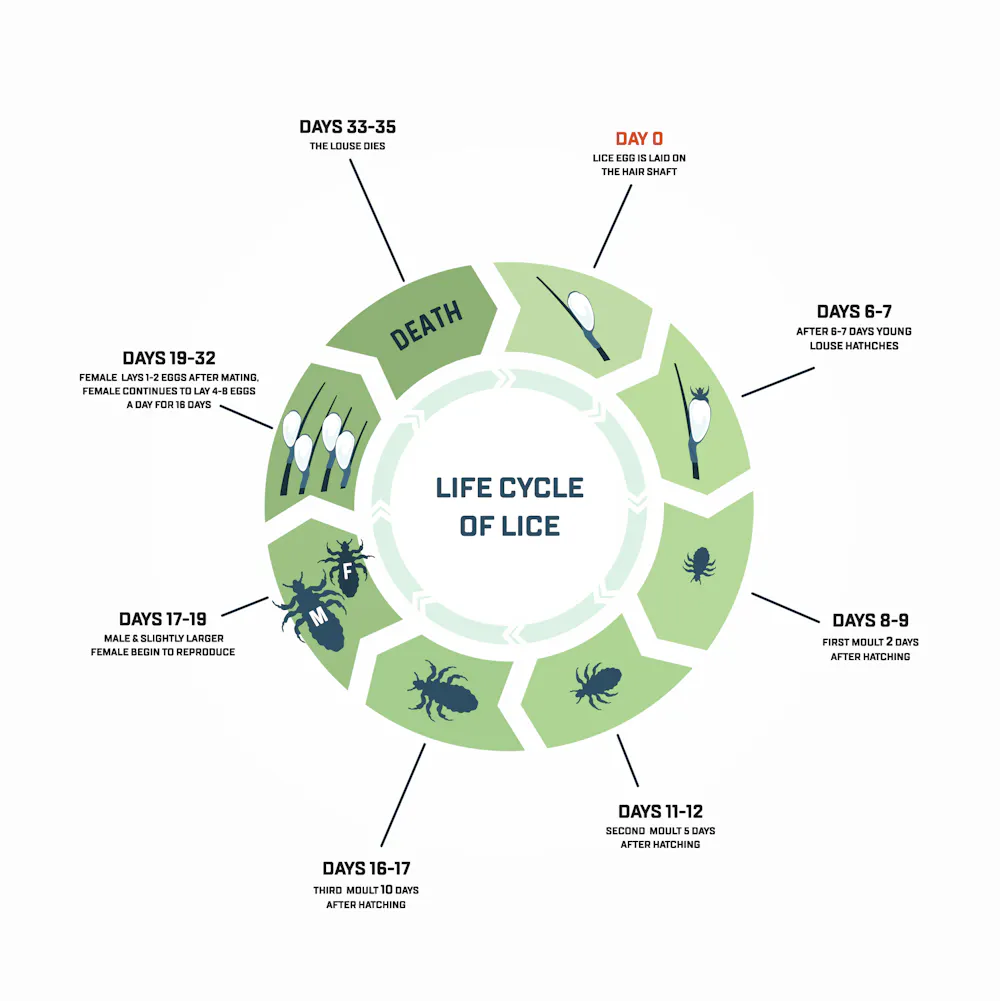
The term “nits” actually describes the eggs of head lice. They’re often the first sign of an infestation. And with one louse laying more than 100 in their month-long lifespan, there can be a lot of them.
Can they spread diseases?
No. Head lice are annoying and their bites may cause skin reactions. But Australian health authorities don’t consider lice a health risk. There is no evidence that head lice[6] can spread pathogens that cause disease.
The stigma of head lice infestations[7] can be greater than any direct health consequences for infested children.
Why do my children always pick up lice?
From child care through to primary school, it’s likely your child has had a head lice infestation at least once. One Australian study found the infestation rate[8] in Australian classrooms ranged from no cases to 72% of children affected.
Girls are more likely to be carry head lice[9] than boys. Long hair means it’s easier for the head lice to hitch a ride.
Head lice don’t jump or fly, they move from head to head via direct contact.
Head lice come home with your children because they spend time in close contact with other children, hugging, playing or crowding around books or screens. Any head-to-head contact is a pathway of infections.
Rules differ slightly between states but in New South Wales[11] and Queensland[12], children don’t need to be kept home from school because of head lice.
How can I keep my home free of head lice?
Keeping the house clean and tidy won’t keep head lice away. They don’t care how clean your bed sheets and towels are, or how frequently you vacuum carpets and rugs.
There may be a risk of head lice transfer on shared pillows, but even that risk is low[13].
There’s no need to change the child’s or other family member’s bedding when you find lice in a child’s hair. Research-based recommendations[14] from NSW Health are that “bed linen, hats, clothing and furniture do not harbour or transmit lice or nits and that there is no benefit in washing them as a treatment option”.
I’ve used nit solution. Why isn’t it working?
A wide range of products are available at your local pharmacy to treat head lice[15]. Australia’s Therapeutic Goods Administration[16] assesses products to ensure that they are both safe and effective.
The problem is that most of these products are insecticides that kill the lice on contact but may not kill the eggs.
Also, if treatments aren’t completed as directed on product labels, some head lice won’t be killed.
Head lice also seem to be fighting back[17] against the chemicals we’ve been using against them and it’s getting harder to clear children of infestations.
So how can you get rid of them?
Don’t expect any miracle cures but health authorities in Australia generally recommend the “conditioner and comb” or “wet comb” method. This means you physically remove the lice[19] without the need for chemical applications.
There are three key steps:
-
immobilise the lice by applying hair conditioner to the child’s damp hair and leaving it there for around 20 minutes
-
systematically comb through the hair using a fine toothed “lice comb”. The conditioner and lice can be wiped off on paper towels or tissues. Only adult lice will be collected but don’t worry, we’ll deal with the eggs later
-
repeat the process twice, about a week apart, to break the life cycle of the head lice.
Repeating the process after a week allows the remaining eggs to hatch. It sounds counter-intuitive but by letting them hatch, the young lice are easier to remove than the eggs. You just need to remove them before they start laying a fresh batch of eggs and the infestation continues.
While children are much more likely to have head lice, the reality is that everyone in the household is just as likely to host a head louse or two. You don’t necessarily need everyone to have a treatment but “grown ups” should be on the lookout for lice too.
References
- ^ aren’t working as well (link.springer.com)
- ^ tiny six-legged insects (www.cdc.gov)
- ^ most commonly (link.springer.com)
- ^ their millions of years (www.floridamuseum.ufl.edu)
- ^ logika600/Shutterstock (www.shutterstock.com)
- ^ no evidence that head lice (www.frontiersin.org)
- ^ stigma of head lice infestations (onlinelibrary.wiley.com)
- ^ infestation rate (onlinelibrary.wiley.com)
- ^ carry head lice (onlinelibrary.wiley.com)
- ^ CDC/Unsplash (unsplash.com)
- ^ New South Wales (education.nsw.gov.au)
- ^ Queensland (education.qld.gov.au)
- ^ risk is low (onlinelibrary.wiley.com)
- ^ Research-based recommendations (www.health.nsw.gov.au)
- ^ treat head lice (onlinelibrary.wiley.com)
- ^ Therapeutic Goods Administration (www.tga.gov.au)
- ^ seem to be fighting back (link.springer.com)
- ^ riopatuca/Shutterstock (www.shutterstock.com)
- ^ physically remove the lice (www.schn.health.nsw.gov.au)