
Scott Morrison's ministerial team looks far from match-fit
- Written by: Michelle Grattan, Professorial Fellow, University of Canberra
It sounded a touch desperate – Prime Minister Scott Morrison imploring backpackers to “come on down” to Australia, as the Omicron crisis escalated.
“Enjoy a holiday here”, said the one-time managing director of Tourism Australia, and “at the same time join our workforce and help us”. The backpacker flow is slow, so there’ll be a $3 million advertising campaign (minus Lara Bingle) to lure them, and they’ll get a rebate on their visas if they come soon.
People were quick to see the irony – while Morrison was spruiking working holidays, travel advice in the US was updated to say “avoid travel to Australia”.
“Come on down” wasn’t Morrison’s only trite line. Another was that “we must respect” Omicron. This accompanies his insistence we shouldn’t “fear” it, part of the pitch for a “balanced” response to the pandemic’s latest ogre.
There’s a lot of fear on the loose. Fear in the health sector about coping in the coming weeks. Families’ fear for relatives shut away in aged care homes. Fear in some businesses that shortages of workers or customers or both could kill them.
And then there are the people feeling vulnerable to the disease itself, even if it is mild in a majority of cases.
Morrison says he and the government understand the frustration of Australians going through this disrupted summer. Polling reflects feelings well beyond frustration. Nine’s Resolve poll, published this week, had the Coalition’s primary vote (34%) falling behind Labor’s (35%).
Apart from unforeseen events, the PM’s future will be a gamble on voter volatility. They’re in a very grumpy mood now. But where will they be in May?
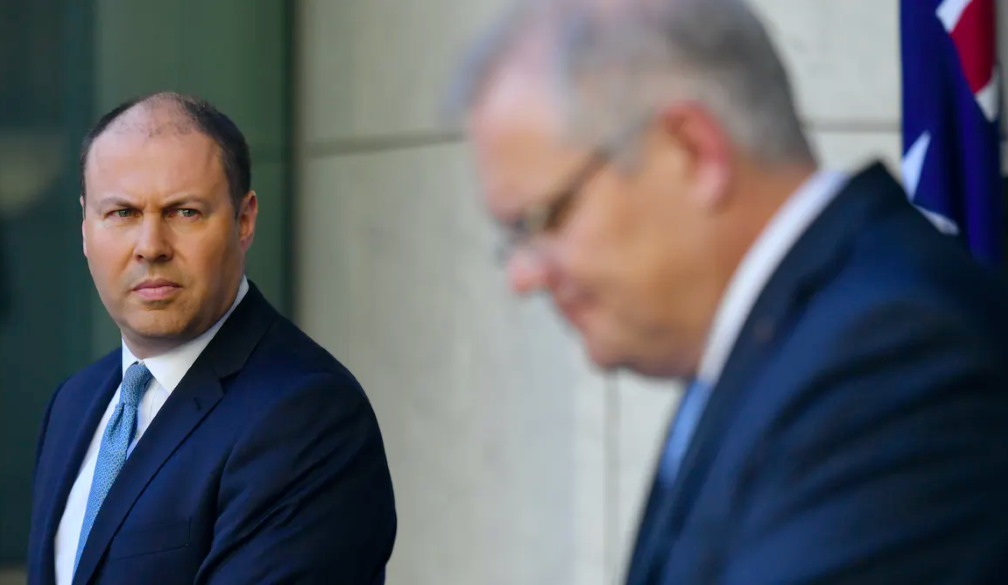
To exacerbate his troubles, as he fights his way through the coming hazardous months, Morrison is surrounded by a team that looks far from match-fit, once you get beyond Treasurer Josh Frydenberg.
Frydenberg has returned to the fray after his bout of COVID; Morrison will have to depend on him for much of the heavy lifting, beyond crafting the budget.
Key to the Coalition’s re-election campaign will be a massive attack on Anthony Albanese. But where are the effective attack dogs to back up the leader?
Mathias Cormann, now watching the unfolding Australian drama from the luxury of his OECD job in Paris, was regularly deployed to land punches; his replacement, Simon Birmingham, is diligent without Cormann’s impact.
In canine terms, Barnaby Joyce is of a breed that poses risk to their owners. He may or may not hold up the Nationals’ regional vote but could be costing the Coalition support in the cities, where independent candidates make much of declaring their Liberal opponents “vote with Barnaby”.
Peter Dutton, who still carries a leadership baton, is a classic head kicker but seems to be keeping his own head down. He is expected, however, to step up his activity soon and will be central to the national security theme in the government’s election campaign.
On climate policy, Angus Taylor, a poor communicator, will need to be wary of miscuing in trying to demolish Labor’s policy. The Coalition won’t get away with exaggerations like 2019.
Given Morrison’s vulnerability among female voters, the PM also needs ministers who can mount a convincing case on women’s policy. But Minister for Women Marise Payne hasn’t shown herself up to the task – she hates venturing into the media, and is tied up with her main portfolio of foreign affairs. There is no Julie Bishop in the ranks.
As Morrison tries to pressure states to open their schools on time and keep them open, Education Minister Alan Tudge remains sidelined while an inquiry examines an allegation (which he denies) from a former staffer and ex-lover that he was violent towards her (kicking her out of bed). There’s no official word on the report’s timing. If Tudge isn’t definitively cleared, Morrison will have yet another problem.
In the vital health area, the hyperactive Greg Hunt will run hard to the finishing line. But he’s retiring, leaving the pertinent question of who’d be his successor in a re-elected Morrison government.
Chief Medical Officer Paul Kelly this week described what that person, or Labor’s Mark Butler if there’s a change of government, can expect to face.
“I think [in] winter we will see more COVID. That’s been the case in every winter so far in all parts of the world. Whether that will be Omicron for people that have not yet got it during this wave or another variant, I can’t tell that.
"What I do know, though, is we’re almost certainly going to have a flu season this year as well in winter. And flu and coronavirus together, as has been seen in several countries in the northern hemisphere right now, is a challenge.”
Meanwhile, Morrison, having waved the populist flag by dispatching the unvaccinated Novak Djokovic, is undermined by homegrown vaccine rebels in his ranks.
This week he denounced the views of the Nationals’ George Christensen, who said parents should not have their children vaccinated, and Christensen has been forced to stand down from a parliamentary committee.
With a February parliamentary sitting looming, who knows whether Christensen will play up in the House? Certainly the two Coalition senators, Alex Antic and Gerard Rennick, who late last year boycotted votes on government legislation because Morrison wouldn’t try to override state vaccine mandates, remain defiant.
The fortnight February session will be brief but brutal. There’ll be Senate estimates hearings, always full of grenades. In the lower house, it will be hard for Labor to “lose” question times.
In the middle of the fortnight, on February 12, will be a “super Saturday” – four state byelections in NSW. These results will have significant fallout for the mood federally.
The seats are Willoughby (Liberal, 21%), Strathfield (Labor, 5%), Bega (Liberal, 6.9%) and Monaro (Nationals, 11.6%). All have high-profile departees – respectively, Gladys Berejiklian, Jodi McKay (former Labor leader), Andrew Constance (former state minister now running federally) and John Barilaro (former Nationals leader).
The NSW government has been hand-in-glove with Morrison in wanting to “push through” the Omicron crisis with everything as open as possible.
Super Saturday will be a referendum on NSW leader Dominic Perrottet’s handling of Omicron, a test of whether COVID management is turning from an electoral positive to a negative. It will also be an indirect judgement on Morrison’s handling of it too – or at least it will be seen as such.
While Super Saturday will be an important real-time barometer before the May federal election, it won’t be the last. South Australia goes to the polls on March 19, with the Liberal government on the ropes as it struggles with COVID and the fallout from scandals.
A big Super Saturday swing against the NSW government would send deep shock waves through the federal Coalition, which (on conventional wisdom) needs to make gains in that state to survive. If a bad result in SA brought a double hit, the mood in the Morrison ranks would be extremely bleak.