



The Coalition before climate denialism, but on the path to offshore detention
- Written by: Chris Wallace, Associate Professor, 50/50 By 2030 Foundation, Faculty of Business Government & Law, University of Canberra
Australian Cabinet papers from 2000, released today, reflect a relatively quiescent Australia where Islamic militancy and offshore detention were barely glimpses on the horizon, and climate science denialism was not a factor in cabinet considerations at all.
It was the year before the “year that changed everything[1]”: 2001, when Al-Qaeda attacked the United States on September 11[2], and the Howard government created its “Pacific Solution[3]” asylum-seeker deterrent. They would both become prisms through which Australian politics would be refracted for many years to come.
In contrast, in 2000, John Howard[4] (prime minister 1996-2007) later mused, “we had no conception of the challenges which would engulf the world in the next few years”.
The government’s concerns half-way through its second term, with a 14-seat majority, were overwhelmingly domestic. The approach to global issues mostly prioritised local implications over international obligations.
Minchin throws a stick in the wheel of an ETS
On climate change, the papers reveal a working consensus among cabinet ministers, with one exception, that an emissions trading scheme (ETS) was not only a possible but a likely route by which Australia would eventually fulfil its international environmental obligations.
The market-based nature and sectoral neutrality of an ETS made it the quality choice, cabinet submissions and departmental co-ordination comments make clear. The papers show early work being done on an ETS within the government.
 Senator Nick Minchin stood alone in his objection to an ETS to tackle climate change. Alan Porritt/AAP
Industry and Resources Minister Nick Minchin stood out against the ETS consensus. Advocating a massive expansion of the gas industry, Minchin pushed for compensation for carbon-intensive industries so large and across so many sectors that it would have massively blunted an ETS’s impact. This drew sharp adverse comments from across the key departments.
Treasurer Peter Costello and his department supported expansion of the gas industry, but drew the line at Minchin’s proposed emasculation of a future ETS. Costello would unsuccessfully bring an ETS proposal to cabinet three years later, in 2003. Howard announced one in the lead-up the 2007 election.
So the 2000 papers contain foundational documents at the heart of this policy arc. They show Minchin as central in swerving cabinet from its consensus ETS support in 2000, to hostility by the time he helped install Tony Abbott as Liberal opposition leader in 2009.
Read more: Bushfires won't change climate policy overnight. But Morrison can shift the Coalition without losing face[5]
The GST takes flight
Costello’s implementation of the goods and services tax (GST)[6] was the centre of heavy cabinet deliberations ahead of its implementation on July 1 2000.
It was the culmination of a textbook exercise in conceiving, publicly advocating for and then successfully implementing a major, complex public policy – an object lesson for governments today.
It begs the question whether, had the Coalition won the 2007 election, an ETS might now be an unremarked-upon aspect of public finance in Australia too, just like the once controversial GST.
Rural and regional Australia was a major focus, with cabinet submissions generally including rural impact statements.
Howard benefited from a congenial relationship with the National Party leader and deputy prime minister, John Anderson[7].
Anderson was the best-educated Nationals leader since Earle Page[8]. He was aligned with the National Farmers Federation (NFF) push for market-oriented policy over the old Country Party “deal-making” policy style, to which the Nationals later reverted.
Howard could count on Anderson’s support in cabinet. In exchange, Anderson ran a massive infrastructure program bringing concrete benefits to the bush and regions and kept its voters welded to the Coalition.
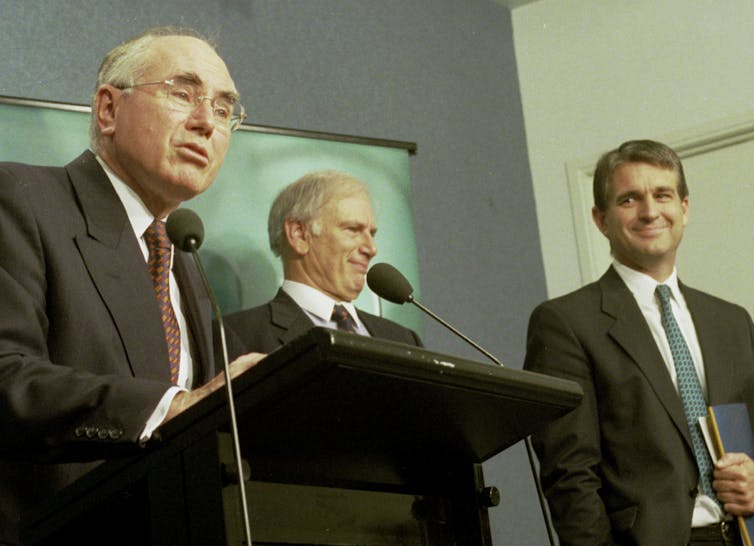 Howard had a strong relationship with Nationals leader John Anderson (right), which offered advantages to both men. AAP/Alan Porritt
Read more: Cabinet papers 1998-99: how the GST became unstoppable[9]
On many issues, little has changed in 20 years
Women are barely mentioned in the papers and were almost non-existent in Howard government decision-making. There was only one woman in the 17 strong cabinet: the family and community services minister, Senator Jocelyn Newman[10].
In the outer ministry, the aged care minister, Bronwyn Bishop[11], came under pressure when it emerged residents at Riverside Home in Melbourne were being subjected to kerosene baths[12], with lethal consequences. Problems in other aged care homes quickly emerged.
Bishop’s cabinet submission in the wake of the crisis trumpeted the government’s Aged Care Act 1997 as “the basis for a sound and sustainable aged care system” and “the most significant change for the industry in its history”.
There was no need to restore nursing ratios, she argued. A “return to ratios would return the industry to detailed input regulation and reduce its efficiency” the submission, which cabinet backed, said.
Indigenous Australians are little mentioned other than in relation to workforce disadvantage and the Northern Territory’s move to mandatory detention for minors.
Cabinet supported only a fraction of the assistance requested by Aboriginal and Torres Strait Islander Affairs Minister John Herron[13] to address deep and worsening Indigenous unemployment.
The government decided not to override the NT government’s mandatory detention move. Instead, it asked Attorney-General Daryl Williams[14] to write to his NT counterpart about its concerns. A week later, cabinet was outraged when it found a United Nations committee investigating potential human rights breaches in Australia against Indigenous citizens, without consultation.
 Indigenous Australians receive little mention in the 2000 cabinet papers. AAP/Marianna Massey
What the 2000 cabinet papers reveal concerning the growing issue of unauthorised boat arrivals in Australia, and in particular the “deterrent” approach Immigration and Multicultural Affairs Minister Philip Ruddock[15] recommended, and cabinet adopted, is historically significant.
They show a government under increasing pressure and moving quickly down a particular path. Departmental comments show this rang increasingly loud alarm bells in the major departments, even as they broadly supported the “deterrent” approach.
There are, and likely always will be, different opinions about the deterrent strategy, and public discussion usually turns on the binary question of whether it was right or wrong.
The 2000 papers are important, not least because they open up critical additional questions, even for its supporters, about whether this strategy could have been implemented differently and better.
Anglosphere politics had begun to make a particular kind of shift to the right, and the Howard government was in the vanguard. It was still relatively early days in that shift, as the fact the government had a cabinet position that included “multicultural affairs” in its title attests.
To put this shift into international context, media mogul Rupert Murdoch would not appoint Roger Ailes CEO of his Fox News channel in the United States until the following year.
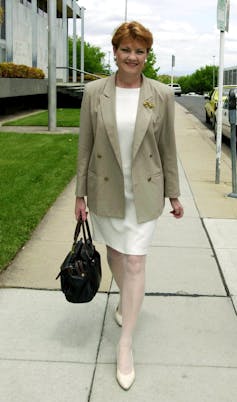 Pauline Hanson’s arrival in Canberra in 1996 marked a shift to explicitly nativist politics in Australia. AAP/Alan Porritt
Australia’s insurgency of explicitly nativist politics was marked by the arrival in Canberra in 1996 of One Nation’s Pauline Hanson[16] as the member for Oxley. Internationally, this wave may have peaked in the election of another nativist redhead, US President Donald Trump, 20 years later.
The fierce conduct of the “history wars[17]” in Australia from the 1990s, the prominent role of conservative think tanks[18] in it, and the early challenge and ongoing political consequences of unauthorised boat arrivals in Australia – which has only relatively recently emerged as an issue in Europe – make Australia an early example of a phenomenon that shifted mainstream conservative politics to a distinctly different place from that occupied before.
In 2000, elements of it were evident but not yet fully activated. The following year, from September 11, they would be supercharged.
Read more: Pauline Hanson built a political career on white victimhood and brought far-right rhetoric to the mainstream[19]
Chris Wallace is the official historian for the 2000-2001 cabinet papers release from the National Archives of Australia. You can read her full essay on the 2000 papers here[20].
References
- ^ year that changed everything (insidestory.org.au)
- ^ Al-Qaeda attacked the United States on September 11 (www.reuters.com)
- ^ Pacific Solution (www.aph.gov.au)
- ^ John Howard (www.aph.gov.au)
- ^ Bushfires won't change climate policy overnight. But Morrison can shift the Coalition without losing face (theconversation.com)
- ^ goods and services tax (GST) (treasury.gov.au)
- ^ John Anderson (www.aph.gov.au)
- ^ Earle Page (adb.anu.edu.au)
- ^ Cabinet papers 1998-99: how the GST became unstoppable (theconversation.com)
- ^ Senator Jocelyn Newman (www.aph.gov.au)
- ^ Bronwyn Bishop (www.aph.gov.au)
- ^ residents at Riverside Home in Melbourne were being subjected to kerosene baths (www.theage.com.au)
- ^ John Herron (www.aph.gov.au)
- ^ Daryl Williams (www.aph.gov.au)
- ^ Philip Ruddock (www.aph.gov.au)
- ^ Pauline Hanson (www.aph.gov.au)
- ^ history wars (www.evatt.org.au)
- ^ conservative think tanks (theconversation.com)
- ^ Pauline Hanson built a political career on white victimhood and brought far-right rhetoric to the mainstream (theconversation.com)
- ^ here (www.naa.gov.au)










