

More than half of funding for the major parties remains secret — and this is how they want it
- Written by: Kate Griffiths, Fellow, Grattan Institute
Political parties in Australia collectively received $168 million in donations for the financial year 2019-20. Today, Australians finally get to see where some of the money came from with the release of data from the Australian Electoral Commission[1].
While the big donors will make the headlines, they are only the tip of the iceberg. More than half of the funding for political parties remains hidden from public view. And that is exactly how the major parties want it.
What does the data tell us?
The Coalition and Labor received more in donations than all other parties combined. The Coalition received 41% of all funds (or A$69 million), while Labor received 33% ($55 million). The Greens came a distant third at 11% ($19 million), bumping Clive Palmer’s United Australia Party out of the position it held during the 2019 election[2].
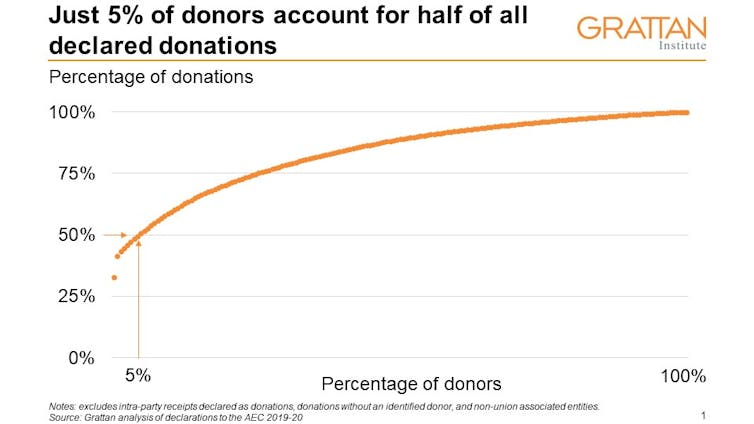
The largest 5% of donors accounted for half of declared donations. For the second year in a row, the largest individual declared donation was made by Palmer’s company Mineralogy, which gave $5.9 million to his own party.
 The Grattan Institute, Author provided (No reuse)
The Coalition’s largest donor, Richard Pratt’s Pratt Holdings[3], donated $1.5 million. Other major donations to the Coalition included the Greenfields Foundation[4] ($450,000), an investment company linked to the Liberal Party; and Transcendent Australia[5] ($203,000), a company owned by Chinese businesswoman Sally Zou[6].
Unsurprisingly, many of Labor’s largest donors are unions, led by the “Shoppies” union[7] (the Shop, Distributive and Allied Employees’ Association, or SDA), which donated almost $500,000. Labor also received large donations from fundraising vehicles associated with the party, including Labor Holdings Pty Ltd[8], which donated $910,000.
Read more:
Eight ways to clean up money in Australian politics[9]
Other large donors are bipartisan givers. The Australian Hotels Association[10] gave $154,000 to the Coalition and $271,000 to Labor. Woodside Energy[11] gave $198,000 to the Coalition and $138,000 to Labor. The Macquarie Group[12] (including Macquarie Telecom) gave $254,000 to the Coalition and $184,000 to Labor. ANZ[13] continued its regular donations to both sides with $100,000 each.
Total donations were smaller than the previous year (an election year). But those who donate “off-cycle” can still have substantial influence, whether they are political devotees, or playing the “long game” of using donations to open doors and wield political influence[14].
The Grattan Institute, Author provided (No reuse)
The Coalition’s largest donor, Richard Pratt’s Pratt Holdings[3], donated $1.5 million. Other major donations to the Coalition included the Greenfields Foundation[4] ($450,000), an investment company linked to the Liberal Party; and Transcendent Australia[5] ($203,000), a company owned by Chinese businesswoman Sally Zou[6].
Unsurprisingly, many of Labor’s largest donors are unions, led by the “Shoppies” union[7] (the Shop, Distributive and Allied Employees’ Association, or SDA), which donated almost $500,000. Labor also received large donations from fundraising vehicles associated with the party, including Labor Holdings Pty Ltd[8], which donated $910,000.
Read more:
Eight ways to clean up money in Australian politics[9]
Other large donors are bipartisan givers. The Australian Hotels Association[10] gave $154,000 to the Coalition and $271,000 to Labor. Woodside Energy[11] gave $198,000 to the Coalition and $138,000 to Labor. The Macquarie Group[12] (including Macquarie Telecom) gave $254,000 to the Coalition and $184,000 to Labor. ANZ[13] continued its regular donations to both sides with $100,000 each.
Total donations were smaller than the previous year (an election year). But those who donate “off-cycle” can still have substantial influence, whether they are political devotees, or playing the “long game” of using donations to open doors and wield political influence[14].
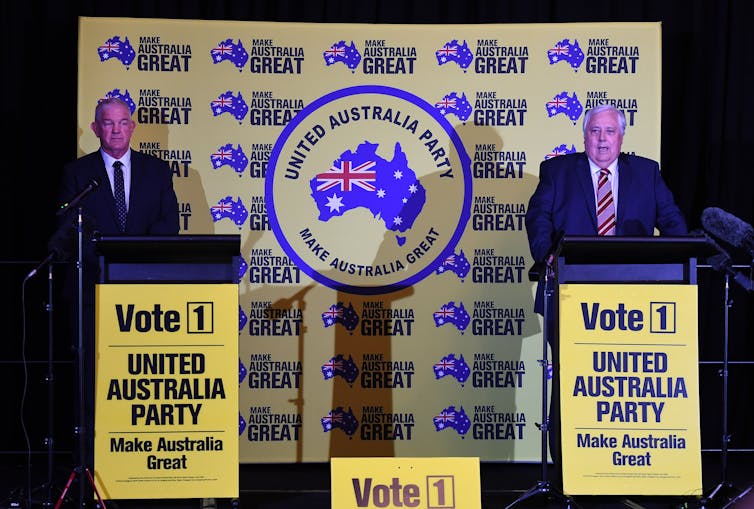 Clive Palmer’s Mineralogy was the biggest individual donor, with a $5.9 million donation to his own party.
Dan Peled/AAP
But a lot of the money remains hidden from public view
Declared donations are only a fraction of the total money flowing to our political parties.
Out of $168 million in party funding, only $15 million of donations were declared (or just 9%). Another $59 million — around one-third — is public funding provided by electoral commissions.
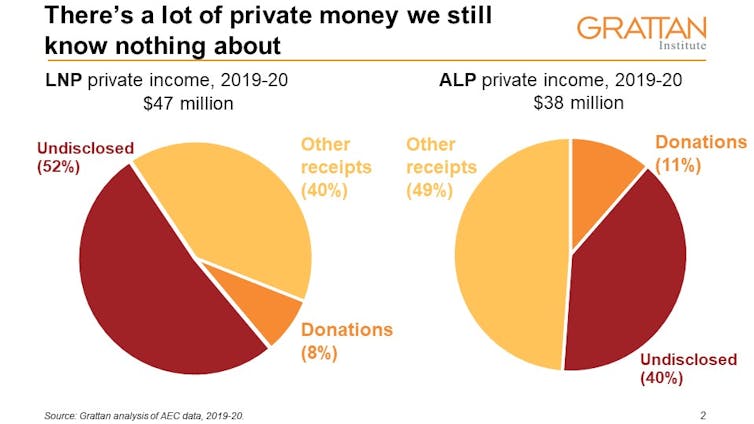
The rest? A murky combination of undeclared donations and a messy bucket of funds called “other receipts”, which includes everything from investment income to money raised at political fundraising dinners. This chart shows the breakdown for the two major parties.
Clive Palmer’s Mineralogy was the biggest individual donor, with a $5.9 million donation to his own party.
Dan Peled/AAP
But a lot of the money remains hidden from public view
Declared donations are only a fraction of the total money flowing to our political parties.
Out of $168 million in party funding, only $15 million of donations were declared (or just 9%). Another $59 million — around one-third — is public funding provided by electoral commissions.
The rest? A murky combination of undeclared donations and a messy bucket of funds called “other receipts”, which includes everything from investment income to money raised at political fundraising dinners. This chart shows the breakdown for the two major parties.
 The Grattan Institute, Author provided (No reuse)
More than half of the Coalition’s private funding is undisclosed, and 40% of Labor’s funds. This rises to about 90% across both parties when other receipts are included.
The major parties want it this way
The Commonwealth donations disclosure regime is incredibly weak compared to almost all Australian states and most other advanced nations. Let’s be clear: this is a political choice backed in by the major parties.
In December, both major parties rejected a bill[15] introduced by crossbench Senator Jacqui Lambie to improve transparency of political donations. It wasn’t revolutionary — the bill didn’t ban donors, or limit donations, or restrict what parties could do with donations. It simply proposed giving the public more and better information on the major donors, including:
requiring donations over $5,000 to be declared by the parties (the current threshold is $14,300)
stopping “donations splitting”, in which a major donor can hide by splitting a big donation into a series of small ones
making income from political fundraising events declarable
publishing data about donations within weeks (rather than the current eight to 19 months).
Yet, the bill was whitewashed. The committee rejected it[16] on the basis that “there is already an effective regime in place”.
Our current system doesn’t have the balance right
The Commonwealth donations disclosure regime is supposed to provide transparency[17] and to “inform the public about the financial dealings of political parties, candidates and others involved in the electoral process”. But it clearly does not deliver on this in its current form.
There is a balance to be drawn between the interests of donors in protecting their privacy and the interests of the public in knowing who funds and influences political parties.
Read more:
A full ban on political donations would level the playing field – but is it the best approach?[18]
But it is very hard to see how the current system – which keeps the majority of private money out of public view and unnecessarily delays the release of all donation data – has got the balance right.
A good disclosure system would close the loopholes that allow major donors to hide, while protecting the privacy of small donors.
Australians consistently say that they are suspicious that politicians are corrupt and that governments serve themselves and their mates rather than the public interest. Perhaps they’re right. Today’s donations release reminds us of the shortfalls of a system designed for donor and party interests over the public interest.
The Grattan Institute, Author provided (No reuse)
More than half of the Coalition’s private funding is undisclosed, and 40% of Labor’s funds. This rises to about 90% across both parties when other receipts are included.
The major parties want it this way
The Commonwealth donations disclosure regime is incredibly weak compared to almost all Australian states and most other advanced nations. Let’s be clear: this is a political choice backed in by the major parties.
In December, both major parties rejected a bill[15] introduced by crossbench Senator Jacqui Lambie to improve transparency of political donations. It wasn’t revolutionary — the bill didn’t ban donors, or limit donations, or restrict what parties could do with donations. It simply proposed giving the public more and better information on the major donors, including:
requiring donations over $5,000 to be declared by the parties (the current threshold is $14,300)
stopping “donations splitting”, in which a major donor can hide by splitting a big donation into a series of small ones
making income from political fundraising events declarable
publishing data about donations within weeks (rather than the current eight to 19 months).
Yet, the bill was whitewashed. The committee rejected it[16] on the basis that “there is already an effective regime in place”.
Our current system doesn’t have the balance right
The Commonwealth donations disclosure regime is supposed to provide transparency[17] and to “inform the public about the financial dealings of political parties, candidates and others involved in the electoral process”. But it clearly does not deliver on this in its current form.
There is a balance to be drawn between the interests of donors in protecting their privacy and the interests of the public in knowing who funds and influences political parties.
Read more:
A full ban on political donations would level the playing field – but is it the best approach?[18]
But it is very hard to see how the current system – which keeps the majority of private money out of public view and unnecessarily delays the release of all donation data – has got the balance right.
A good disclosure system would close the loopholes that allow major donors to hide, while protecting the privacy of small donors.
Australians consistently say that they are suspicious that politicians are corrupt and that governments serve themselves and their mates rather than the public interest. Perhaps they’re right. Today’s donations release reminds us of the shortfalls of a system designed for donor and party interests over the public interest.
References
- ^ Australian Electoral Commission (transparency.aec.gov.au)
- ^ 2019 election (theconversation.com)
- ^ Richard Pratt’s Pratt Holdings (www.theaustralian.com.au)
- ^ Greenfields Foundation (www.crikey.com.au)
- ^ Transcendent Australia (www.adelaidenow.com.au)
- ^ Sally Zou (www.abc.net.au)
- ^ “Shoppies” union (www.crikey.com.au)
- ^ Labor Holdings Pty Ltd (transparency.aec.gov.au)
- ^ Eight ways to clean up money in Australian politics (theconversation.com)
- ^ Australian Hotels Association (aha.org.au)
- ^ Woodside Energy (www.woodside.com.au)
- ^ Macquarie Group (www.macquarie.com)
- ^ ANZ (www.anz.com.au)
- ^ open doors and wield political influence (grattan.edu.au)
- ^ bill (www.aph.gov.au)
- ^ rejected it (www.aph.gov.au)
- ^ provide transparency (www.aec.gov.au)
- ^ A full ban on political donations would level the playing field – but is it the best approach? (theconversation.com)