

women left behind despite the focus on well-being
- Written by: Jennifer Curtin, Professor of Politics and Policy, University of Auckland
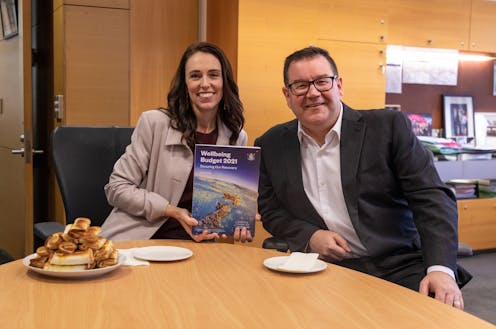
Finance Minister Grant Robertson called this a recovery budget for “all New Zealanders”. But was it an inclusive budget? Specifically, what did Budget 2021 offer those women who were significantly affected by the job losses resulting from COVID-19?
The budget priorities[1] included an objective to “support into employment those most affected by COVID-19, including women and young people”. Yet in the budget speech[2], Robertson announced no explicit initiatives for women workers.
Indeed, as was the case in 2020, the focus was on physical infrastructure — building hospitals, schools, houses, roads, rail and a refurbished Scott Base. Around 221,000 jobs are projected[3] to result, some of which are linked to this capital investment of NZ$57.3 billion dollars over four years.
Such spending initiatives are not gender neutral. Our highly gender-segregated[4] labour market means this investment is likely to generate many more jobs for men than women.
Despite the extension of the Training Incentive Allowance[5] to higher qualifications, and targeted programmes such as Tupu Aotearoa[6] for Pacific peoples, there was no mention of support to increase the number of women in trades.
Some initiatives are already in place, but evidence shows desegregating labour markets[7] is no easy task. Often it is a heavily lopsided process. Women are encouraged into male dominated occupations, but not vice versa.
A focus on building need not preclude investment in the care economy[8]. The latter is just as likely as construction to result in economic growth. Research[9] also shows women need child care to support their labour market participation, and increasing child care places increases jobs (usually for women).
Budget 2021[10] offered little in this regard. It provided funding for just 3,300 additional places in Out of School Care[11].
Australia is doing better for women
The lack of a gender lens makes New Zealand a laggard compared to the conservative government of Australia. Scott Morrison’s federal budget, handed down two weeks ago, was accompanied by an 81-page Women’s Budget Statement[12]. New spending initiatives focused on women’s economic security, safety and health and well-being.
The statement included a raft of statistical evidence underpinning the government’s decision to invest in social infrastructure. In addition, new money was allocated for women to enter STEM[13] careers and to fund more services for women taking up work in trades.
Alongside this, frontline services for victims of family domestic violence received an injection of money, and A$16.6 million was committed to support a National Women’s Health Strategy[14] (over four years).
Read more: NZ Budget 2021: billions more for benefits, but one eye on the bottom line[15]
Obviously, Morrison’s was an election budget. To go to the polls later this year, and to secure a win, he has to ameliorate an anticipated backlash from women voters[16] horrified by the allegations of sexual assault, bullying and discrimination within his own party.
Women were also critical of the fact they were largely overlooked in the 2020 budget[17], which focused on growing male-dominated industries.
Morrison may not be comparable to Jacinda Ardern in terms of his feminist leanings, but his minister for women, who is charged with championing the Women’s Budget Statement, is Senator Marise Payne[18], Australia’s Foreign Minister and a liberal feminist.
Some Australian commentators[19] argue the budget offerings for women have not gone far enough[20]. But it certainly appears to be more gender responsive than what we witnessed in New Zealand on Thursday afternoon.
Gender should be central to planning
So what do Ardern and Robertson need to change to ensure our progressive well-being approach accounts for women?
Mainstreaming gender analysis across all portfolios, so the budget process becomes more responsive to the needs of different groups of women and men, would be a good place to start.
Key international organisations, including the OECD[21], IMF[22] and the United Nations[23], promote the economic and social value of gender responsive budgeting[24]. Canada, Iceland and a number of other OECD countries have made significant progress in embedding gender analysis across all aspects of new and existing expenditure.
Read more: Wage restraint aims to lift the lowest-earning public servants, but it won't fix stubborn gender and ethnic pay gaps[25]
Three elements are required for successful implementation. First, a high-level strategy to ensure analysts take account of gender in their everyday practice across government (including budgeting).
Second, providing tools, training and disaggregated data to support this analysis (like our own “Bringing Gender In[26]” tool and the Integrated Data Infrastructure[27]). Third, working with parliament and civil society organisations to foster collaboration and accountability.
However, implementation of a gender-responsive budgeting process also requires political will to ensure public servants embrace this work. The adoption of a well-being approach, using Treasury’s Living Standards Framework[28] and He Ara Waiora[29], represents a good first step. But to ensure budget outcomes are equitable, and resources shared with all New Zealanders, gender analysis is essential throughout the budget process.
International evidence[30] suggests implementation is not always easy. However, without gender-responsive budgeting, the gendered nature of public expenditure will remain invisible. This will be detrimental to the well-being of the economy and to reducing inequality.
References
- ^ budget priorities (www.treasury.govt.nz)
- ^ budget speech (www.treasury.govt.nz)
- ^ Around 221,000 jobs are projected (www.beehive.govt.nz)
- ^ gender-segregated (women.govt.nz)
- ^ Training Incentive Allowance (www.workandincome.govt.nz)
- ^ Tupu Aotearoa (www.mpp.govt.nz)
- ^ desegregating labour markets (journals.sagepub.com)
- ^ investment in the care economy (www.ituc-csi.org)
- ^ Research (www.stats.govt.nz)
- ^ Budget 2021 (www.treasury.govt.nz)
- ^ Out of School Care (www.workandincome.govt.nz)
- ^ Women’s Budget Statement (budget.gov.au)
- ^ STEM (www.australiancurriculum.edu.au)
- ^ National Women’s Health Strategy (www1.health.gov.au)
- ^ NZ Budget 2021: billions more for benefits, but one eye on the bottom line (theconversation.com)
- ^ backlash from women voters (www.bbc.com)
- ^ 2020 budget (www.theguardian.com)
- ^ Senator Marise Payne (www.smh.com.au)
- ^ Some Australian commentators (insidestory.org.au)
- ^ not gone far enough (theconversation.com)
- ^ OECD (www.oecd-ilibrary.org)
- ^ IMF (www.imf.org)
- ^ United Nations (www.unfpa.org)
- ^ gender responsive budgeting (www.researchgate.net)
- ^ Wage restraint aims to lift the lowest-earning public servants, but it won't fix stubborn gender and ethnic pay gaps (theconversation.com)
- ^ Bringing Gender In (women.govt.nz)
- ^ Integrated Data Infrastructure (www.stats.govt.nz)
- ^ Living Standards Framework (www.treasury.govt.nz)
- ^ He Ara Waiora (www.treasury.govt.nz)
- ^ International evidence (www.policyalternatives.ca)
Read more https://theconversation.com/nz-budget-2021-women-left-behind-despite-the-focus-on-well-being-161187