Boris Johnson overstates Morrison's climate ambition, as Australia-UK trade agreement reached
- Written by: Michelle Grattan, Professorial Fellow, University of Canberra
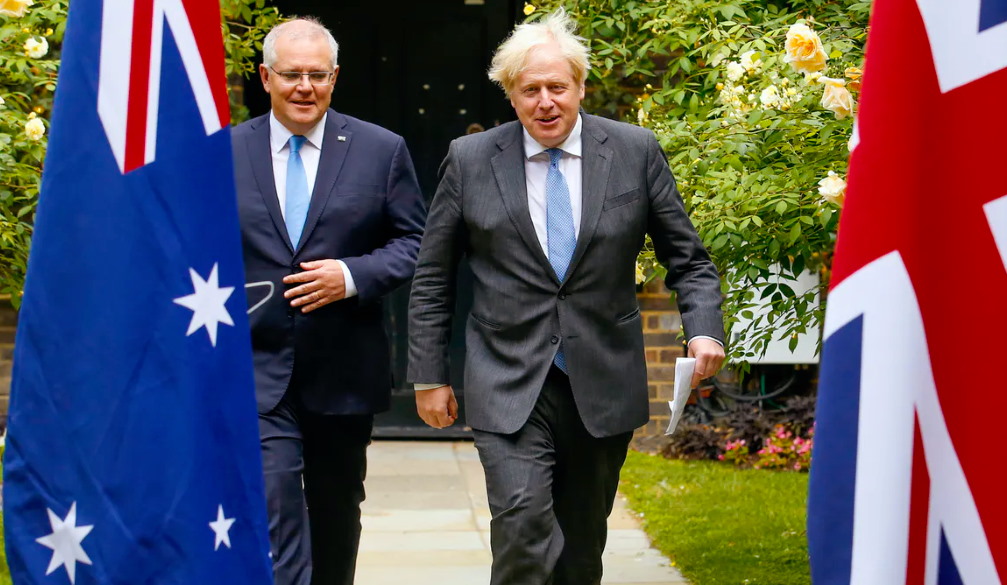
British Prime Minister Boris Johnson put Scott Morrison on the spot when he told their joint news conference he thought the Australian PM had “declared for net zero by 2050”.
When Johnson made the statement a journalist interjected to point out Morrison’s policy was to get to net zero “preferably” by 2050.
Johnson pressed on to say this was “a great step forward when you consider[…] the situation Australia is in. It’s a massive coal producer. It’s having to change the way things are orientated, and everybody understands that.
"You can do it fast. In 2012 this country had 40% of its power from coal. It’s now less than 2%, going down the whole time. […] I’m impressed by the ambition of Australia. Obviously we’re going to be looking for more the whole time, as we go into COP26 in November.”
The net zero moment came as the two stood together to announce they had reached an in-principle agreement on a free trade deal between Britain and Australia – the first such deal the United Kingdom has done post Brexit.
Johnson had been asked whether he wanted Australia to go beyond its present 2030 emissions reduction target.
Morrison has been under strong pressure from both Johnson and United States President Joe Biden to embrace the 2050 target. But he has so far not done so, despite edging towards it. His position is to get to net zero “as soon as possible, preferably by 2050.”
Formally embracing the target would threaten a fight within the Nationals that could destabilise the party’s leader Michael McCormack.
Nationals Senate leader Bridget McKenzie warned this week:
“There is no agreement with the second party of this Coalition government on any target date for zero emissions. In fact it would fly in the face of the Nationals public policy commitment.”
The free trade agreement, which still has details to be finalised, would reduce barriers on the mobility of workers between the two countries as well on trade in goods and services.
The deal would promote more exchange of young people, allowing them to stay and work in each country for three years instead of two. This arrangement would apply to people up to age 35 rather than 30, as at present.
The federal government says Australian producers and farmers would “receive a significant boost by getting greater access to the UK market” while Australian consumers would “benefit from cheaper products, with all tariffs eliminated within five years, and tariffs on cars, whisky, and the UK’s other main exports eliminated immediately” the agreement started.
Australia would within five years place less onerous conditions on British backpackers, who presently have to spend a set time working in agriculture, or other sectors of labour shortage in regional Australia, to get an extension of their visa.
A separate agriculture visa would be established for UK and Australian visa holders, to get more two way traffic (for example, of shearers) in the agricultural sector.
Over 10 to 15 years the UK would liberalise Australian imports of beef and sheep meat, with shorter periods for sugar and dairy products.
The agricultural sectors in both Britain and Australia expressed concerns when the agreement was being negotiated. In Australia farmers have been worried about the possibility of losing labour if the conditions on backpackers were scrapped.
Johnson said the deal would be good for British car manufacturers and the export of British financial and other services, and he hoped for the agricultural sectors on both sides.
On agriculture “we’ve had to negotiate very hard. […] This is a sensitive sector for both sides, and we’ve got a deal that runs over 15 years and contains the strongest possible provisions for animal welfare.”
The removal of the farm work requirement would make it easier for British people and young people to go and work in Australia, he said.
Morrison said the deal would open the pathway to Britain’s entry into the The Comprehensive and Progressive Agreement for Trans-Pacific Partnership (CPTPP).
He also indicated it was “enormously helpful” in the context of the difficulties with China. “Where you have challenges with one trading partner from time to time, then the ability to be able to diversify your trade into more and more countries is incredibly important.”
Morrison and Johnson discussed the final points of the agreement in principle over a dinner meeting at 10 Downing Street. Their talks also included climate change.