
The debate over transgender athletes' rights is testing the current limits of science and the law
- Written by: Claire Breen, Professor of Law, University of Waikato
The petition[1] presented to parliament last week calling for trans women to be excluded from women’s sport is simply the latest round in a difficult and volatile global debate.
Organised by Save Women’s Sport Australasia, the petition challenges Sport New Zealand’s “draft guiding principles[2] for the participation of transgender players in sport” for failing to consult widely enough.
Despite the draft principles covering community-level sport[3], not international competition, former Olympians and elite athletes supported the petition in an open letter[4] to Minister for Sport and Recreation Grant Robertson.
The controversy comes not long after New Zealand transgender weightlifter Laurel Hubbard’s Pacific Games victory was criticised[5] due to her alleged physical advantage, and not long before the Olympic Games open in late July.
Overall, this polarising issue is likely to keep dividing people[6]. Consensus looks increasingly difficult[7] to achieve. With both sides claiming discrimination, can existing laws and principles provide a way forward?
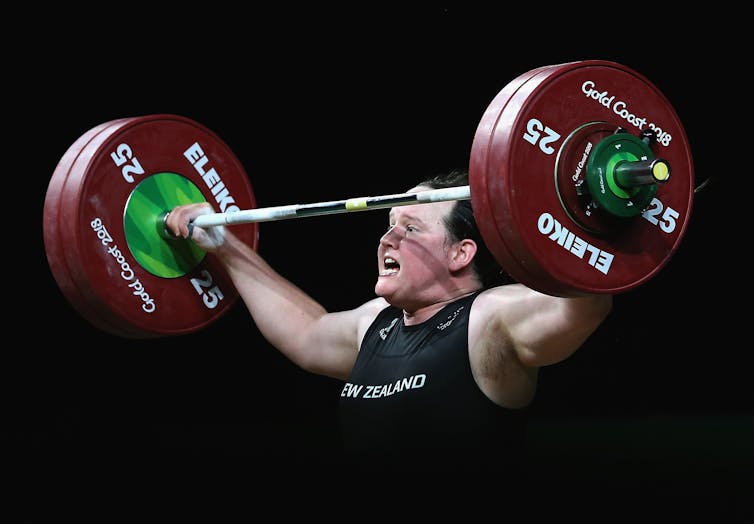 New Zealand weightlifter Laurel Hubbard competing at the Gold Coast 2018 Commonwealth Games.
GettyImages
New Zealand weightlifter Laurel Hubbard competing at the Gold Coast 2018 Commonwealth Games.
GettyImages
Sports participation as a human right
The wider relationship between sports and human rights[8] is complex and often contradictory. No explicit right to participate in sport exists in international law. However, a number of core human rights are relevant:
Recognising trangender athletes
As with all human rights, the right to participate in sport is underpinned by the right to be free from discrimination on grounds of sex, gender or other status[9]. That includes gender identity and the right of trans people to be free from discrimination.
This broad principle informs much of the thinking on the issue. The UN Special Rapporteur on the Right to Health[10], for example, has said the participation of girls and women in sport should not result in the arbitrary exclusion of transgender people.
Read more: How high school sports became the latest battleground over transgender rights[11]
The rapporteur has also asked for a consensus by all international sporting bodies and national governments, in consultation with transgender organisations, with subsequent policies ideally reflecting international human rights norms.
The UN’s Independent Expert[12] on “protection against violence and discrimination based on sexual orientation and gender identity” has highlighted the negative impact of exclusionary practices in sport, and noted the value of inclusive programs.
The UN Convention on the Elimination of All Forms of Discrimination Against Women calls for equality between men and women in sports[13] and includes gender identity[14] among the forms of potential discrimination.
The devil is in the detail
Beyond these areas of broad agreement, however, the issue quickly becomes more complex.
In Aotearoa New Zealand, the Human Rights Act 1993 prohibits discrimination[15] on the grounds of “sex” and “sexual orientation”. These prohibitions have been interpreted to encompass the legal right of trans people to be free from discrimination.
Read more: Hostility to elite trans athletes is having a negative impact on participation in everyday sport[16]
However, the act also says[17] it is not discriminatory to exclude people of one sex from participating in any competitive sporting activity in which the strength, stamina or physique of competitors is relevant.
Unfortunately, this is where the arguments run into the limited help offered by science. There is still strong disagreement about whether transgender athletes have a competitive advantage or not.
The limits of science and the law
Research focusing on testosterone levels to justify the exclusion (or inclusion) of trans athletes has been criticised as an inappropriate oversimplification[18].
Whether testosterone even provides a competitive advantage[19] is disputed, and commentators point to other factors[20] that may be at play.
One study of the available literature[21] concluded that a consensus could not be reached due a lack of data. That finding was itself challenged, but both sides agreed more research was required.
Read more: Do naturally high testosterone levels equal stronger female athletic performance? Not necessarily[22]
In the meantime, we need to recognise the limits of science and the law when it comes to setting demonstrably balanced guidelines for trans athletes’ participation in sport.
Progress will only come through listening to both sides in the short term, but broad support for the required research is also needed in the longer term.
Ultimately it is in everyone’s interests that this hugely complex issue is resolved properly. Given it goes to the heart of human identity, the potential benefits are not confined to the sporting world.
References
- ^ petition (www.parliament.nz)
- ^ draft guiding principles (www.stuff.co.nz)
- ^ covering community-level sport (www.stuff.co.nz)
- ^ open letter (www.savewomenssport.com)
- ^ criticised (www.abc.net.au)
- ^ dividing people (www.rnz.co.nz)
- ^ increasingly difficult (www.nytimes.com)
- ^ sports and human rights (www.abc.net.au)
- ^ other status (www.refworld.org)
- ^ UN Special Rapporteur on the Right to Health (undocs.org)
- ^ How high school sports became the latest battleground over transgender rights (theconversation.com)
- ^ Independent Expert (undocs.org)
- ^ equality between men and women in sports (www.ohchr.org)
- ^ gender identity (www.refworld.org)
- ^ prohibits discrimination (www.legislation.govt.nz)
- ^ Hostility to elite trans athletes is having a negative impact on participation in everyday sport (theconversation.com)
- ^ also says (www.legislation.govt.nz)
- ^ inappropriate oversimplification (www.stuff.co.nz)
- ^ competitive advantage (www.rnz.co.nz)
- ^ other factors (www.theguardian.com)
- ^ study of the available literature (link.springer.com)
- ^ Do naturally high testosterone levels equal stronger female athletic performance? Not necessarily (theconversation.com)