
UNESCO has always been mired in politics and squabbling, but this shouldn't detract from its work
- Written by: Stephen Hill, Emeritus Professor, Faculty of Law, Humanities and the Arts, University of Wollongong
Australia’s Great Barrier Reef made the international headlines this week. It was not good news for the reef, described by David Attenborough as “one of the greatest and most splendid natural treasures that the world possesses”.
A report tabled by the World Heritage Centre of UNESCO recommended adding the reef to the list of 53 other World Heritage sites[1] considered “in danger” — a move the Morrison government suggested was motivated by political pressure.
The “in danger” classification matters to Australia since the reef is estimated[2] to support 64,000 jobs and contribute A$6.4 billion to the economy per year.
If the World Heritage Committee downgrades the reef’s status as a World Heritage site, this will almost certainly damage its attractiveness as a tourism destination and thus Australia’s economic benefit.
But why does such a report from this UN agency matter so much? The reason is the World Heritage Committee has significant clout on the global stage — and politics have indeed been an unfortunate part of its operations since its inception.
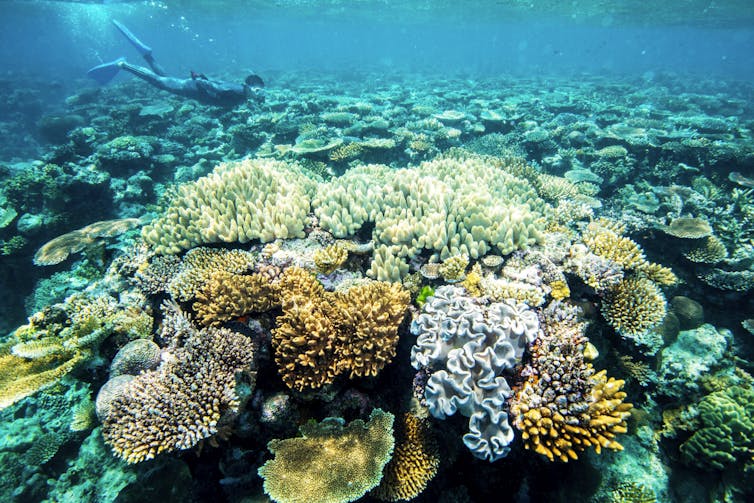 The Australian government said it was ‘blindsided’ by the UN recommendation to list the Great Barrier Reef as ‘in-danger’.
KYDPL KYODO/AP
The Australian government said it was ‘blindsided’ by the UN recommendation to list the Great Barrier Reef as ‘in-danger’.
KYDPL KYODO/AP
‘Clearly there was politics behind it’
UNESCO’s mandate to build peace through international cooperation in education, the sciences, culture and media freedom stems from its founding principles in 1945 after the second world war. The preamble to its constitution declares,
… since wars begin in the minds of men, it is in the minds of men that the defences of peace must be constructed.
Nations are elected to UNESCO’s World Heritage Committee at a biennial conference of all 193 UNESCO member states. This committee has significant power — it is authorised to make decisions on behalf of the world. And though the UN member states may complain about its decisions, none can challenge the committee’s independence or authority.
The current chair of the World Heritage Committee is China, which adds to the reason why Australia has protested so loudly at its recommendation.
Australia’s environment minister, Sussan Ley, and minister for foreign affairs, Marise Payne, were immediately on the phone to UNESCO’s director-general, Audrey Azoulay, in Paris, to express their deep concerns. Ley said[3],
This decision was flawed and clearly there was politics behind it, and that has subverted the proper process.
The head of UNESCO’s World Heritage Marine Program, Dr Fanny Douvere, pointed out, however, that the report was a rigorous scientific document[4] with inputs from Australia’s own Great Barrier Reef Marine Park Authority and official government reports on water quality — assessed and analysed by an expert team in the World Heritage Centre.
Furthermore, she said, work on the report started years ago, and the Chinese government was “not aware” of the recommendations being made.
We have yet to see how this altercation will play out, likely at the next meeting of the World Heritage Committee in China in July.
How UNESCO is structured
Behind the scenes at UNESCO, there is a complex play of international politics and UN bureaucratic processes and actions which do, at times, have an influence on the agency’s work.
I was appointed to a senior level within UNESCO from 1995–2005, working in both a field office and at its headquarters in Paris, and I played a central role in the organisation’s attempts to reform and decentralise its operations in the early 2000s. So, I have good knowledge of the beast from the inside.
The first thing to realise is there is a divide between headquarters and the field[5]. Nearly all attention is focused on UNESCO’s headquarters. This is where member state ambassadors have their offices and all the important committees are based. As a result, decisions on international conventions and actions are the province of the officialdom in Paris.
But this is not where the most effective program action happens — this is the work of the more than 50 field offices[6] around the world. And the UNESCO field offices do make a real difference.
In my own work in Indonesia, as examples, we reformed the country’s entire basic education system from centralised rote learning to decentralised open classroom exploration. We also helped the country move from total censorship of the media by helping pass legislation to ensure a free press and built a radio network of 32 independent stations across the country trained in investigative journalism.
Headquarters provided excellent technical assistance, but the field office ran the show and found the funding.
Much of the criticism aimed at UNESCO is focused on its over-bureaucratic structure and poor productivity. This criticism is largely fed by the attention placed on what happens at headquarters in Paris, not at the field offices in places like New Delhi, Jakarta and Maputo.
Read more: Australian government was 'blindsided' by UN recommendation to list Great Barrier Reef as in-danger. But it's no great surprise[7]
Member states withdrawing funding
The second thing to realise about UNESCO is it is a “technical” agency, not a “funding” organisation like, for example, the UN Development Program.
Because funding is dependent on member states, this has real consequences. Sensitive political issues can cause member states to become upset, prompting them to withdraw from the organisation — with their funding.
For instance, after Palestine was added as a full member[8] in 2011, both the US and Israel stopped paying their dues[9]. The US, which accounted for more than 20% of UNESCO’s budget, accrued some US$600 million in unpaid dues.
The Trump administration then pulled the US out of the organisation altogether after the World Heritage Committee designated the old city of Hebron in the West Bank as a Palestinian World Heritage site in 2017. The US ambassador to the UN, Nikki Haley, called UNESCO’s politicisation a “chronic embarrassment[10]”.
 Israel and the US opposed the move to designate Hebron a Palestinian World Heritage site that was also ‘in danger’.
Bernat Armangue/AP
Israel and the US opposed the move to designate Hebron a Palestinian World Heritage site that was also ‘in danger’.
Bernat Armangue/AP
This wasn’t the first time the US withdrew. In 1984, the Reagan administration pulled out of UNESCO amid complaints about the way it was run and what one American official, Gregory Newell, called[11] “extraneous politicisation”. He decried what he perceived as
… an endemic hostility toward the institutions of a free society — particularly those that protect a free press, free markets and, above all, individual human rights.
Keeping in mind UNESCO’s mandate
UNESCO’s listing of the Great Barrier Reef as “in danger” is at its heart a moral decision concerned with minimising the effects of climate change and stimulating member states into action.
Because it is playing out at headquarters level, however, there is the whiff of political involvement. This is, after all, where states play power politics with their memberships, funding and influence.
Read more: Is UNESCO World Heritage status for cultural sites killing the things it loves?[12]
But the organisation is so much more when you move away from the glitter of the world’s capitals and into the field. Here, the agency’s business is about building trust and connecting with communities to make change happen.
This is in keeping with UNESCO’s mandate, which is important to remember when attention is diverted to self-interested squabbling among its members.
References
- ^ 53 other World Heritage sites (whc.unesco.org)
- ^ estimated (www2.deloitte.com)
- ^ Ley said (www.theguardian.com)
- ^ was a rigorous scientific document (www.theguardian.com)
- ^ headquarters and the field (www.angusrobertson.com.au)
- ^ more than 50 field offices (en.unesco.org)
- ^ Australian government was 'blindsided' by UN recommendation to list Great Barrier Reef as in-danger. But it's no great surprise (theconversation.com)
- ^ full member (news.un.org)
- ^ stopped paying their dues (www.pbs.org)
- ^ chronic embarrassment (www.washingtonpost.com)
- ^ called (www.nytimes.com)
- ^ Is UNESCO World Heritage status for cultural sites killing the things it loves? (theconversation.com)