
how decades of progress in Afghanistan could be wiped out in short order
- Written by: William Maley, Emeritus Professor, Australian National University
Afghanistan is teetering on the brink of an almost unimaginable disaster. The withdrawal of US and allied forces, scheduled by President Joe Biden to be completed by September 11, threatens to precipitate the unravelling of the most pro-Western government in Southwest Asia.
It also endangers the entire framework of the Afghan state that has been built up since the overthrow of the Taliban regime in 2001.
Should this occur, the most likely results[1] would be the establishment of a theocratic regime in Kabul, the collapse of swathes of the country into a civil war (with a distinctly transnational dimension), and attempts by millions of refugees to flee the country.
In May 2010, US Secretary of State Hillary Clinton pledged[2] to a visiting delegation of Afghan women that
We will not abandon you. We will stand with you always.
Yet abandoning the Afghans who relied on such commitments is exactly what the US has now done. When pressed about his approach last week, Biden angrily cut off a questioner[3] by saying “I want to talk about happy things”.
Afghans at this point are finding it very hard to identify happy things to discuss.
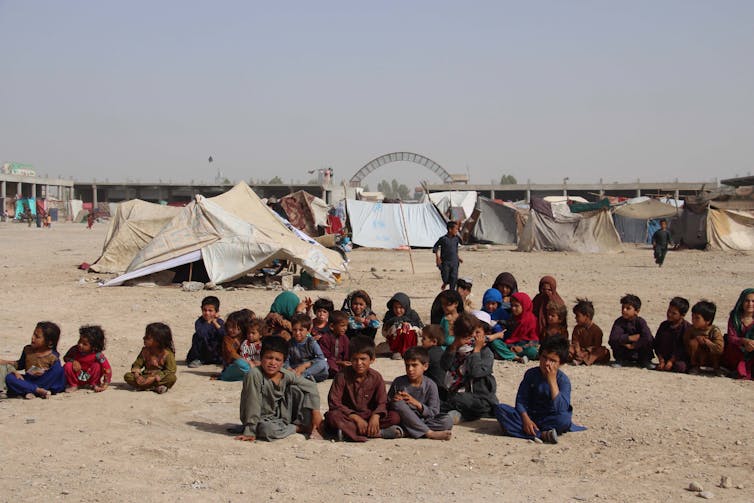 People displaced by security operations against Taliban militants in Helmand province.
Waten Yar/EPA
People displaced by security operations against Taliban militants in Helmand province.
Waten Yar/EPA
Why the psychology of the public matters
The mass psychology of the Afghan public will be key in determining how events evolve in the country. And this is something American political leaders have shown little sign of understanding.
When regimes change in Afghanistan – as with the collapse of the communist regime in April 1992[4] or the Taliban regime in November 2001 – it is typically because key players deem it prudent to shift away from powerholders whose power appears to be decaying.
While the Afghan government has left many people disappointed and disaffected – it is over-centralised, debilitated by patronage networks, and often extractive in character – the Taliban are anything but popular among Afghans. A careful 2019 survey conducted by the Asia Foundation found 85% of respondents had no sympathy[5] at all for the Taliban.
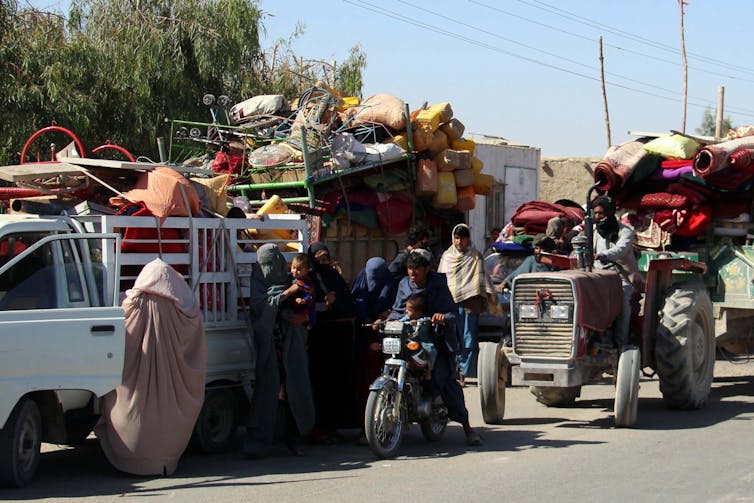 Afghans flee their villages after fighting intensified between Taliban militants and security forces in Helmand province last year.
Watan Yar/EPA
Afghans flee their villages after fighting intensified between Taliban militants and security forces in Helmand province last year.
Watan Yar/EPA
But in Afghanistan, it does not pay to be on the losing side. And there is a grave danger that a spreading perception the Taliban are poised to take over could lead to that very outcome by triggering a cascade of defections from the government and army.
With dozens of districts falling to the Taliban in late June and early July, this could happen quickly. US intelligence estimates that it could take two or three years[6] for the country to fall under Taliban control appear dangerously sanguine.
Read more: Faces of those America is leaving behind in Afghanistan[7]
A total abandonment of the Afghan people
Immediate responsibility for this tragic situation lies with the US. The bulk of foreign forces were actually withdrawn from Afghanistan by the end of 2014. The US thereafter played a much smaller, but absolutely critical, role in supporting the Afghan government.
The US did this in three ways: by providing air power to complement ground operations carried out by the Afghan army, by supplying intelligence, and most importantly, by steadying the nerves of vulnerable Afghans who accepted the US as a true partner in confronting brutal practitioners of terror, such as the Taliban and Islamic State.
This US approach was sustainable and relatively inexpensive. And while it did not hold out the prospect of a “Berlin 1945”-style victory, it did serve to avoid the consequences of a catastrophic defeat.
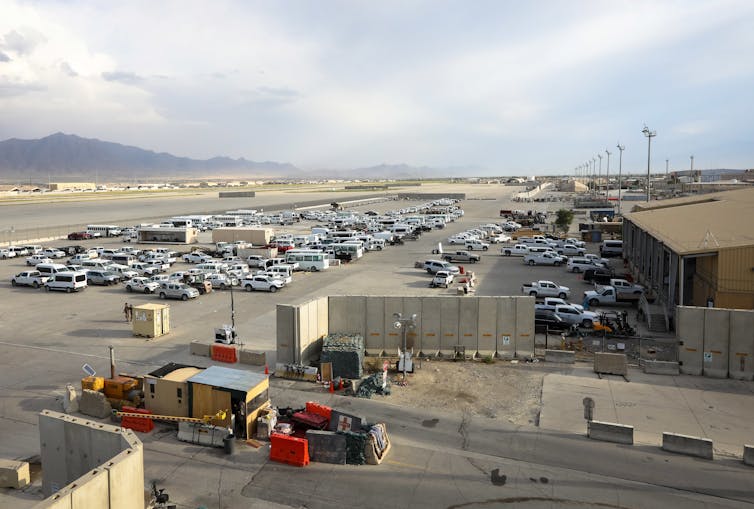 Vehicles left by the US military inside the Bagram Air Base after soldiers departed this week.
EDAYATULLAH AMID/EPA
Vehicles left by the US military inside the Bagram Air Base after soldiers departed this week.
EDAYATULLAH AMID/EPA
All this came unstuck under the Trump administration, which bypassed the Afghan government and signed a deal with the Taliban on February 29, 2020. This was called the “Agreement for the Bringing of Peace to Afghanistan[8]”.
In reality, it was simply an exit deal for the US. And it killed off the prospects of meaningful negotiations between the Afghan government and the Taliban – allegedly its main dividend[9] – by giving the Taliban all they really wanted at the very outset of what was supposed to be a “peace process”.
Read more: Protecting education should be at the centre of peace negotiations in Afghanistan[10]
The Taliban – hardly able to believe their luck – simply escalated their attacks[11] on democracy advocates, civil society actors, and the media.
Biden’s decision[12] to adopt the Trump approach as his own amounted to a dagger in the heart for those Afghans who had hoped the new US administration would show more judgement and sensitivity than the old.
Pakistan’s intervention now key
While immediate responsibility for the current debacle lies with the Trump and Biden administrations, Pakistan is even more to blame. The Pakistan government had godfathered the Taliban in the first place and resumed its support for the group[13] when US attention drifted to Iraq in 2003.
The dangers to which this gave rise were obvious. In a leaked November 2009 cable, the US ambassador to Afghanistan, retired Lieutenant-General Karl Eikenberry, wrote[14]:
More troops won’t end the insurgency as long as Pakistan sanctuaries remain. Pakistan will remain the single greatest source of Afghan instability so long as the border sanctuaries remain, and Pakistan regards its strategic interests as best served by a weak neighbour. […] Until this sanctuary problem is fully addressed, the gains from sending additional forces may be fleeting.
Despite compelling advice, even from the former Pakistan ambassador to the US[15], as to how dangerous the sanctuary problem was for US objectives in Afghanistan, successive US presidents shrank from addressing it directly. Instead, they allowed the problem to fester.
If the situation in Afghanistan is to be salvaged, this will require more than just promises of support or offers of money.
Read more: For the Afghan peace talks to succeed, a ceasefire is the next — and perhaps toughest — step forward[16]
Almost the only tool that remains to address the psychological despair in Afghanistan is immense and effective pressure on Pakistan to strike at Taliban sanctuaries, ammunition supplies, and logistics systems on Pakistani soil.
Being a sovereign state involves not just rights, but also duties. One is to prevent one’s territory from being used to mount attacks on other states.
Reportedly, the Pakistan army chief, General Qamar Javed Bajwa, and intelligence chief, Lieutenant General Faiz Hameed, recently briefed lawmakers[17] in Pakistan that “well-trained Afghan Taliban militants were present across Pakistan” and that the army “could launch an offensive against the group immediately”.
If the Pakistan army can “launch an offensive” against the Taliban “immediately”, the US and its allies should immediately pressure it to do so. But one wonders whether the Biden administration has the gumption to demand this.
References
- ^ results (www.cis.org.au)
- ^ pledged (foreignpolicy.com)
- ^ cut off a questioner (www.nytimes.com)
- ^ communist regime in April 1992 (www.britannica.com)
- ^ no sympathy (theconversation.com)
- ^ two or three years (www.nytimes.com)
- ^ Faces of those America is leaving behind in Afghanistan (theconversation.com)
- ^ Agreement for the Bringing of Peace to Afghanistan (www.state.gov)
- ^ dividend (www.washingtonpost.com)
- ^ Protecting education should be at the centre of peace negotiations in Afghanistan (theconversation.com)
- ^ escalated their attacks (tolonews.com)
- ^ decision (www.nytimes.com)
- ^ resumed its support for the group (www.taylorfrancis.com)
- ^ wrote (goodtimesweb.org)
- ^ former Pakistan ambassador to the US (www.nytimes.com)
- ^ For the Afghan peace talks to succeed, a ceasefire is the next — and perhaps toughest — step forward (theconversation.com)
- ^ briefed lawmakers (gandhara.rferl.org)