Nanyang Technological University Develops Efficient Semi-Transparent Solar Cell
A research team at Nanyang Technological University (NTU) has successfully developed a semi-transparent perovskite solar cell with a thickness of approximately one ten-thousandth of a human hair. Despite their extremely small size, these devices achieve the highest power conversion efficiency yet reported for ultra-thin perovskite solar technologies.
The researchers point out that these ultra-thin solar cells could transform car windows, skyscraper glass facades, and even smart glasses into electricity-generating surfaces without requiring major design changes. This technology heralds a future where cities can produce more renewable energy without taking up additional land or adding bulky rooftop infrastructure.
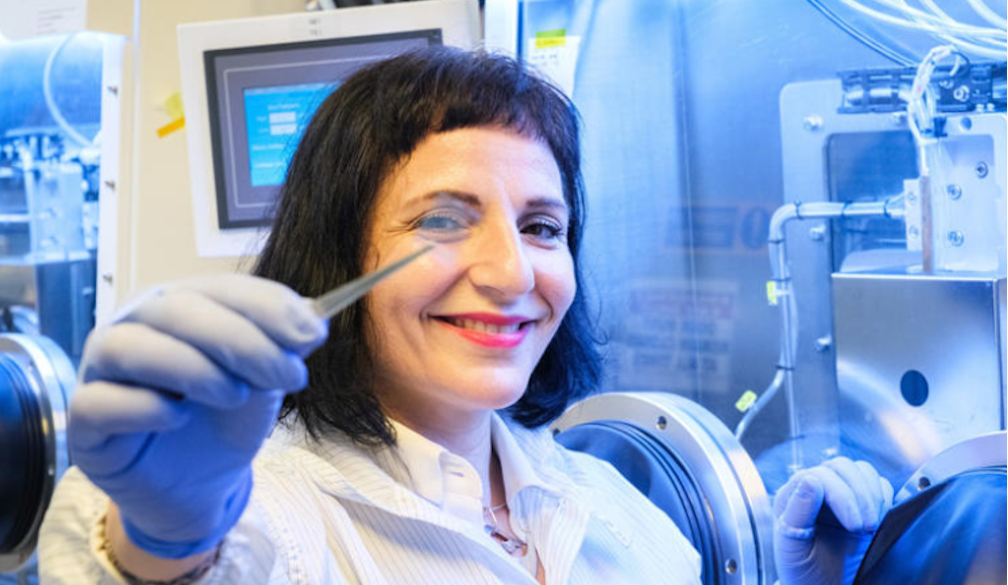
NTU Assoc Prof Annalisa Bruno seeing through the ultrathin perovskite solar cell which is just 10 nanometers. Credit: Nanyang Technological University
Solar Energy Hidden in Glass
Designed by the research team led by Annalisa Bruno, this solar cell generates electricity while maintaining a nearly invisible appearance. Thanks to its semi-transparent and color-neutral characteristics, it can be more easily integrated into office buildings, windows, and glass facades than conventional solar panels. This technology holds great appeal for architects and developers who wish to add renewable energy systems without altering the exterior appearance of buildings.
The perovskite material used in this cell offers higher sunlight absorption efficiency and lower production costs than silicon. Unlike traditional solar panels, this novel device can also generate electricity under indirect or diffuse light conditions, making it particularly useful in densely populated cities where high-rise buildings often block direct sunlight.
The researchers state that large office buildings with glass facades could use this technology to offset part of their electricity demand. Preliminary estimates suggest that if successfully deployed, such buildings could generate hundreds of megawatt-hours of electricity annually.
Vacuum-Formed Ultra-Thin Layers
In the manufacturing process, the research team employed thermal evaporation — an industrial technique where materials are heated inside a vacuum chamber until they vaporize and deposit as a thin film. This method enabled the team to produce highly uniform perovskite layers only 10 nanometers thick, while avoiding the toxic solvents commonly used in solar cell manufacturing, which could simplify future large-scale production.
By adjusting the thickness of the perovskite layer, the team produced both opaque and semi-transparent versions. The opaque version achieves efficiencies between 7% and 12%, depending on thickness. The semi-transparent version allows 41% of visible light to pass through while converting sunlight into electricity with an efficiency of 7.6%.
Commercial Applications
Independent experts believe this manufacturing approach could help propel transparent solar technology toward mass production. Professor Sam Stranks from the University of Cambridge notes that before commercial deployment becomes truly viable, researchers will still need to demonstrate long-term durability and stability.
The NTU team has filed a patent for the technology and is collaborating with industry partners to refine the manufacturing process. The researchers plan to further enhance the durability of their cells and expand their application to larger surface areas before bringing them to market. They believe this technology could ultimately transform windows, vehicles, and consumer electronics into silent sources of renewable energy.