



Acting PM Michael McCormack on net zero 2050 and prospects for a new coal-fired power station
- Written by: Michelle Grattan, Professorial Fellow, University of Canberra
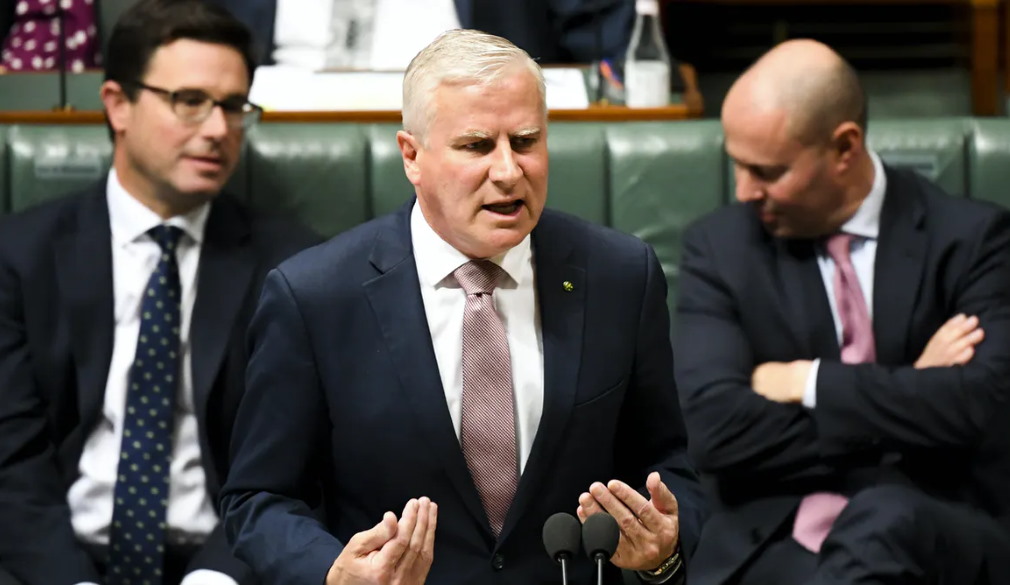
With Scott Morrison overseas, Nationals leader Michael McCormack has been Acting Prime Minister this week. In this podcast, he speaks about the free trade agreement with the UK, climate change, coal, the Nationals, and China.
With speculation about whether Morrison will embrace a 2050 net zero target before the Glasgow climate conference, the attitude of the Nationals is critical and McCormack is under pressure from a vocal group in his party that is strongly against the target.
McCormack says the National party will not supporting signing up to the target this year.
When it is put to him, “we can be sure that the Nats would not embrace that target?” his reply is definite. “Correct”.
On coal, unlike many in the government, McCormack believes the controversial proposal for a coal-fired power station at Collinsville in Queensland can be a goer. A feasibility study is being conducted for the project. (It is understood a draft report has been produced already.)
McCormack says the study is “very much on its way”. Shire Energy CEO Ashley Dodd “texts me every day of every week and highlights the progress. And last week there were some really, really positive news.”
Asked whether he thinks the government will be able to support the project, McCormack says, “provided every box [including environmental ones] is ticked, yes”.
“If the proponents come forward with everything that they’re required to do, then I can see no reason why it wouldn’t be supported. And of course, it’s not just the federal government. It’s other entities, too, which need to come on board.”
Transcript (edited for clarity)
Michelle Grattan: Michael McCormack, leader of the Nationals and deputy prime minister, is acting PM this week while Scott Morrison is overseas.
The Labor Party is relishing giving McCormack heat in question time. But McCormack himself seems to be equally relishing the limelight. And this week he had some good trade news to sell to farmers. Michael McCormack joins us today to talk about the Tamil family, the Australian-UK free trade agreement, climate change, coal and the Nationals.
Michael McCormack, can we start with the Biloela family? The government is taking quite a hard line, refusing to allow them to return to the town, which is in the National seat of Flynn. But your member for Flynn, Ken O'Dowd, supports the families return. Mr. O'Dowd is retiring at the election, would you expect your candidate next time round to say the family should be returned or to support the government’s line that they shouldn’t be?
Michael McCormack: Well, Ken has done a marvellous job for Flynn, for Gladstone, Emerald and every other town in that electorate in central Queensland. But the next candidate for Flynn hasn’t been decided. The ultimately the person who will run for the LNP and sit with the National Party, hopefully after the next election has not been determined. And that will be up to that person. But what we’ve done as far as the Biloela family, every step of the way is stick to our clear and steadfast policy. And that is that if you came to Australia via an unauthorised vessel, then you would not be settled in this country. And we’ve stuck by that. And by sticking to that policy, which was made clear at the election when we returned to power in 2013 and continued at the subsequent elections in 2016, 2019, is that we’ve stopped the boats and that has saved lives. Now, under Labor’s watch, under those six years of labour from 2007 when they dismantled John Howard’s clear policy on boats and on illegal immigrants to 2013, when they finished government, Labor saw, sadly, 1,200 people lost at sea. Now we don’t want to go back to those bad dark days. We want to make sure that at every step of the way that people know our clear immigration policies and that if they do attempt to board a vessel via a people smuggler and try to get to Australia, then they will not be settled here.
MG: Let’s move on to the free trade agreement, which was agreed in principle this week between Scott Morrison and Boris Johnson. Its got concessions and advantages for Australian farmers, but they do seem a long way off. A decade, at least 10 to 15 years for our beef and sheep meat exports.
MM: Well, there’s immediate access for 35,000 tonnes tariff free for beef, 25,000 tonnes of sheep meat, 80,000 tonnes of sugar, 24,000 tonnes for dairy produce. This is a good outcome. And trade equals jobs. More trade equals more jobs. So we can look at those things. And as it’s also eight years for beef and sheep and 10 years for the sugar cane produce. And yes, there are elements that do go out to a further period. But this is a good outcome for Australian farmers and for Australians in general. Regional Australia has grown despite Covid-19 and despite every other thing that’s been thrown against it and agriculture has grown to a $66 billion enterprise, we want to make it $100 billion by 2030. Only by doing trade deals such as this are we going to realise that outcome.
MG: In the talks that Scott Morrison has had with the British prime minister, climate change was, of course, one of the elements, and that’s been a theme of the G7 leaders. Now, your Senate leader, Bridget McKenzie, this week warned that it would be against the Nationals’ policy to sign up to net zero by 2050, to sign up to that firmly. What would be the Nationals’ position if the prime minister wants to embrace that target?
MM: Well, we’re not going to sell our coal miners out, no way, shape or form, as Nationals. And nor is Scott Morrison. I was pleased to see overnight that Japan said individual countries should set their own targets and their own pathway to lower emissions. And Japan, of course, has 14 of its 53 power stations are coal-fired power stations. And so they’ve also set a clear pathway to continuing exports. And Australia is the best coal exports in the world. But Australia is not a signatory to the G7 plus or G7 communique. And Scott Morrison hasn’t signed away anything and nor would he. We’ve actually lowered our emissions by 20%, which is, from 2005 levels, which I haven’t seen those sorts of emissions being lowered to that extent, by the US, by Canada or many of those other countries that often make statements about climate, and so, you know, you look at our rooftop solar capacity, it is the highest take-up in the world. And so we’re doing our part, we’re meeting and beating our international obligations for 2030 big time. And we’ll continue to do that. And regional Australia will lead the way in that process.
MG: So if I can just clarify this, the Nationals would not embrace the 2050 target as a firm commitment this year.
MM: Well, how do we get there? That’s the question. Well, it’s technology, not taxes. That’s always been what we’ve said. And we’re not signing, we’re not signing up to anything. We’re not signing up to any international agreements, again, to see farmers and factories and households paying more for energy.
MG: So we can be sure that the Nats would not embrace that target.
MM: Correct.
MG: Right. So, you mentioned coal, the study of a possible coal fired power station at Collinsville. That was set up, what, before the last election?
MM: Part of the underwriting new generation investments.
MG: Around the last election. Now, where is that up to? Is that finished?
MM: Well, Ashley Dodd, who is the proponent of Shine Energy, which is the company that is exploring that possibility, they received some very good news last week. The business case is actually at the moment being reviewed. If it all stacks up, then I can’t see why you wouldn’t have such a facility in Gladstone, which needs the energy. Now Gladstone, I’m not sure whether, Michelle, you visited in more recent times, but it is booming and you’ve got so many companies looking to set up there. And looking to establish there and the port is expanding - it’s a very deep water harbour. We want to see Gladstone be its best self, we want to see it be the industrial manufacturing powerhouse of central Queensland, of the nation. But we’re not going to do it if we don’t have the power. So Shine Energy, forging on, they’re getting that help through that UNGI [Underwriting New Generation Investments] process. And measures are going well.
MG: So that means the study is nearly finished or?
MM: Very much on its way. Yes. And Ashley Dodd…
MG: And you think…
MM: Texts me every day of every week and highlights the progress. And last week there were some really, really positive news. He’s in a good frame of mind. Shine Energy, stand ready to to do what they need to do. But of course, it also needs to meet all the environmental implications. Yes, it does. And yes, it will.
MG: So you think that the government will be able to support this enterprise.
MM: Well, provided every box is ticked, yes.
MG: But nevertheless, you get the feeling that Scott Morrison has now turned away from coal and he’s putting more emphasis on gas. You don’t think that times have just passed by the possibility of this project going ahead?
MM: Well, there’s also diversification of the energy market. And we’ve always said that we believe in a range of energy options. Gas, yes, it’s a big part of it. I’m delighted that Keith Pitt has been so forward leaning with Beetaloo Basin and we’re supporting that project. Massive project, huge numbers of jobs, with the right road infrastructure, with the right amenities in that regard. In the Northern Territory, and even the, even the Gunner government which realises that this might be a way out of their economic malaise, and they’re in a bit of strife at the moment with debt. But this can only help that process of the Northern Territory government getting to some way back to where it needs to be and also addressing the energy needs and export requirements of this nation.
MG: So just to be clear, on Collinsville, it is quite feasible you think that we could have a new coal fired power station there
MM: If everything stacks up. Yes. If everything… Because that’s part of the UNGI process. That’s part of what we put in place prior to the 2019 election. And if the proponents come forward with everything that they’re required to do, then I can see no reason why it wouldn’t be supported. And of course, it’s not just the federal government. It’s other entities, too, which need to come on board. But this is a process that will be worked through.
MG: Now, turning to China, obviously Australian farmers have taken quite a lot of the brunt of China’s ire with Australia generally because it’s their products that are running into obstacles. Do you have any concerns that Australia is going too far in its criticisms of China, so far that we’re really doing ourselves damage?
MM: We trade a $149.6 billion with China. It’s our largest trading partner and I’ve been very, very careful with my comments around that, because what I don’t want to see is the barley grower in South Australia or Western Australia, the meat worker in a boning room in Casino, lose their job or lose their market because in some way, Beijing misinterpreted anything or any support that I have for our trade continuing. And it’s important. It’s important for our growers. It’s important for our workers. It’s important for our nation. That trade continues with China. Yes, I appreciate there are difficulties, but there are always difficulties in a, in a competitive market. And this is one of the reasons why we’re working through this process diligently, respectfully, pragmatically, practically, as you would expect. But that’s also why one of the reasons I’m pleased that Dan Tehan is working so hard to diversify our markets as well in the UK-Australia free trade agreement in principle is one of those recently, of course, opened up a trade arrangement with Indonesia that grew and expanded what we had before and 35,000 tonnes of barley going to Mexico for the very first time recently. That’ll help there. The beer production and everything else and indeed the sheep meat going to Saudi. These are important diversifications of our markets that are good.
MG: But do you think we need to be more careful? The government needs to be more careful with its language about China?
MM: We’ll always do and say what’s in Australia’s national interests first and foremost.
MG: Do you think there’s any possible threat to iron ore exports?
MM: I would like to think not, because Australia’s iron ore is the best in the world.
MG: But what do you think?
MM: Well, I mean, these are matters for others to decide. But I say again that the mills and the production processes in China need our metallurgical coal, need our iron ore. China knows that if it wants to build a better future, then Australia’s resources are one way to be able to enhance and provide that.
MG: Now, just turning to the Nationals. These days, there always seems to be a good degree of angst in the Nationals - more than there used to be - at least in my memory. Is this mainly to do with issues or is it a question of personalities and ambitions?
MM: Oh well, there’ll always be personalities and ambitions in Canberra. That’s why, that’s why the place is like it is. But I’m focused on making sure that our $110 billion of infrastructure is rolled out supporting 100,000 workers. I’m focused on making sure that the regions can get the best deal that they can get in every way, shape or form, whether it’s through infrastructure, whether it’s through water resources, whether it’s through agriculture. That’s my only focus. You’ll only ever get me commenting publicly and privately about the things that will be good for regional Australia. I’ll leave the politics to others if they so choose to go down that path. People out in regional Australia, particularly through Covid and particularly when they’re catching mice in greater numbers than they ever expected. People who are looking to the skies to see that the next shower is going to provide them with that subsoil moisture, to be able to give them hope when they’re planning a crop. They’re not worried. They’re not worried about the internal goings on, the machinations of a federal parliament. They want what’s best for them. And the bread and butter issues are my issues as well. Their concerns are my concerns.
MG: Just finally, because we can hear the bells ringing…
MM: I think that’s just the start of parliament, so a little bit of time…
MG: For parliament to start. I just wonder what it feels like as acting prime minister, sitting in that question time hot seat, being peppered with questions which are well-outside your normal field of the questions you need to answer?
MM: Funnily enough, it’s actually not because when you are the deputy prime minister, you get asked questions from every which way, every angle, every topic. When you’re out at a Bathurst roadside on the Great Western Highway, you’ll get questions about every topic under the sun.
MG: Not so many people are listening, though.
MM: Sure. And for those people who are listening to question time, I’m always amazed by the number of truckies who are listening in as they deliver the goods around the nation, and good on them, they they keep the wheels of the economy turning.
MG: So what’s their feedback?
MM: Good. Generally good. And question time is a cauldron. It’s a robust debating chamber. And you just have to have read your topic, know your topic, and but also show that you’re human. I don’t think people want politicians to be just reading from script all the time or just sticking to the, to the talking points, and I’ve never been like that, I’m always somebody who yes, you’ll see me as I am. I’m Michael from Marra - little town with, tell you what, when I was when I was born and grew up there in the first four years that dad had the farm there, it had only a population of just over 100. How good is it that we have a nation where a little village of just over 100 people can produce somebody who can go on and be the acting prime minister? That gives hope to every boy and girl out there who ever aspired to open the batting for Australia in the cricket, to be a politician, to be the best nurse or doctor or engineer or scientist that they could be, that providing they work hard, providing they listen to their parents and their teachers and provided they have a bit of luck, you can be anything in this nation.
MG: Also, you’re former journalists, of course. So…
MM: I am, and what a great and noble profession that is!
MG: You’ve seen the process from a different perspective. Michael McCormack, thank you very much for talking with the conversation today. We’ll let you get back to those briefs for the parliamentary day.






Additional audio
A List of Ways to Die[1], Lee Rosevere, from Free Music Archive.
References
- ^ A List of Ways to Die (freemusicarchive.org)









