it is not Craig Kelly)
- Written by: Christopher Scanlon, Senior Lecturer in Communication, Deakin University
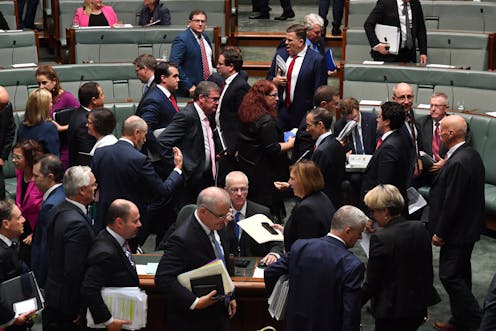
Which federal MP spends the most on Facebook advertising?
If you guessed Prime Minister Scott Morrison or Labor leader Anthony Albanese — or even headline-grabbing backbenchers Craig Kelly or Andrew Laming — you would be wrong. Way off, in fact.
No, the biggest spender on Facebook advertising — for the 90 day period between 20 June to 17 September 2021 — was deputy Labor leader, Richard Marles.
As recent scandals around the 2016 US presidential elections and the Brexit vote show, knowing how those in the political sphere spend their advertising dollars is key to maintaining trust and integrity in our political system. This has never been more important in an age where political messages can be targeted to particular audiences with laser-like precision.
Facebook’s Ad Library
I got the data for my study from Facebook’s Ad Library[1], a publicly accessible database of ads which are served up across Facebook, the Facebook-owned Instagram, Facebook Messenger and Facebook’s Audience Network, which is used to run ads within games and apps beyond Facebook’s platforms. The database is searchable by advertiser, location and keywords and can be filtered for issues, elections or politics.
Unless you specify otherwise, Facebook ads are automatically placed wherever its algorithm “decides” they should be placed.
Facebook launched[2] its ad library in 2019. This came in the wake the 2016 US presidential election where the social network’s advertisements were used to influence the outcome.
Read more: Fact check US: What is the impact of Russian interference in the US presidential election?[3]
The ad library launched in Australia in March 2020[4].
By making ads on Facebook’s platforms, particularly those relating to elections and politics, accessible, the social media giant is attempting to improve transparency about who spends how much and on what issues.
Hey, big spender
My data analysis reveals Marles spent A$45,056 advertising on the social media site in the three months to 17 September 2021.
That’s more than double the next highest lower house MP advertising on Facebook, assistant defence minister Andrew Hastie. He spent $17,251 over the same period.
Deputy Labor leader Richard Marles tops the list of recent Facebook ad spenders in federal parliament. Mick Tsikas/AAPThe adverts run by Marles focused on campaigning against proposed changes to the National Disability Insurance Scheme, campaigning against Geelong mayor and local Liberal candidate Stephanie Asher, and advocating for a federal anti-corruption commission.
Morrison doesn’t even rank in the top ten Facebook advertisers in federal parliament, coming in at number 15, while Albanese is ranked 12th. Perhaps the leaders’ relatively low ranking is not surprising. If you are a leader, you have a greater platform to get your message out without having to spend up big on Facebook ads.
It’s impossible to say exactly what you get for this money, as your ads are effectively bidding against other advertisers seeking the same audience. The cost per 1,000 impressions varies constantly. During an election campaign, the costs is likely to go higher, but still be much cheaper than traditional newspaper and TV advertising.
What about senators and premiers?
The data for the past three months shows MPs in the House of Representatives are bigger spenders than their Senate colleagues.

In the upper house, the biggest spenders on Facebook ads over the past three months were Liberal senators Zed Seselja and Concetta Fierravanti-Wells, who spent $18,280 and $17,192 respectively. Labor senator Kristina Keneally was the third highest ad spender, dropping $16,667 on Facebook ads.
And the state premiers? Victorian Premier Daniel Andrews spent $13,897, well behind his South Australian counterpart Steven Marshall, who spent $34,471.
NSW Premier Gladys Berejiklian does not come up in the Facebook Ad Library, suggesting her Facebook page is not used to buy advertisements on the platform.
What information can you get?
When you search the ad library, users can see summaries about how much was spent, where it was spent and the ad copy and images that were displayed to Facebook users. Facebook also gives an indication of the potential reach of each ad and the number of screens it appeared on.
Marles’ adverts, for example, reached a potential audience of 100,000–500,000 people. In practice, though, his best-performing ad[5] in the past three months was seen by 20,000–25,000 people, while his poorest performing ad[6] was seen by 1,000–2,000.
You can can also search and view advertisements by political parties and organisations.
Here, the ALP dominates, spending $173,067 over the past three months, in comparison to the Liberal Party, which spent $23,167. Pauline Hanson’s One Nation comes in third, with a Facebook ad spend of $10,118.
The spending by political parties is modest compared to some non-governmental organisations. For example, Greenpeace Australia Pacific spent $327,117, ahead of Amnesty International Australia ($255,052) and the Australian Conservation Foundation ($253,260).
How the ad library could be better
Will Facebook’s steps toward improving transparency in public discussion and debate improve matters?
Perhaps, but at the moment it’s not the easiest tool to use, especially for the average user. To find out who spent the most among federal MPs requires entering the names manually. For a company that is otherwise obsessed about the user experience, the design of the ad library seems an afterthought.
And while you can create a link to the data, it doesn’t appear to update in real-time. The results are a snapshot of ad spend, frozen in time. This means the data is always slightly behind and users are required to enter the data anew to create a more up-to-date comparison. Facebook does have the capacity to provide real-time access to precise numbers if they so wished.
A bigger problem is Facebook’s system relies on individuals and organisations to self-report if an advertisement is related to social or political issues. This is required by Australian law[7], but those seeking to affect the outcome of election may just take the chance of avoiding such scrutiny.
For example, last October, Clive Palmer ran an ad about border closures titled “Down with the wall!!![8]” without a disclaimer. It was eventually removed by Facebook, but not before it had been served up in 10,000–15,000 Facebook feeds.
Read more: After Clive Palmer's $60 million campaign, limits on political advertising are more important than ever[9]
Nevertheless, Facebook’s efforts to improve transparency around ad spending and reach is arguably more open and democratic than traditional advertising. Marles’ and other advertisers’ ad spends might raise eyebrows, but at the very least they’re being upfront about what they’re spending.
Perhaps it’s time we insisted all social and political advertising, both online and off, achieved similar levels of transparency.
References
- ^ Facebook’s Ad Library (www.facebook.com)
- ^ launched (www.cnbc.com)
- ^ Fact check US: What is the impact of Russian interference in the US presidential election? (theconversation.com)
- ^ March 2020 (www.smh.com.au)
- ^ best-performing ad (www.facebook.com)
- ^ poorest performing ad (www.facebook.com)
- ^ required by Australian law (en-gb.facebook.com)
- ^ Down with the wall!!! (www.facebook.com)
- ^ After Clive Palmer's $60 million campaign, limits on political advertising are more important than ever (theconversation.com)
&media=https://www.thetimes.com.au/https://images.theconversation.com/files/422016/original/file-20210920-48840-1rp3y31.jpg?ixlib=rb-1.1.0&q=45&auto=format&w=496&fit=clip&description=it%20is%20not%20Craig%20Kelly) "Pin It")