How fussy eating and changing environments led to the diversity of sharks today (and spelled the end for megaladon)
- Written by: Mohamad Bazzi, Postdoctoral research fellow, University of Zurich
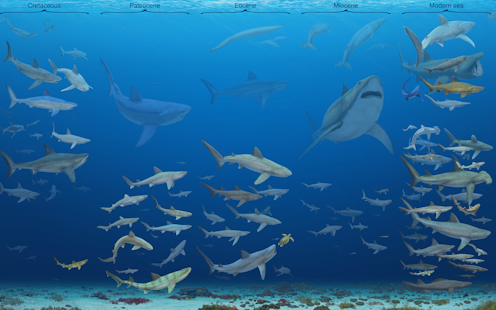
Before humans and early primates, before dinosaurs, and even before trees, there were sharks. Sharks have been around for more than 400 million years (although how long exactly remains contested[1]). They have survived five major mass extinctions[2].
But the sharks of long ago are not like the ones we see today. In fact, we still understand quite little about their long-term evolution. Our research, published today[3] in the journal Current Biology, demonstrates how shark evolution over the past 83 million years has been driven by diet preference and climate change — leading to the diversity we see today.
As it turns out, being picky about your prey is a risky game for sharks to play.
When the scales tipped
One of the more peculiar patterns in biology is for very closely related orders of living animals to have greatly different numbers of species. A notable example is the difference in species number between mackerel sharks (the Lamniformes order) and ground sharks (the Carcharhiniformes order).
Both orders share nearly 170 million years of evolutionary history, and both have species found the world over. However, there are only 15 species of Lamniformes known today (including the great white shark), compared to more than 290 species of Carcharhiniformes (including hammerheads, tiger sharks and many species found on coral reefs).
But why do some orders of shark thrive, while others dwindle? To find out, we turned to the fossil record.
The fossil record reveals shark species in prehistoric times followed a very different pattern to species alive today. Before the “age of dinosaurs” ended some 66 million years ago, at the end of the Cretaceous Period, Lamniformes were more diverse than Carcharhiniformes.
To investigate this shift, we looked at changes in the shapes of shark teeth over the past 83 million years.
Why teeth?
Unlike their soft cartilaginous skeleton, shark teeth are made up of a substance called “enameloid”, making them very hard. Sharks also continuously grow new teeth, which means their teeth provide an almost continuous fossil record.
Luckily, the shapes of shark teeth also provide rich information on their diets. For instance, a fish-eating shark is likely to have pointy, narrow teeth — often with multiple cusps to increase its chances of catching slippery prey (see the image of the mako shark below, a predominately bony-fish specialist).
By comparison, a shark that specialises in hunting seals is more likely to have broad teeth, which may be serrated to help with cutting. It is precisely this variation in tooth shape which we focused on in our latest study.
By examining more than 3,000 teeth, we found a clear link between changes in tooth shape over time and changes in the environment that took place during and after the end-Cretaceous mass extinction — the same event that wiped-out non-bird dinosaurs about 66 million years ago.
Plenty of fish, yet sharks can be choosy
During the Cretaceous, when Laminformes were more abundant, many shark species lived in inland seas that were common at the time. One example was the Western Interior Seaway, which divided North America into east and west “subcontinents”.
However, towards the end of the Cretaceous, these inland seas started disappearing. Sea levels lowered and exposed entire chunks of land. Inland seas are rare today (the Caspian Sea is one example, but it too is receding).
Read more: The Caspian Sea is set to fall by 9 metres or more this century – an ecocide is imminent[4]
The reduction in these marine ecosystems led to a significant loss of wildlife, including marine reptiles and cephalopod ammonites (relatives of squid and octopus) upon which many Cretaceous Lamniformes preyed.
As a result, many Lamniformes suffered extinction[5]. On the other hand, Lamniformes with more generalised diets survived the extinction event — as did Carcharhiniformes, which also tend to have more generalised diets.
Why the meg went missing
A similar event may have occurred just a few million years ago to one of the most awe-inspiring lamniform sharks ever known: the meg (Otodus megalodon). The meg was the largest predatory shark species to have existed.
Megalodon was truly an imposing predator that lived during the Miocene and early Pliocene, roughly 4—23 million years ago. Based on its tooth shape, it likely specialised in eating whales, which were very diverse at that time.
Our results show the period in which it lived was also a turning point for Lamniformes, with record-low tooth disparity (a loss in the amount of shape variation).
Although it’s still difficult to know why exactly the meg went extinct, it’s likely its specialised diet, which might have included the giant sperm whale Leviathan melvillei[6], put it at a disadvantage as cooling climates during the Miocene and Pliocene led to changes in its preferred diet.
To generalise, it seems specialised diets, such as that of the megalodon and some Cretaceous Lamniformes, may have put these species at a greater risk of extinction.
Read more: Making a megalodon: the evolving science behind estimating the size of the largest ever killer shark[7]
Today’s species
So what does this mean for modern sharks?
By studying the stomach contents of modern Lamniformes, we found most species tend to feed on specific food groups. The thresher and mako sharks feed primarily on bony fish. The basking shark exclusively eats plankton, while adult great white sharks feed mainly on mammals.
Since Lamniformes were much more diverse in the past, our research indicates the low diversity of Lamniformes living today is likely the result of repeated extinction events.
By comparison, modern and past Carcharhiniformes are and were more flexible in their diets. They also benefited directly from the expansion of coral reefs over the past 50 million years.
Thanks to important biological insights offered by the fossil record, we now have evidence dietary specialisation and adaptability to environmental changes likely drove shark evolution over the past 83 million years — leading to the imbalance in Lamniformes and Carcharhiniformes species numbers today.
But what does the future hold? Although it’s hard to say for sure, the news isn’t great for Lamniformes. Of the 15 species remaining, five are classified as “endangered” or “critically endangered” by the International Union for Conservation of Nature and Natural Resources[8]. Another five are considered “vulnerable”.
Lamniformes are also mostly oceanic species with specialised diets, and are therefore particularly vulnerable to chronic overfishing[9] and habitat destruction[10].And since our results indicate diet and prey availability underpinned much of the diversity among modern sharks, we think it will probably decide their survival in the future, too.
References
- ^ remains contested (www.nhm.ac.uk)
- ^ major mass extinctions (cosmosmagazine.com)
- ^ published today (doi.org)
- ^ The Caspian Sea is set to fall by 9 metres or more this century – an ecocide is imminent (theconversation.com)
- ^ extinction (www.cell.com)
- ^ Leviathan melvillei (www.nationalgeographic.com)
- ^ Making a megalodon: the evolving science behind estimating the size of the largest ever killer shark (theconversation.com)
- ^ International Union for Conservation of Nature and Natural Resources (www.iucnredlist.org)
- ^ overfishing (www.cell.com)
- ^ habitat destruction (www.nature.com)
&media=https://www.thetimes.com.au/https://images.theconversation.com/files/424002/original/file-20210930-16-qezo3t.png?ixlib=rb-1.1.0&rect=47%2C5%2C3950%2C2469&q=45&auto=format&w=496&fit=clip&description=How%20fussy%20eating%20and%20changing%20environments%20led%20to%20the%20diversity%20of%20sharks%20today%20(and%20spelled%20the%20end%20for%20megaladon) "Pin It")