Early childhood educators feel burnt out and undervalued. Here's what we can do to help
- Written by: Penny Levickis, Senior Research Fellow, REEaCh (Research in Effective Education in Early Childhood) Hub, The University of Melbourne
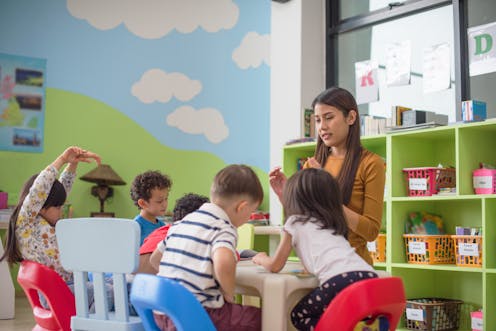
Australian early childhood educators feel burnt out and undervalued. Our research[1] reports on more than 200 educators’ experiences during the COVID-19 pandemic, which exposed existing strains on the system and further eroded their well-being.
However, educators also identified three important ways their well-being can be restored. As one educator told us:
“You cannot pour from an empty cup. Our well-being needs to be supported so we can do the best job possible.”
The pandemic has brought into sharp focus the challenging working conditions[2] the profession faces. Educators have to navigate emotionally complex work. They work long hours, with poor pay[3] and a lack of status or public recognition. Their opportunities for professional development or career progression are limited.
As a result, levels of work-related stress and burnout are high. Many are choosing to leave the sector[4].
Read more: Early childhood educators are leaving in droves. Here are 3 ways to keep them, and attract more[5]
Well-being is essential for educators to do their job well. Their well-being affects the well-being, learning and development of children across the country. A stable, qualified and healthy workforce [6] is essential for families, communities and societies.
In our research[7], more than 85% of educators reported the pandemic had negative impacts on their well-being. However, three key findings detail how well-being can be supported. Educators talked about the importance of:
self-care
relationships with children, families and colleagues (and in educators’ personal lives)
recognition for their essential work.
Self-care has to be a priority
Educators spoke about a renewed focus on self-care to support their own well-being.
“We’ve all finally realised that taking the dog for a walk has huge merits and having some meditation and doing some mindfulness and having our weekly yoga sessions are all actually working.”
Self-care involved more than exercise and meditation. Creativity was also a support for well-being, including activities such as baking, clay-making and knitting. Educators took proactive steps for their health, to strengthen their own well-being.
Service supports also matter. Counselling and professional development services were helpful. Educators made use of (mostly online) professional services such as Beyond Blue[8] and the Employee Assistance Program[9]. Some services provided additional resources to support mental health.
“The psychologist was extremely powerful and she’s given a few presentations of how to look after ourselves.”
Read more: Early childhood educators are slaves to the demands of box-ticking regulations[10]
Supportive relationships lighten the load
Personal and professional relationships are key to educators’ well-being. Supportive professional relationships provided solidarity and shared understanding. The value of being able to unload, debrief or talk with others at work increased throughout lockdowns.
“That sense of belonging to a team and all the educators really caring very strongly for each other.”
Despite reporting that the pandemic had a negative impact on their well-being, educators reported strong relationships with the children[11] they work with. Teaching and engaging with children is central to educators’ well-being. Connection to other aspects of children’s lives is also important:
“COVID has taught us that it’s the relationships we have with parents, with families, with everybody in our community that’s the most important thing.”
Recognise their essential work
Educators in our research rated their sense of contribution high. Workforce studies[12] reflect this, showing educators value and recognise the importance of their work with children. But their professional contribution is not always acknowledged.
“[Being told by government] we are here to support ‘essential workers’ without actually being referred to as essential ourselves was a real blow to the industry and self-esteem of educators.”
Read more: 'Insulting' and 'degrading': budget funding for childcare may help families but educators are still being paid pennies[13]
Acknowledgement at the local level was even more important to educator well-being during the pandemic:
“Families [are] really, really appreciating the work that we do. I think they got an extra insight into, and appreciation, for the work that the educators do for their children.”
Research[14] in child development shows us the continuum of vital learning between birth and eight years of age. However, the Australian education system treats school and pre-school settings very differently. Educators felt ignored in government decision-making throughout the pandemic, and have long argued for early learning to be recognised as pivotal for life trajectories.
“A system that acknowledges the absolute fundamental truth that unless you get early childhood right, you never get it. That child then struggles into adulthood. And as educators, we know that. So that affects our well-being as well.”
Let’s listen to educators
The pandemic has added to existing strains on the system. Educators’ well-being has continued to suffer as a result. As one educator said:
“The stress of COVID-19 exacerbated any of the stresses and difficulties that were going [on], it didn’t create them. The precedent that we have, there were always going to be problems.”
We know there’s a problem, we know the problem affects the community more broadly, but to support well-being effectively, we need to understand the experiences of educators themselves. We need to keep listening to them and act on what they’re telling us.
Here’s a good place to start: encourage self-care and provide access to resources; support and sustain relationships; acknowledge educators’ essential role in society and recognise that their well-being matters.
References
- ^ Our research (link.springer.com)
- ^ challenging working conditions (eprints.qut.edu.au)
- ^ long hours, with poor pay (theconversation.com)
- ^ choosing to leave the sector (theconversation.com)
- ^ Early childhood educators are leaving in droves. Here are 3 ways to keep them, and attract more (theconversation.com)
- ^ A stable, qualified and healthy workforce (snapshots.acecqa.gov.au)
- ^ our research (link.springer.com)
- ^ Beyond Blue (www.beyondblue.org.au)
- ^ Employee Assistance Program (eapassist.com.au)
- ^ Early childhood educators are slaves to the demands of box-ticking regulations (theconversation.com)
- ^ reported strong relationships with the children (link.springer.com)
- ^ Workforce studies (www.oecd-ilibrary.org)
- ^ 'Insulting' and 'degrading': budget funding for childcare may help families but educators are still being paid pennies (theconversation.com)
- ^ Research (journals.sagepub.com)