Schools need to know classrooms' air quality to protect against COVID. But governments aren't measuring it properly
- Written by: Geoff Hanmer, Honorary Professional Fellow, Faculty of Design, Architecture and Building, University of Technology Sydney
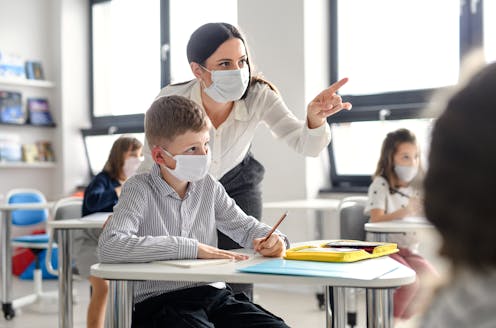
Students have returned to school in New South Wales and Victoria after weeks of lockdowns. Along with vaccination and masks, experts have flagged[1] good ventilation as one of the key factors in reducing the probability of COVID infection in schools.
COVID is rarely transmitted outside. The US Centers for Disease Control in the US say[2] the chance of transmission outside is much less than being inside a building. Some have estimated the risk of transmission outside[3] is as low as 0.1% of the risk inside.
The risk of transmission reduces as the amount of fresh air ventilation increases. This is why adequate ventilation is a crucial factor in mitigating transmission risk, and why governments are encouraging people to meet and eat outside.
On October 12, NSW Education Minister Sarah Mitchell said[4]:
Parents can be assured that everything is being done to ensure schools are safe for students […]
But hundreds of schools and day care centres in NSW have recorded a positive case[5] since face-to-face learning resumed a few weeks ago. In Victoria, more than 400 schools have recorded a positive case. This suggests that mitigation measures are not working as well as they could.
Field measurements taken by my colleagues and I show some naturally ventilated classrooms and staff rooms in NSW and Victoria will be low risk on most days. But others will be high risk on any day without the operation of a HEPA air purifier to remove virus particles if an infected person is present.
But without adequate monitoring of air quality, schools will not know what kinds of measures they need to take.
The important of measuring air quality
People breathe out carbon dioxide (CO2). This means the amount of CO2 in a room compared to outside air gives a good guide to the room’s level of ventilation. CO2 in outside air is about 400 parts per million (ppm) and a well-ventilated room will be no more than 800 ppm.
CO2 concentration can be measured using a CO2 meter. An adequate CO2 meter can be purchased for less than $100. (Most devices with a non dispersive infra-red sensor[6] will be accurate enough to measure ventilation levels.)
Governments in Victoria and NSW have announced a number of initiatives to improve ventilation and make air purifiers available.
Read more: From vaccination to ventilation: 5 ways to keep kids safe from COVID when schools reopen[7]
In September, Victoria announced a $190 million program[8] to improve ventilation in government and low fee, non-government schools. The program included the roll out of 51,000 air purifiers during term 4, ventilation monitoring using CO2 meters and $25,000 grants for each school to fund the construction of shade structures to facilitate outdoor learning.
Around the same time, the NSW government announced[9] a review of ventilation in 2,200 schools in the public system prior to the return of students. It also announced it would provide 10,000 air purifiers[10] to schools in need.
Since then, the NSW education department ad minister have been actively dissuading parent groups from checking CO2 levels or buying air purifiers. Mitchell told Parliament on October 19 that parents did not need to buy[11] purifiers. She said:
We will be buying the purifiers that we need for classrooms, based on what is needed, based on what the evidence shows us.
But safe ventilation in naturally ventilated school rooms can only be established by CO2 monitoring on site, preferably in real time, as changes in occupancy, weather conditions and wind speed can drastically impact ventilation.
Windows in most classrooms aren’t enough
Under the National Construction Code (NCC), buildings can be either naturally ventilated or mechanically ventilated. Nearly all schools in Australia are naturally ventilated with only 40 of the 2,200 government schools in NSW relying on mechanical ventilation[12].
To comply with the code’s natural ventilation provisions, a room must be provided with[13]:
[…] a ventilating area not less than 5% of the floor area of the room required to be ventilated […]
The term “ventilating area” is in practice taken to mean the area of the window pane that can be opened, not the actual area of the opening. For example, an awning window opens outwards with a top hinge.
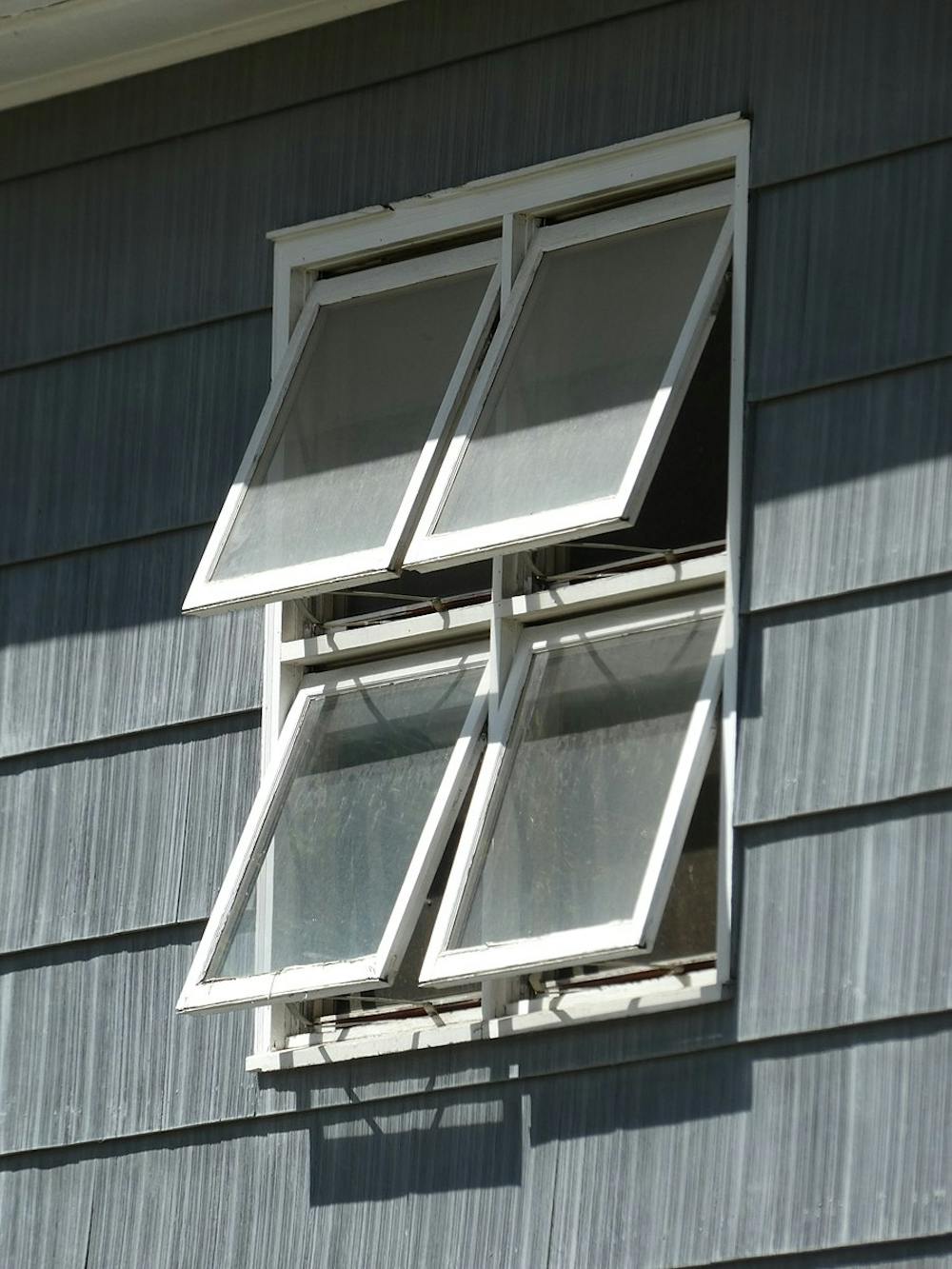
Its bottom and side openings are often substantially blocked by the surrounding wall and window sill. In a 65 square metre classroom, four awning windows complying with the NCC will have a maximum opening area of 0.932 sq m – far less than the 3.25 sq m that a literal reading of the NCC might imply.
Double hung sash windows (that can be opened by sliding the window up) or horizontally sliding windows in the same classroom will in many cases deliver only 0.450 sq m of open area. This is because another requirement of the NCC often restricts window openings to a maximum of 125 mm to stop children falling out, or getting their head stuck in the opening.
 Double hung sash windows slide upwards.
Wikimedia Commons[15]
Double hung sash windows slide upwards.
Wikimedia Commons[15]
Schools need CO2 monitors
On October 7, Schools Infrastructure NSW issued a report[16] by consultants providing an assessment of ventilation in NSW classrooms based on a “worst case” model of a 65 sq m naturally ventilated classroom.
The model predicts that between 1.733 sq m and up to 2.802 sq m of open area will be required to provide adequate ventilation. Unfortunately, most classrooms will only provide between 0.450 and 0.932 sq m of open window area, significantly less than the model predicts will be required.
Instead of proving classroom ventilation in NSW is adequate, the model suggests that it isn’t.
Read more: Australian children are learning in classrooms with very poor air quality[17]
Because the NSW government doesn’t appear to have used CO2 monitors to measure air quality, it is impossible to determine which of the 56,000 occupied rooms in government schools will need to be equipped with one of the 10,000 air purifiers that have been procured.
OzSAGE, an organisation of scientists providing independent advice to the government, advises that[18]:
CO2 reading below 800 ppm indicates a low risk of infection
CO2 reading between 800 ppm to 1,500 ppm indicates a moderate risk of infection. Improvements should be made where practicable to increase ventilation, by opening more windows, encouraging cross ventilation, the flow of air from one side of a building to the other or operating an HEPA air purifier that will remove virus particles from the air
CO2 reading above 1,500 ppm indicates a high risk of infection. Immediate improvements must be made to increase ventilation or air purifiers must be operational. If this is not possible, the activity should be promptly relocated.
Without CO2 monitors and with a flawed ventilation model, there is no evidence that all school spaces in NSW are safe. Either the government needs to promptly provide every school with a CO2 monitor or parent and community groups should buy their own.
References
- ^ experts have flagged (theconversation.com)
- ^ say (www.cdc.gov)
- ^ transmission outside (www.nytimes.com)
- ^ NSW Education Minister Sarah Mitchell said (www.smh.com.au)
- ^ recorded a positive case (www.abc.net.au)
- ^ dispersive infra-red sensor (en.wikipedia.org)
- ^ From vaccination to ventilation: 5 ways to keep kids safe from COVID when schools reopen (theconversation.com)
- ^ $190 million program (www.premier.vic.gov.au)
- ^ announced (www.hvacrnews.com.au)
- ^ would provide 10,000 air purifiers (www.smh.com.au)
- ^ parents did not need to buy (www.smh.com.au)
- ^ mechanical ventilation (www.smh.com.au)
- ^ must be provided with (ncc.abcb.gov.au)
- ^ Wikimedia Commons (commons.wikimedia.org)
- ^ Wikimedia Commons (commons.wikimedia.org)
- ^ issued a report (www.schoolinfrastructure.nsw.gov.au)
- ^ Australian children are learning in classrooms with very poor air quality (theconversation.com)
- ^ advises that (ozsage.org)