Unboxing the wonders of Christmas lingo
- Written by: Kate Burridge, Professor of Linguistics, Monash University
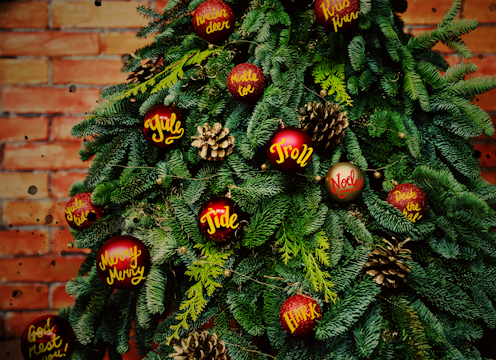
“Kondo-ing” (de-cluttering) has become all the rage. But languages are hoarders[1] that hang onto every used bit of clothing, threadbare cushion or musty old piece of luggage. You never know, these might be useful one day.
Christmas is a great reminder of how important it is to hang onto some old stuff – decorations stowed in closets, dusty words lingering in our brains. At Christmas, we drag out boxes of tinsel, baubles and fairy lights. We also trot out words, meanings and even grammar that we stopped using in our everyday language long ago.
So, let’s unpack this dusty box of Christmas lexical curiosities. We’ll toll trolls, blaze yules, graze mules, and then finish with a Christmas cracker of a linguistic joke (well, it’s no worse than any other you’ll hear this holiday season!)
This Christmastide, may God keep you t(r)olling
Untangling and dusting off these lexical curiosities – like those Christmas lights we haphazardly stowed the year before – takes some work. We needn’t go further than the lyrics of our favourite carols to see this. For example, the puzzling line (in Deck the Halls) that instructs us to “troll the ancient yuletide carol”.
Trolls sound scary. If they’re not leaving offensive messages on the internet, they’re giants living in Tolkien’s Middle-earth. But the gentle trolling we do at Christmas has a different (French) origin. It entered English in the 14th century meaning “to stroll” – but taking a few twists and turns, as words can do, it eventually arrived at another meaning “to sing merrily in full voice” (think of those rousing trolly-lollies).
The references to “yuletide” and “the blazing yule before us” are equally bewildering. Tide here has nothing to do with flows of water, but preserves the original meaning “season” or “time”. Yule like tide is one the oldest English Christmas words (8th century), but its meaning has shifted dramatically – from the original name for December or January (and presumably the pagan festivities around then), its meaning morphed into “Christmastide” a century later.
The opening line of the carol “God rest you merry, gentlemen” also dusts the cobwebs off some linguistic junk. Basically, it’s a good wish and means something like “happiness to you gentlemen”. It doesn’t help that the verb rest here has nothing to do with “relaxing” but means “keep”; what’s more it appears in a grammatical form that no longer exists. The old subjunctive signalled non-real events, such as wishing. This job is now done by other verbs (like may) – so, a more modern version would be “May God keep you merry, gentleman!”.
But even merry isn’t terribly common these days. Putting aside euphemistic references to alcohol-induced states of cheerfulness, we usually only encounter merry in carol lyrics like this one, and of course in the expression Merry Christmas (and perhaps also Robin Hood’s band of merry men).
Away in the manger…the little Malteser lay down his sweet head
Whenever untangling and dusting off our Christmas curiosities gets too hard, we can turn the task over to kids. They often refashion these yuletide curiosities into something that seems a bit more reasonable. “Tolling the yuletide carol” has a much jollier image than “trolling” it, and “get dressed, you married gentlemen” would seem like good advice. Certainly a “grazing mule before us” makes a lot more sense than that “blazing yule”.
But it probably wasn’t children who “decked the halls with Buddy Holly”. In fact, adults are responsible for a lot of remodelled Christmas expressions, and they’ve been doing it for centuries.
Read more: The dark side of mondegreens: how a simple mishearing can lead to wrongful conviction[2]
Look at mistletoe. It has absolutely nothing to do with toes, though this seems quite reasonable when you look at the plant, especially hanging as decoration. In fact mistletoe grew out of misteltan, the plant name combined with earlier tan (“twig”).
Despite their appearance, reindeer have nothing to with reins (“harness”). Reindeer was the original Viking word for this animal hreinn combined with deer, which simply meant “creature” (so (h)reindeer was one of those redundant compounds like oaktree).
Words we’ve purloined from other languages are especially prone to these linguistic makeovers. Look what we’ve done to Kris Kringle – it’s come a mighty long way from the German dialect word Christkindel (“Christ child”).
Plum puds sans plums, and boxing days without boxes
We sometimes find a cracked bauble or two in our box of lexical curiosities, but we’re loath to toss them out. We just keep using them or find new uses for them. Plum puddings don’t have plums in them anymore – the dried plums were replaced by raisins, but we’ve kept the name.
As foodie John Ayto[3] describes, traditional Christmas fare had all sorts of “plum” dishes, even plum broth and plum porridge. Occasionally modern plum puddings become plump puddings – time will tell whether this catches on.
So what about Boxing Day with no boxes (unless you’ve been to those post Christmas sales). In the 17th century, Christmas boxes were earthenware containers taken around on the first weekday after Christmas. The purpose was to collect money for the workers and, like piggy banks, they were then broken and the money distributed.
Clearly the events around this seasonal payment have changed dramatically and box now refers to a day not a container – the day has shifted too, and fixed on the December 26.
Read more: What's in a name? Well, quite a bit if your name is Karen (or Jack, John, Jeff, Dolly, Biddy, Meg ...)[4]
A closing Christmas cracker
Our box of Christmas curiosities is overflowing, but we refuse to Kondo any of it! We so want to dazzle you with stories about hark, a’wassailing, noel – even the unappetising though intriguing historical links between the words pudding and botulism.
Instead, we ask you to pull on the end of our Christmas cracker, and share in a daggy linguistic joke:
What do we call Santa’s little helpers?
Subordinate clauses
We wish you a conjubilant holiday, meaning one “filled with good cheer but most especially the good cheer that comes from being in the company of others”.
References
- ^ hoarders (books.google.com.au)
- ^ The dark side of mondegreens: how a simple mishearing can lead to wrongful conviction (theconversation.com)
- ^ John Ayto (books.google.com.au)
- ^ What's in a name? Well, quite a bit if your name is Karen (or Jack, John, Jeff, Dolly, Biddy, Meg ...) (theconversation.com)