4 essential reads on the critical role of rapid tests
- Written by: Matt Williams, Breaking News Editor
President Joe Biden has outlined plans[1] to massively ramp up COVID-19 testing in an effort to curb – or at least slow – the spread of the highly infectious omicron variant across the U.S.
In a speech on Dec. 21, 2021[2], Biden said he aimed to get out “as many tests, as quickly as possible” and said free at-home kits would be sent out to Americans beginning in January.
At the forefront of the push against the omicron variant will be new federal testing sites and the distribution of 500 million rapid tests[3], free of charge, to the public. To enable the speedy rollout of tests, the White House committed to using the Defense Production Act[4], which allows the federal government to “allocate materials, services and facilities” from the private sector to meet the demands of the nation.
The focus on testing comes at a time of high demand for kits[5] that diagnose infection. The arrival of the omicron variant has coincided with a desire by many to get tested before meeting up with loved ones over the holiday period, resulting in long lines outside test sites[6] and a run on home kits[7] being sold at pharmacies.
Throughout the coronavirus pandemic, The Conversations’s team of health experts has been on hand to explain why testing is such a crucial part of the response.
1) What exactly is a rapid COVID-19 test?
The type of test that Biden is hoping to get into the hands of Americans is a rapid antigen test[8].
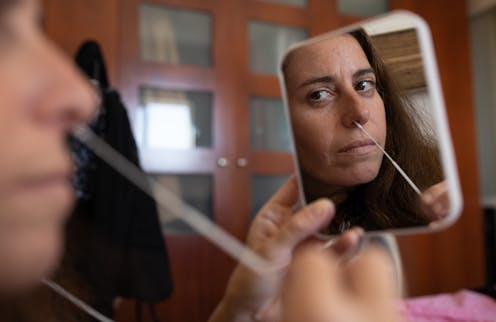
Rapid antigen tests look for proteins from the virus that may be present in samples collected via saliva or a swab up the nostrils.
The tests are relatively cheap and quick, with results known in around 15 minutes. They are, however, not 100% reliable and can miss the early stages of COVID-19 infection.
PCR tests[9], which are better at detecting low levels of the virus, are usually performed by a doctor or health practitioner – although some are available for home use – after which the samples are sent to a lab.
Like the rapid test, the first step in a PCR test is the collection of genetic material – again, saliva or nostril swab.
After that initial procedure, the sample is amplified through a sophisticated process that causes the test DNA to replicate until there are a billion copies of the original piece.
This allows for a very high level of accuracy, with the test being able to detect the tiniest presence of SARS-CoV-2, the virus that causes COVID-19.
But as Nathaniel Hafer[10], an expert in molecular medicine at UMass Chan Medical School, notes, the PCR test has weaknesses[11] – a PCR test can cost up to US$100 or more, and results can take several days to come through.
It’s important to note that all tests are a snapshot at the time of sample collection and are much more likely to be accurate when a person is infectious. So people are encouraged to take multiple tests 24 hours apart.
Read more: What's the difference between a PCR and antigen COVID-19 test? A molecular biologist explains[12]
2. Why rapid tests are important – especially now
Despite PCR tests being better at detecting low levels of the virus, the antigen tests can be particularly useful at a time when many people need to get tested.
As Hafer notes in a separate article for The Conversation, rapid tests are[13] “a welcome tool in society’s fight against the COVID-19 pandemic.”
He advises readers to take a test, be it PCR or antigen, as soon as they show symptoms of COVID-19. And the same holds true whether someone is vaccinated or not.
“The faster you can determine if you have COVID-19, the sooner you can isolate yourself, which helps prevent transmission to others,” he writes.
And even if someone gets a negative antigen result, it shouldn’t be assumed that they are in the clear. Anyone showing symptoms would be advised to have a follow-up rapid or PCR test.
Read more: Rapid tests play a crucial role in curbing COVID-19 infections – especially as people gather for the holidays[14]
3) So how do you use a home testing kit?
One of the big benefits of the rapid test is that it can be performed at home – no need for a lab setting or skilled lab technicians.
Zoë McLaren, a public health policy expert at the University of Maryland, Baltimore County[15], explained how readers should go about using their home test[16].
First off, plan ahead.
“It’s important to have a plan for what to do based on the test results. If you get a positive result, immediately take precautions to slow transmission, such as self-isolating, letting close contacts know about the test result and reporting the case to health authorities,” McLaren writes. Even when presented with a negative result, caution is advised, “and, if you have symptoms or a known exposure, it’s a good idea to do a follow-up rapid antigen or PCR test just in case the first test was a false negative.”
A second rapid test performed 24-36 hours after the initial test can help detect coronavirus cases that may have been missed the first time around due to an insufficient viral load, writes McLaren.
Read more: Over-the-counter rapid antigen tests can help slow the spread of COVID-19 -- here's how to use them effectively[17]
4) And if you still can’t get your hands on a rapid test?
Despite the massive planned rollout of rapid tests announced by Biden, there may well still be difficulties finding a kit.
Loss of smell or taste can be an indicator of COVID-19 infection. John Hayes[18] and Cara Exten[19], both of Penn State, recount how a graduate student’s mother discovered recently that she could neither smell nor taste her habitual cup of coffee. She quarantined and got a rapid test, which came back positive.
The fact that she confirmed her suspicions by use of an antigen test underscores a key point: If you have the slightest inkling that you may have COVID-19, or been in contact with someone who has, it is advisable to get tested to know for sure.
“Using loss of smell as a COVID-19 test is far from perfect. But because a daily smell check is very specific, instantaneous and quite literally free, it is a highly useful screening tool,” write Hayes and Exten.
Read more: Daily DIY sniff checks could catch many cases of COVID-19[20]
.
Editor’s note: This story is a roundup of articles from The Conversation’s archives.
References
- ^ outlined plans (www.nytimes.com)
- ^ speech on Dec. 21, 2021 (www.cbsnews.com)
- ^ 500 million rapid tests (apnews.com)
- ^ Defense Production Act (www.militarytimes.com)
- ^ high demand for kits (www.nbcnews.com)
- ^ long lines outside test sites (www.cnn.com)
- ^ run on home kits (www.axios.com)
- ^ rapid antigen test (www.cdc.gov)
- ^ PCR tests (www.fda.gov)
- ^ Nathaniel Hafer (profiles.umassmed.edu)
- ^ PCR test has weaknesses (theconversation.com)
- ^ What's the difference between a PCR and antigen COVID-19 test? A molecular biologist explains (theconversation.com)
- ^ rapid tests are (theconversation.com)
- ^ Rapid tests play a crucial role in curbing COVID-19 infections – especially as people gather for the holidays (theconversation.com)
- ^ a public health policy expert at the University of Maryland, Baltimore County (publicpolicy.umbc.edu)
- ^ go about using their home test (theconversation.com)
- ^ Over-the-counter rapid antigen tests can help slow the spread of COVID-19 -- here's how to use them effectively (theconversation.com)
- ^ John Hayes (foodscience.psu.edu)
- ^ Cara Exten (www.nursing.psu.edu)
- ^ Daily DIY sniff checks could catch many cases of COVID-19 (theconversation.com)