why some men just can't stomach plant-based food
- Written by: Dora Marinova, Professor of Sustainability, Curtin University
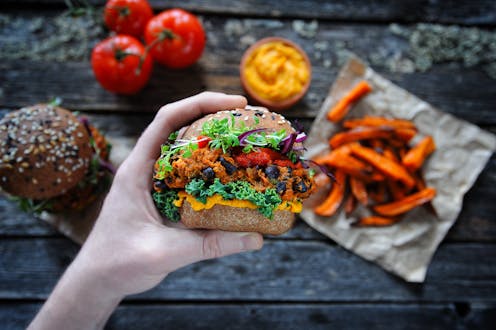
Meat alternatives are suddenly everywhere, from burger joints to supermarket shelves to restaurant-grade food.
One problem? For men, in particular, there is often a visceral attachment to slaughter-derived meat. This could pose a stumbling block for an industry worth an estimated $A9.4 billion[1] globally in 2020 and seeing significant growth, with grocery sales in Australia up by 46%[2] in 2020.
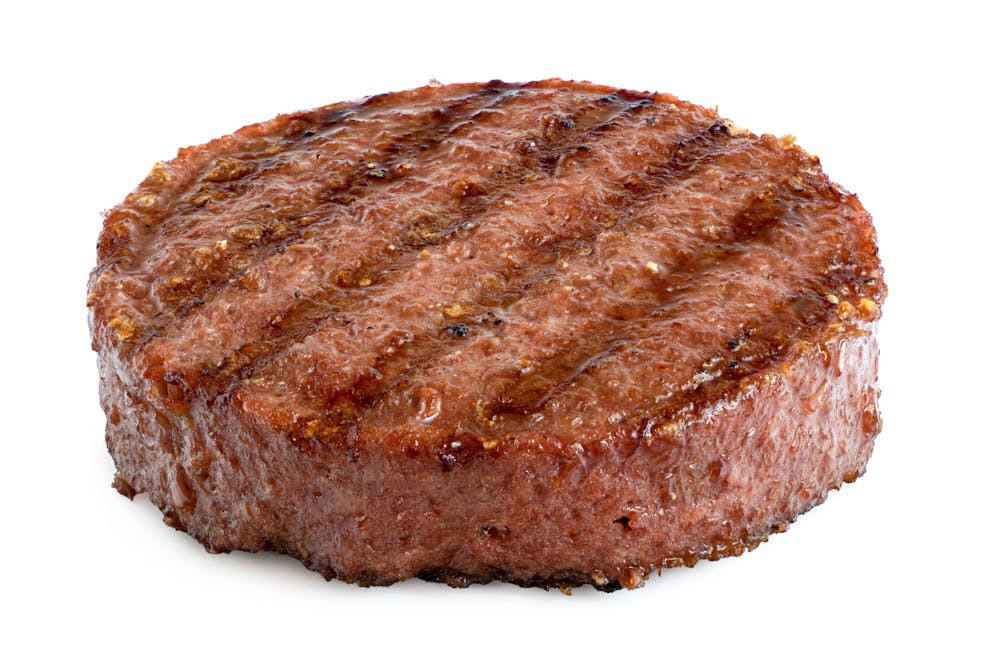
Our new research[3] is based on interviews with 36 men who recently went to vegan restaurants in Sydney and tried a plant-based burger. We found none of these men, who usually eat animal meat four to five times a week or more, were likely to include plant-based alternatives in their diets permanently.
But why? That’s the interesting part. Many of our interviewees made a strong link between animal meat and their own masculinity. “I don’t want to end up with my friends laughing at me over a plant-based burger,” one said. Another told us plant-based burgers were “ruining [his] reputation as a man”. A third said he felt guilty choosing plant-based burgers: “I was feeling I was sacrificing my manhood, my masculinity. It’s even worse when you are kind of forced to do it as everyone around is doing it. There is no other option.”
Why do some men react so strongly to meat alternatives?
We interviewed men aged 18-40, as these are the generations most likely[4] to embrace flexitarianism (meat-reduction) and include more plant-based foods. That’s why it was surprising to see the strength of their negativity.
We believe two psychological responses are at work:
The men we interviewed saw the idea of a vegan-only menu as a blow to their freedom to choose, regardless of whether they enjoyed the burger. They were determined to restore their freedom. This is in line with the idea of psychological reactance[5], which suggests people will react very strongly to perceived loss of freedoms
on the other hand, the men we interviewed wanted to impress or please their girlfriends or partners who had taken them to the restaurant. This is linked to impression management theory, which describes how we strive to be in control of how others see us. Earlier research[6] has shown men, in particular, can buy into eating larger and unhealthy meals as part of impression management. Our interviewees had to juggle how their partner saw them as well as how their friends and other men would see their choices.
What happens when these two theories collide? You get themes emerging like these:
focusing on the novelty of a vegan restaurant. One 18 year old told us: “You don’t need to be a vegan to go and try a veggie burger. I am not a vegan, but everyone is talking about [these burgers]. I am not even kidding, they are so popular.” A 29 year old said: “We used to go out and eat steaks and burgers in pubs and steakhouses […] now we are mingling with the veggie burger eaters. Strange world!”
protecting masculinity through food choice. A 22 year old told us: “Friends nowadays can trace you everywhere. I don’t want to end up with my friends laughing at me over a plant-based burger,” while a 19 year old said he had to “guard what [my girlfriend] is saying in front of my male friends. I think she is smart enough and understands the implications of this. We do have a vegan friend, and everybody is constantly fooling him and it’s very annoying to think that I can get in his place with my vegetarian burger”
scepticism over the taste of the plant-based burgers. One 32 year old told us it was “tasteless for me […] not even close to real meat. You could have it once but that’s it”
concerns over the health of plant-based burgers. A 21 year old told us plant-based burgers were not better for health compared to meat. “They are ultra-processed imitations,” he said.
Read more: Diners more likely to choose a vegetarian option when 75% of the menu is meat-free – new research[7]
Why does this matter?
The emergence of this new industry is a clear response to urgent calls[8] to change our current food systems[9] due to the heavy environmental footprint of animals bred for meat, destruction of pristine habitat to create more fields, as well as animal welfare concerns. Our reliance on meat also affects our health, both on an individual and population level[10]. New alternatives to animal-sourced meat represent the start of the transition to more sustainable food choices.
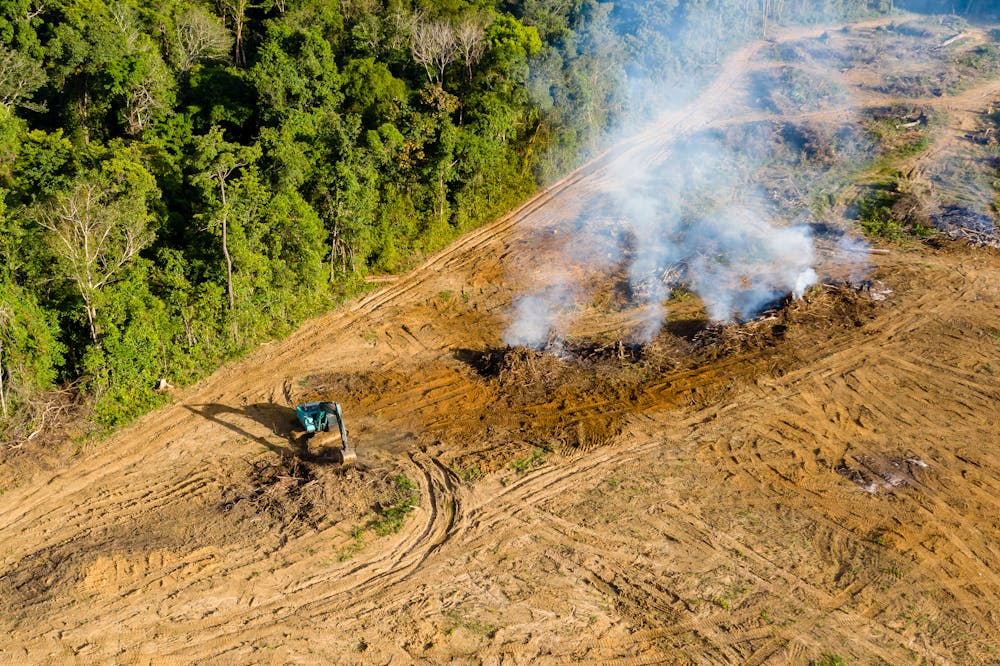 Clearing land for meat animals is a major source of biodiversity and wilderness loss.
Shutterstock
Clearing land for meat animals is a major source of biodiversity and wilderness loss.
Shutterstock
Unfortunately, plant-based alternatives can only help us tackle our overlapping environmental crises of climate change, extinctions, wilderness loss and pollution if people actually want to eat them in preference to animal muscle. This may mean improving the ingredients used in some alternative products and reducing the processing to boost how healthy they are.
Read more: How scientists make plant-based foods taste and look more like meat[11]
Forcing people to abandon animal meat is a non-starter, given how strongly we react to perceived loss of freedoms. That means we need to go after the psychological reasons some men, in particular, have such a strong attachment to animal meat.
How can we do that? Social marketing would be a good start, given the successes of previous common-good campaigns around making tobacco use less popular, uptake of sunscreen and COVID vaccinations.
Our study shows any marketing messages to encourage men to take up plant-based alternatives will need to be tailored very carefully. These could include:
describing plant-based foods as a deliberate choice to make to improve nutrition, reduce health risks and improve the environment. This approach would be likely to suppress the reactance backlash
presenting new forms of male identity focused on food to describe a masculinity centred around caring for themselves and for wilderness to create a positive impression management.
Even with reluctant or avoidant eaters, the plant-based sector is still expected to grow strongly, adding $3 billion to the Australian economy[12] by 2030.
Just imagine if we could bring everyone along – even self-described carnivores.
References
- ^ estimated $A9.4 billion (www.statista.com)
- ^ up by 46% (www.foodfrontier.org)
- ^ new research (www.mdpi.com)
- ^ most likely (www2.deloitte.com)
- ^ psychological reactance (www.ncbi.nlm.nih.gov)
- ^ Earlier research (www2.psy.unsw.edu.au)
- ^ Diners more likely to choose a vegetarian option when 75% of the menu is meat-free – new research (theconversation.com)
- ^ urgent calls (www.thelancet.com)
- ^ food systems (www.nature.com)
- ^ population level (www.thelancet.com)
- ^ How scientists make plant-based foods taste and look more like meat (theconversation.com)
- ^ $3 billion to the Australian economy (acola.org)