it's too early for the RBA to pull the trigger on interest rates
- Written by: Richard Holden, Professor of Economics, UNSW

Inflation is picking up in Australia, and there is considerable speculation about what the central bank will do with interest rates in 2022.
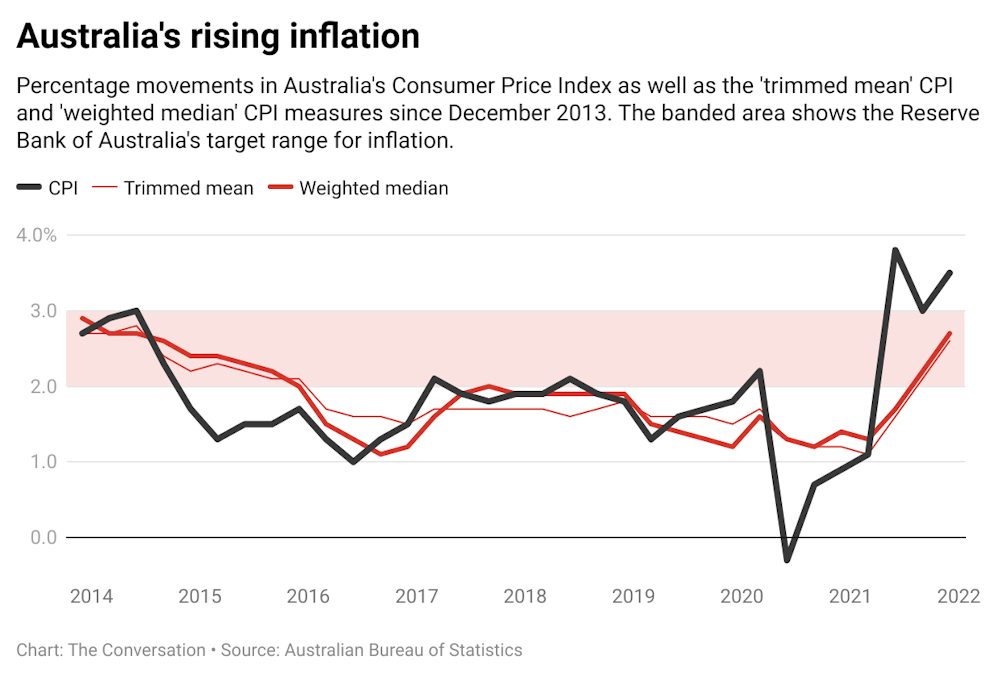
The Consumer Price Index[1] figures out this week show prices over 2021 rose 3.5%[2]. That increase reflected big jumps in some prices – such as transportation costs, up 12.5% – while other prices fell – such as communication (down 0.5%) and clothing & footwear (down 0.3%).
These large differences across categories are why the Australian Bureau of Statistics also reports a less volatile measure of price changes known as the “trimmed mean”. That rose by 2.6% over the past year – in the middle of Reserve Bank of Australia’s target range of 2-3% inflation.
The trimmed mean is what the RBA tends to focus on, and will surely be a key topic at the central bank’s first board meeting for the year, next Tuesday.
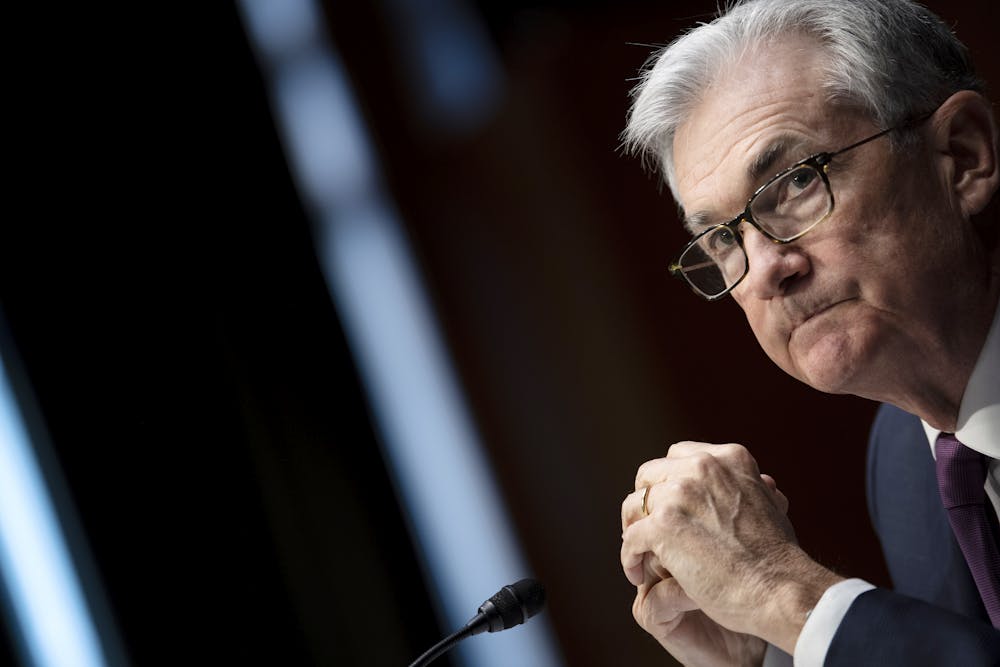 US Federal Reserve board chairman Jerome Powell has clearly signalled an interest rate rise in on the cards for March.
Brendan Smialowski/AP
The most notable voice arguing inflation was structural was former US Treasury Secretary Larry Summers. “Team transitory” was led by Nobel laureate and New York Times columnist Paul Krugman, who conceded in December[10] inflation was less transitory than he had thought.
The evidence has had clear implications for the US. The Fed will raise interest rates to bring inflation down. History tells us that once the Fed sets its mind to taming inflation it will succeed. The only question is whether it can do so without inducing a recession. The coming 12 to 18 months will be very informative in this regard.
Read more:
Inflation: why it is the biggest test yet for central bank independence[11]
Lessons for Australia
The US narrative around “out of control” inflation is spilling over into Australia’s national discussion, even though inflation is far less of a concern and the RBA has more options than the US Fed.
Inflation in Australia is right in the middle of the target band, not miles outside it as in the US. The Fed cannot wait. Here, the RBA has time to assess how inflation is playing out before pulling the trigger on increasing interest rates.
That said, matters are not helped by talk in the business community of inflation spiralling out of control, or in other circles of potential industrial action[12] over lack of wage growth.
We should remember that over the past few years the RBA has achieved exactly what it intended to do, entirely consistent with its mandate. Its core objective as an institution is to keep inflation between 2% and 3%. Right now it is 2.6%.
This is essentially the first time since Philip Lowe took over as RBA governor in September 2016 that inflation has been in the target band. In contrast, inflation averaged 2.5% over the 10-year tenure of Lowe’s predecessor, Glenn Stevens. Talk about on the money.
It would be remiss of me not to mention I was a tough critic[13] of the RBA in 2019 over it being too slow to cut rates in the face of low inflation. But the bank has done what a substantial group of economists pushed it to do – and it has worked.
There are two caveats.
The first has to do with Lowe’s “forward guidance[14]” about the central bank not raising rates, basically no matter what, until 2023 or even 2024. Many people, myself included, thought that was always a bad idea.
Read more:
Vital Signs: RBA governor Philip Lowe's dangerous game on interest rates[15]
What matters more, though, is the future.
If the RBA does decide to begin raising rates this year, the challenge will be to do so without damaging Australia’s economic recovery from the pandemic.
This will be part science, part art. It’s why the job of Reserve Bank governor is so important for the nation.
References^ Consumer Price Index (www.abs.gov.au)^ rose 3.5% (theconversation.com)^ CC BY (creativecommons.org)^ market participants think (www.smh.com.au)^ began in March 2020 (www.rba.gov.au)^ it promised (theconversation.com)^ Inflation hits 3.5%, but one high number won't budge the Reserve Bank on interest rates (theconversation.com)^ rose 7% (www.bls.gov)^ strongly signalled (www.nytimes.com)^ conceded in December (www.nytimes.com)^ Inflation: why it is the biggest test yet for central bank independence (theconversation.com)^ potential industrial action (www.skynews.com.au)^ a tough critic (research.economics.unsw.edu.au)^ forward guidance (www.rba.gov.au)^ Vital Signs: RBA governor Philip Lowe's dangerous game on interest rates (theconversation.com)
US Federal Reserve board chairman Jerome Powell has clearly signalled an interest rate rise in on the cards for March.
Brendan Smialowski/AP
The most notable voice arguing inflation was structural was former US Treasury Secretary Larry Summers. “Team transitory” was led by Nobel laureate and New York Times columnist Paul Krugman, who conceded in December[10] inflation was less transitory than he had thought.
The evidence has had clear implications for the US. The Fed will raise interest rates to bring inflation down. History tells us that once the Fed sets its mind to taming inflation it will succeed. The only question is whether it can do so without inducing a recession. The coming 12 to 18 months will be very informative in this regard.
Read more:
Inflation: why it is the biggest test yet for central bank independence[11]
Lessons for Australia
The US narrative around “out of control” inflation is spilling over into Australia’s national discussion, even though inflation is far less of a concern and the RBA has more options than the US Fed.
Inflation in Australia is right in the middle of the target band, not miles outside it as in the US. The Fed cannot wait. Here, the RBA has time to assess how inflation is playing out before pulling the trigger on increasing interest rates.
That said, matters are not helped by talk in the business community of inflation spiralling out of control, or in other circles of potential industrial action[12] over lack of wage growth.
We should remember that over the past few years the RBA has achieved exactly what it intended to do, entirely consistent with its mandate. Its core objective as an institution is to keep inflation between 2% and 3%. Right now it is 2.6%.
This is essentially the first time since Philip Lowe took over as RBA governor in September 2016 that inflation has been in the target band. In contrast, inflation averaged 2.5% over the 10-year tenure of Lowe’s predecessor, Glenn Stevens. Talk about on the money.
It would be remiss of me not to mention I was a tough critic[13] of the RBA in 2019 over it being too slow to cut rates in the face of low inflation. But the bank has done what a substantial group of economists pushed it to do – and it has worked.
There are two caveats.
The first has to do with Lowe’s “forward guidance[14]” about the central bank not raising rates, basically no matter what, until 2023 or even 2024. Many people, myself included, thought that was always a bad idea.
Read more:
Vital Signs: RBA governor Philip Lowe's dangerous game on interest rates[15]
What matters more, though, is the future.
If the RBA does decide to begin raising rates this year, the challenge will be to do so without damaging Australia’s economic recovery from the pandemic.
This will be part science, part art. It’s why the job of Reserve Bank governor is so important for the nation.
References^ Consumer Price Index (www.abs.gov.au)^ rose 3.5% (theconversation.com)^ CC BY (creativecommons.org)^ market participants think (www.smh.com.au)^ began in March 2020 (www.rba.gov.au)^ it promised (theconversation.com)^ Inflation hits 3.5%, but one high number won't budge the Reserve Bank on interest rates (theconversation.com)^ rose 7% (www.bls.gov)^ strongly signalled (www.nytimes.com)^ conceded in December (www.nytimes.com)^ Inflation: why it is the biggest test yet for central bank independence (theconversation.com)^ potential industrial action (www.skynews.com.au)^ a tough critic (research.economics.unsw.edu.au)^ forward guidance (www.rba.gov.au)^ Vital Signs: RBA governor Philip Lowe's dangerous game on interest rates (theconversation.com)