The royal commission must find ways to keep veterans out of jail
- Written by: Arlie Loughnan, Professor of Criminal Law, University of Sydney
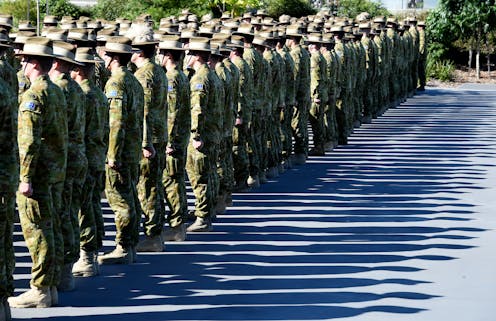
The royal commission[1] into veteran suicide returned for its second session of hearings on Monday.
With one veteran dying by suicide every two weeks in Australia[2] and evidence veterans have poorer mental health[3] than Australians overall, this work is urgent and important.
But as the royal commission investigates the risk factors around veterans’ mental health, it is missing a key part of the puzzle: contact with the criminal justice system.
A key part of minimising the risk of veteran suicide is keeping veterans out of jail.
Time in prison is itself associated with a higher risk of suicide[4]. There is also some evidence veterans are over-represented[5] in Australia’s jail system compared to other occupations.
Read more: 'Life just went to crap': why army veterans are twice as likely to end up in prison[6]
Nationally, it has been estimated [7] nearly 3% of defence force personnel are arrested within a few years of finishing their military service. About 5% of those who have left full-time military service are reported as being arrested or imprisoned.
We know many veterans have complex mental health disorders - such as PTSD - as a result of their military service, and this can lead to criminal conduct and time in prison.
In Australia, the mental health of veterans who have been in prison is not well understood. Prison and military service separately increase the chance of suicide, and this tends to indicate that veterans who have been in jail have a significantly increased risk of suicide[8].
Recognition is not enough on its own
Military service - including training and deployment - can of course be traumatic and dangerous. It is also done on behalf of Australia. Because of this, veterans are owed a particular debt by government and society.
In 2019, new federal legislation [9] recognised the need to support veterans and their families. But this was largely a symbolic act. We need proper investigations into the complex, continuing, and uncomfortable consequences of military service on veterans’ health and welfare.
The key issue is how society can best support veterans returning to civilian life. This includes strategies to prevent veterans ending up in the criminal justice system, but also offer specialised support to those who do.
Specialist veterans courts
This sort of support already exists in the United Kingdom and United States. In the US, for example, eligible veteran defendants have a specialist pathway out of the criminal justice system through veterans’ treatment courts.
Read more: One veteran on average dies by suicide every 2 weeks. This is what a royal commission needs to look at[10]
In general, these courts provide treatment to veterans who have committed nonviolent crimes and are suffering mental health disorders related to military service. A growing body of evidence[11] suggests these courts are more successful at preventing re-offending than jail time, and also improve the health and well-being of participants.
Could this work in Australia?
There are several similar models in operation in Australia, including the NSW drug court[12] and mental health courts for other at-risk groups such as those with drug addictions and serious mental illnesses.
A veterans’ court would be a problem-solving court, with an emphasis on rehabilitation, allowing service providers and veteran peers to work with veterans to move away from criminal conduct.
Individuals participating in veterans’ court processes may have their sentence suspended or their sentencing hearing deferred while they complete a drug treatment program or other treatment option. On successful completion of the program, the individual may even avoid a prison term.
What next for the royal commission
The royal commission will provide an interim report by August 11 2022 and a final report by June 15 2023 – so there is still time for a thorough consideration of veterans’ contact with the criminal justice system.
This is relevant under the terms of reference[13]. While they do not specifically mention the courts or criminal justice system, they do include “systemic issues and any common themes among defence and veteran deaths by suicide”.
Read more: We studied 50 years of royal commissions — here's how they make a difference[14]
Further work with veterans’ bodies in Australia will be necessary to determine the feasibility of and demand for veterans’ courts. But once this work is done, such courts could provide a practical, evidenced-based way to help those who have served our country.
If you or anyone you know needs help or is having suicidal thoughts, contact Lifeline on 131 114 or beyondblue on 1300 22 46 36.
References
- ^ royal commission (defenceveteransuicide.royalcommission.gov.au)
- ^ two weeks in Australia (theconversation.com)
- ^ poorer mental health (theconversation.com)
- ^ higher risk of suicide (www.aihw.gov.au)
- ^ veterans are over-represented (www.dva.gov.au)
- ^ 'Life just went to crap': why army veterans are twice as likely to end up in prison (theconversation.com)
- ^ estimated (www.dva.gov.au)
- ^ increased risk of suicide (www.dva.gov.au)
- ^ new federal legislation (theconversation.com)
- ^ One veteran on average dies by suicide every 2 weeks. This is what a royal commission needs to look at (theconversation.com)
- ^ body of evidence (www.researchgate.net)
- ^ NSW drug court (www.drugcourt.nsw.gov.au)
- ^ terms of reference (defenceveteransuicide.royalcommission.gov.au)
- ^ We studied 50 years of royal commissions — here's how they make a difference (theconversation.com)
Read more https://theconversation.com/the-royal-commission-must-find-ways-to-keep-veterans-out-of-jail-176880