How humid is it? 3 things to keep you cool in a hot and sticky summer (and 3 things that won't)
- Written by: Connor Graham, Research Fellow, Thermal Ergonomics Laboratory, University of Sydney
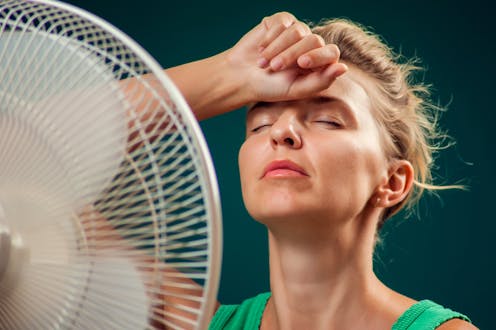
La Niña[1] has resulted in a humid summer[2] for much of eastern Australia.
This climate pattern typically causes warm, humid air to rise from the western Pacific Ocean, ultimately leading to greater cloud formation, increased rainfall, and higher humidity along Australia’s eastern seaboard and tropical north.
So what’s the best way to cope with what’s left of a hot and humid La Niña summer?
Read more: Back so soon, La Niña? Here's why we're copping two soggy summers in a row[3]
In praise of sweat (and evaporation)
Sweating (and the heat loss that goes with it) is by far the most effective way our bodies use to cool us down. But it’s not sweating alone that does the trick. It’s the evaporation of sweat that is key.
For every gram of sweat you evaporate, a little over 2.4 kilojoules[4] of heat energy is taken with it.
That’s a bit difficult to visualise. So let’s think of it in terms of boiling water.
Evaporating roughly 140 grams of sweat results in enough energy (heat) “loss” to bring a litre of 20℃ water to boiling point (at sea level).
We were treated to some interesting facts during this year’s notoriously sweaty Australian Open tennis tournament.
Champion player Rafael Nadal was reported to have evaporated over 4 kilograms of sweat[5] during his 4 hour 8 minute quarter-final win[6] over Denis Shapovalov.
That’s the equivalent of brewing a 250 millilitre cup of tea via the energy of his own sweat-liberated-heat – every 2.2 minutes of the match.
Read more: Health Check: how to exercise safely in the heat[7]
So how is this all related to humidity?
Sweat evaporation is dictated primarily by the wetness of the skin, and the absolute humidity of the air. Absolute humidity[8] is a function of the amount of water vapour in the air.
This is not to be confused with relative humidity[9] which is the term usually used in weather reports. This tells us how much water vapour the air is holding (as a percentage) relative to how much it could possibly hold, which goes up with temperature.
The bigger the difference between the wetness of the skin and the absolute humidity, the more readily sweat evaporates.
Read more: Why do I sweat so much?[10]
In arid climates, such as central Australia, where the absolute humidity is low, sweat evaporates so rapidly you can barely feel it on your skin.
Whereas in humid conditions, such as in northern Australia and more recently much of eastern Australia, sweat evaporation is hindered.
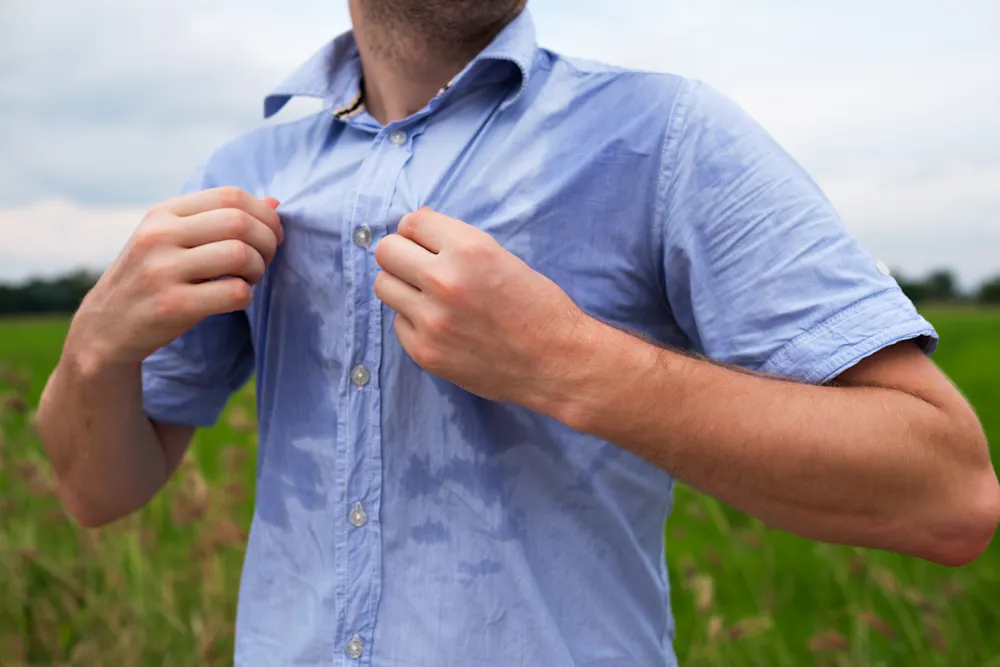
This is why on humid days we think we’re much sweatier, when in reality we may not be sweating that much more than any other warm day. It’s just more sweat is staying on our skin (rather than evaporating), forming patches on our clothes and making us feel sticky.
What can we do about it?
These three simple strategies will actually keep you cool on a humid day (without aircon):
1. Use a fan
Use a fan to increase air flow[12] and accelerate sweat evaporation. These tend to work to at least 39℃[13].
Misting fans also work[14] well as water settles on the skin and subsequently evaporates, taking body heat with it. Alternatively, you can spray your skin with water and sit in front of a fan[15].
2. Use ‘ice towels’
Wrap crushed ice in a damp towel[16] and wrap it around your neck. Professional tennis players regularly do this to keep cool. This circumvents the need for evaporation by taking heat straight from the body via conduction.
3. Wet your clothes
Soaking your t-shirt with water and putting it back on reduces the increase in core temperature[17] the same way as the evaporation of sweat. But it has the added bonus of not dehydrating the body. Alternatively, directly wetting the skin with a spray or wet sponge provides the same benefit[18].
What won’t work
Here are three strategies commonly recommended for beating the heat that won’t always work.
1. Evaporative cooling
Evaporative coolers[19] work by passing hot air across a wet membrane to cool it. These work really well on hot, dry days. But on humid days, the air can hold less extra water, so evaporation is reduced and therefore, air is cooled far less.
2. Drinking chilled drinks
Although cold drinks may feel like they cool you down, it is mainly in your mind. Your body warms up the cold fluids or ice. At the same time, this triggers a reduction in sweating[20], which reduces the amount of heat you lose via evaporation. One cancels out the other.
This results in the same body temperature[21] irrespective of how cold (or hot) the drink is.
We’re not suggesting abandoning drinks altogether. In fact, you do need to replenish water that you sweat, to avoid dehydration. But don’t expect cold drinks to perform any better than warm ones. Just drink fluid at the temperature you find most palatable.
Similarly, eating cold food, such as ice cream or other frozen or chilled snacks, does not result in any net cooling effect. By all means, eat them if they make you feel better, but don’t expect them to actually cool you down.
3. Sunscreen
While it is very important to protect you skin from UV, there is no evidence wearing sunscreen makes any difference to how hot you get or how hot you feel.
References
- ^ La Niña (www.bom.gov.au)
- ^ a humid summer (www.smh.com.au)
- ^ Back so soon, La Niña? Here's why we're copping two soggy summers in a row (theconversation.com)
- ^ 2.4 kilojoules (journals.physiology.org)
- ^ over 4 kilograms of sweat (www.theguardian.com)
- ^ 4 hour 8 minute quarter-final win (ausopen.com)
- ^ Health Check: how to exercise safely in the heat (theconversation.com)
- ^ Absolute humidity (www.weather.gov)
- ^ relative humidity (www.bom.gov.au)
- ^ Why do I sweat so much? (theconversation.com)
- ^ Shutterstock (www.shutterstock.com)
- ^ increase air flow (jamanetwork.com)
- ^ to at least 39℃ (www.sciencedirect.com)
- ^ also work (www.sciencedirect.com)
- ^ sit in front of a fan (www.sciencedirect.com)
- ^ crushed ice in a damp towel (journals.lww.com)
- ^ reduces the increase in core temperature (journals.physiology.org)
- ^ the same benefit (jamanetwork.com)
- ^ Evaporative coolers (www.choice.com.au)
- ^ reduction in sweating (journals.physiology.org)
- ^ same body temperature (link.springer.com)
&media=https://www.thetimes.com.au/https://images.theconversation.com/files/445592/original/file-20220210-24693-kz2jtl.jpg?ixlib=rb-1.1.0&rect=1%2C0%2C997%2C663&q=45&auto=format&w=496&fit=clip&description=How%20humid%20is%20it?%203%20things%20to%20keep%20you%20cool%20in%20a%20hot%20and%20sticky%20summer%20(and%203%20things%20that%20won't) "Pin It")