On Sidney Nolan, the painter who re-envisaged the Australian landscape
- Written by: Julie Shiels, Lecturer - School of Art, RMIT University
Review: Sidney Nolan: Search for Paradise, Heide Museum of Modern Art
The Sidney Nolan retrospective is held in a contemporary Eden in the Melbourne suburbs — the place where the artist’s own search for paradise began.
Nolan is best known for his modernist depictions of the history and mythology of Australian bush life, and his role in re-envisaging the landscape. This exhibition, curated by Kendrah Morgan, reframes his artistic work by focusing on his motivations: a relentless pursuit of paradise permeated with an unresolved sexual relationship.
Originally, Heide Museum of Modern Art was the home of cultural benefactors John and Sunday Reed[1], with whom Nolan was deeply entangled.
The narrative begins with a tiny painting, Woman and Tree Garden of Eden (1941). When he painted it, Nolan had left his wife and baby daughter and was living at Heide in a ménage à trois with the Reeds. The biblical references are overt: the fall of man, symbolised by a tree, a serpent, and a woman.
Window Girl and Flowers (1942) is painted on a repurposed six-pane window. Allusions to Eve have been tempered: each frame is like an animation cel with illustration-style renderings of a woman who is more earth goddess than wily temptress.
Nolan’s ability to produce a poetic affect from an awkward aesthetic is already evident in these early works
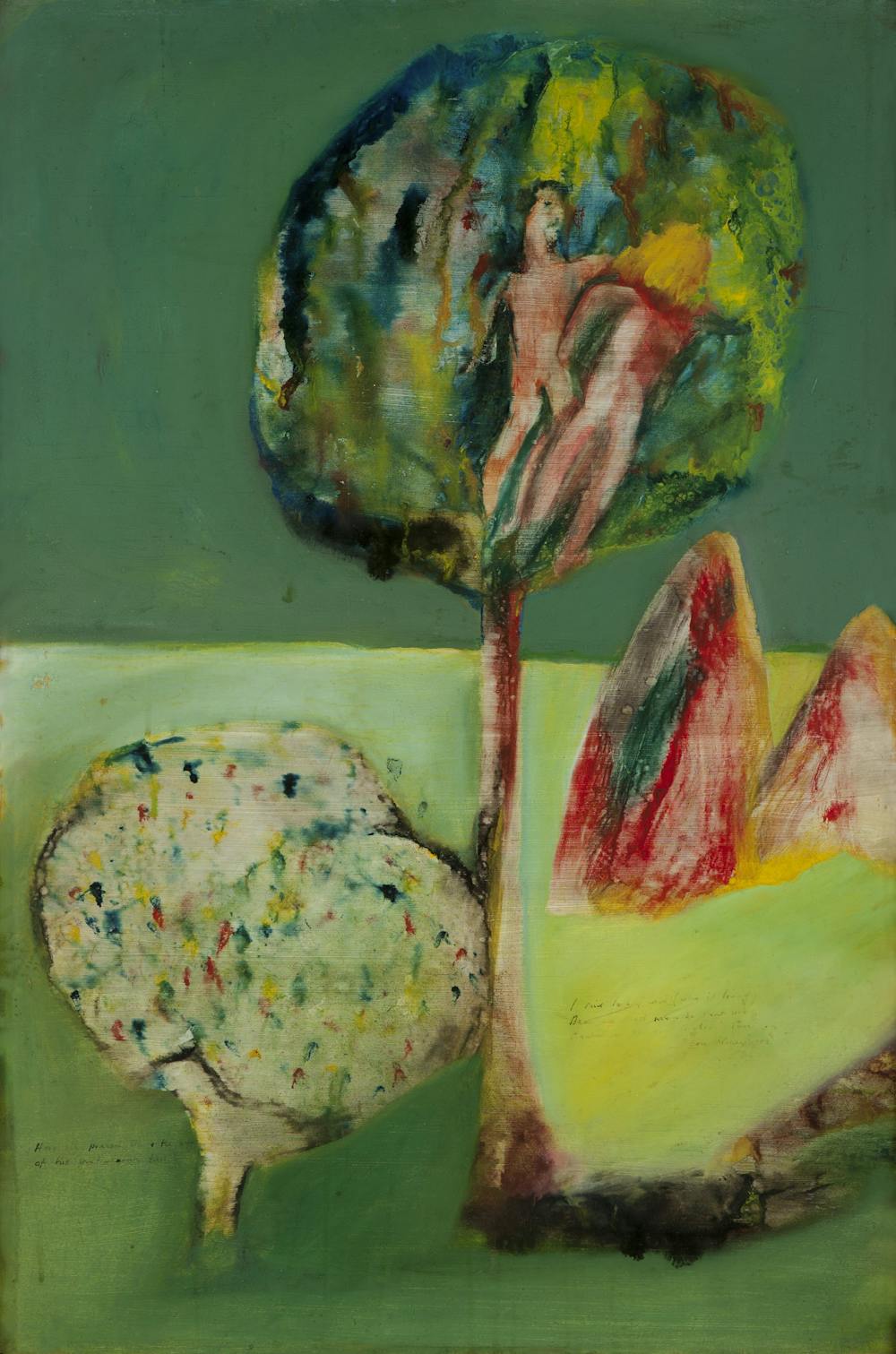
Nolan’s utopia was short-lived. In 1942 he was conscripted into the army and stationed in Victoria’s Wimmera region where he began painting with a modernist sensibility. Arabian Tree (1943) continues his exploration of the fall and his relationship with Sunday Reed. A naked man and woman are enclosed in the canopy of a tree. The female figure appears off balance, as if out of kilter or in a swoon.
By comparison to his brash, empty Wimmera landscapes, the marks and intensity of colour in Rosa Mutabilis (1945) are more subdued. The farmhouse in the distance and smudgy almost human forms in the foreground are hard to apprehend.
Reed is almost disappearing in a shroud of rose petals: even in his imagination, the artist is unable to get close.
Read more: Friday essay: the Melbourne bookshop that ignited Australian modernism[2]
The Australian landscape
While in the Wimmera, Nolan had more time to paint. Using the vivid primary colours of commercial house paint, this period marked the start of his engagement with the Australian landscape.
Other escapist preoccupations, such as childhood recollections and connections to St Kilda, were vivified in red, blue and yellow.
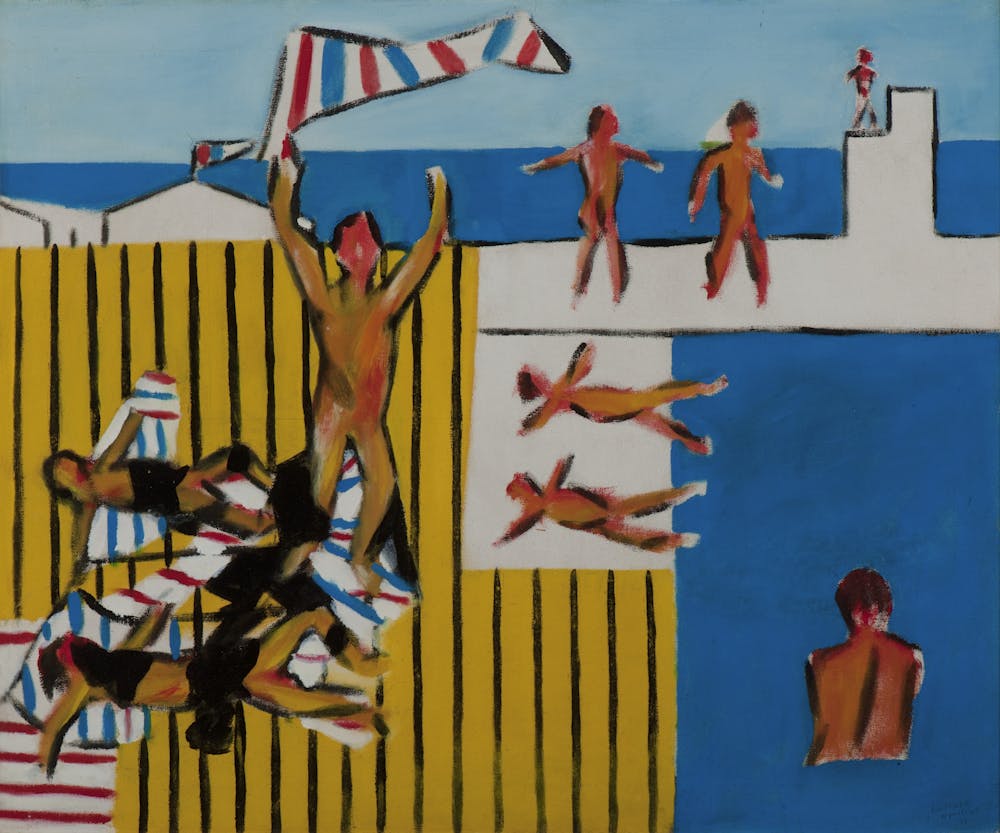 Sidney Nolan Bathers 1943. Ripolin enamel on canvas 62.9 x 75.5 cm. Heide Museum of Modern Art, Melbourne Bequest of John and Sunday Reed 1982.
© The Trustees of the Sidney Nolan Trust/DACS. Licensed by Copyright Agency
Sidney Nolan Bathers 1943. Ripolin enamel on canvas 62.9 x 75.5 cm. Heide Museum of Modern Art, Melbourne Bequest of John and Sunday Reed 1982.
© The Trustees of the Sidney Nolan Trust/DACS. Licensed by Copyright Agency
In these paintings the simplicity of life is rendered through rudimentary lines, bold palette and hierarchies of form. The scenes seem to offer an escape in time and place from his reality, confined as a soldier to an inland army camp.
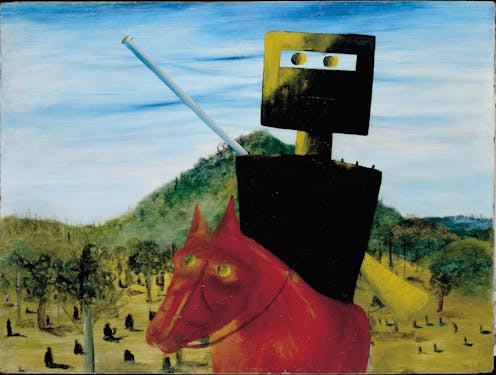
Nolan started his Ned Kelly series in Wimmera, the paintings he is perhaps best known for. But this retrospective pairs two of his lesser-known works, emphasising their comic qualities and inviting us to consider this iconic series with fresh eyes.
Policeman in Wombat Hole (1946) sits alongside Kelly and Horse (1946), adding to the Kelly myth of his response to authority. In this latter painting, even the animals are laughing.
Nolan’s deft ability to create an awkward aesthetic that produces the poetic is again operating in these works: a poetic of irreverence.
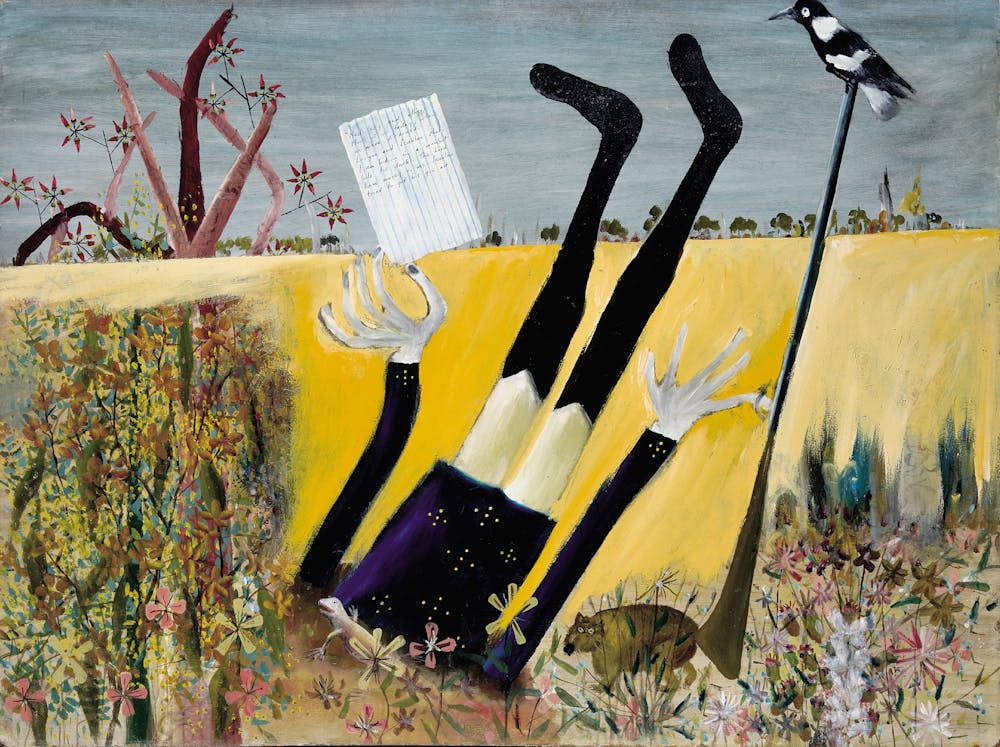 Sidney Nolan Policeman in a Wombat Hole 1946. Enamel on fibre board 91.8 x 122.3 cm. Canberra Museum and Gallery, Canberra. Gift of the artist to the people of Australia 1974.
© Canberra Museum and Gallery
Sidney Nolan Policeman in a Wombat Hole 1946. Enamel on fibre board 91.8 x 122.3 cm. Canberra Museum and Gallery, Canberra. Gift of the artist to the people of Australia 1974.
© Canberra Museum and Gallery
On the road
In the late 1940s, travelling across Australia, Nolan painted myths and histories significant to the white Australian narrative. While responsive to First Nations’ perspectives, he never challenged the colonial vision or its grip on this stolen land and the settler imagination.
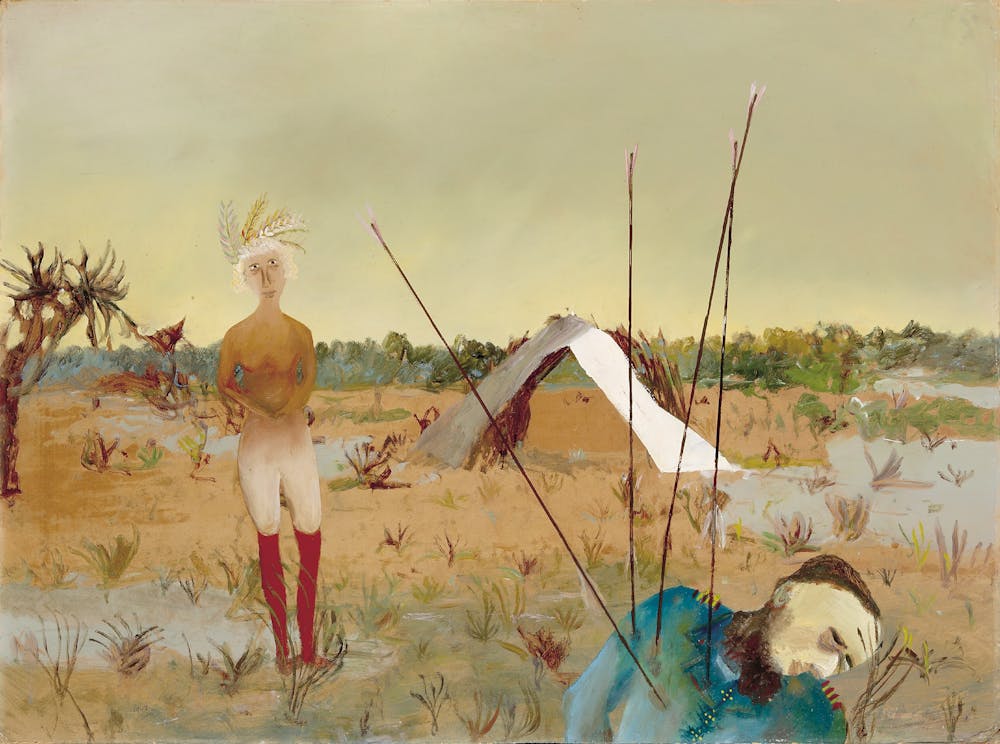 Sidney Nolan Death of Captain Fraser 1948. Enamel on compressed fibre board 91.2 x 122.4 cm. Canberra Museum and Gallery, Canberra. Gift of the artist to the people of Australia 1974.
© Canberra Museum and Gallery
Sidney Nolan Death of Captain Fraser 1948. Enamel on compressed fibre board 91.2 x 122.4 cm. Canberra Museum and Gallery, Canberra. Gift of the artist to the people of Australia 1974.
© Canberra Museum and Gallery
In the 1950 and 60s, like many Australian creatives, Nolan lived in London. It was a convenient base for an artist who saw travel as means to discover hidden things about the self “using the outside world as a lever”. Nolan was drawn to places where there had been prior civilisations in order both to understand their achievements, and how they had perished.
Between 1968 and 1970, Nolan made his own paradise. His Paradise Garden mural is made from 1,320 vivid individual panels of real and imagined flora.
In one of Heide’s smaller galleries, 18 of these panels envelop the viewer and provide a contra point to a book of poems and drawings by the same name (1971).
This exposé of Nolan’s life at Heide – and his unresolved relationship with the Reeds – spews out in an unbridled, often pornographic expression of rage. Brought together in one space, the contradictory forces of the book and the mural panels exemplify Nolan’s conflicted drives.
A contemporary re-imagining
Nolan painted Self Portrait 1943 while serving in the army. In it, he employs exaggeration, distortion and smears of face paint to suggest a warrior.
Worimi artist Dean Cross adopts this self-portrait as a central image in Sometimes I Miss the Applause, a double screen video work commissioned to respond to the Nolan retrospective.
A reproduction of the self-portrait is adhered to a square bag that Cross uses as a mask, simultaneously suggesting Ned Kelly’s helmet and channelling Nolan. Kitted up in the mask and a tracksuit, Cross performs a rehearsal of the Maiden’s Dance from Stravinsky’s ballet The Rite of Spring.
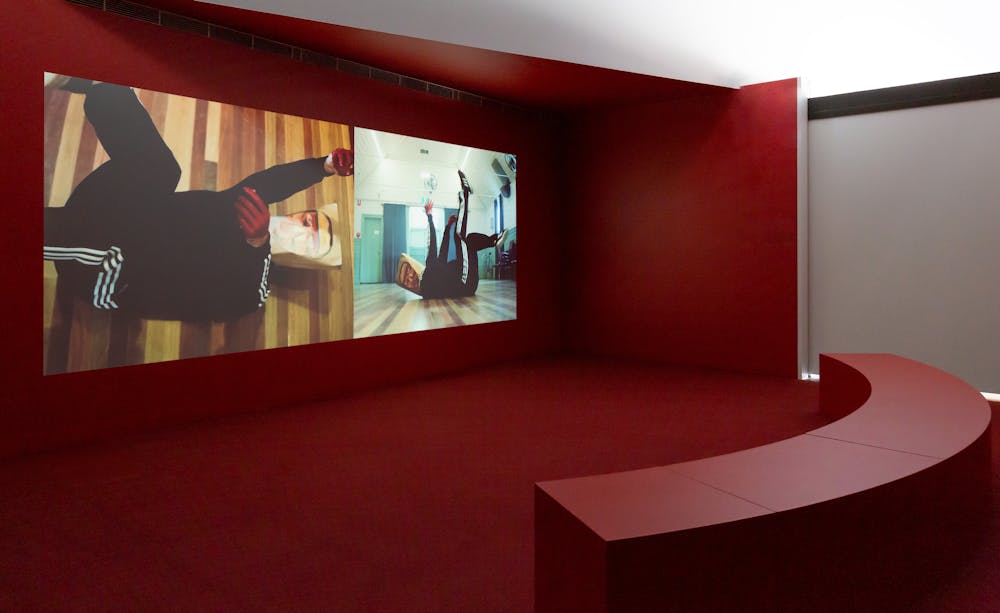 Installation view. Dean Cross: Sometimes I Miss the Applause. Heide Museum of Modern Art.
Photograph: Christian Capurro
Installation view. Dean Cross: Sometimes I Miss the Applause. Heide Museum of Modern Art.
Photograph: Christian Capurro
First performed in 1913, the ballet prompted such contention that a fight[3] broke out in the audience. Kenneth MacMillan’s 1962[4] interpretation for the Royal Ballet, with Nolan’s production design appropriating First Nation imagery and motifs, remains equally contentious.
Cross returns the favour, appropriating Nolan’s signature style of the awkward and the poetic, referring to, imitating and reinterpreting Nolan imagery. The finale where Cross departs through an over exposed and bleached out exit door suggests he, unlike Nolan, has found paradise.
It is an insightful and irreverent response to the retrospective, at once paying tribute to Nolan’s artistic vision and achievements and revealing their limitations.
Sidney Nolan: Search for Paradise is at the Heide Museum until June 13.
Read more: The Sidney Nolan mystery: did British government knowingly knight a wartime deserter?[5]
References
- ^ John and Sunday Reed (www.smh.com.au)
- ^ Friday essay: the Melbourne bookshop that ignited Australian modernism (theconversation.com)
- ^ a fight (www.bl.uk)
- ^ Kenneth MacMillan’s 1962 (www.kennethmacmillan.com)
- ^ The Sidney Nolan mystery: did British government knowingly knight a wartime deserter? (theconversation.com)