Putin is on a personal mission to rewrite Cold War history, making the risks in Ukraine far graver
- Written by: Matthew Sussex, Fellow, Strategic and Defence Studies Centre, Australian National University
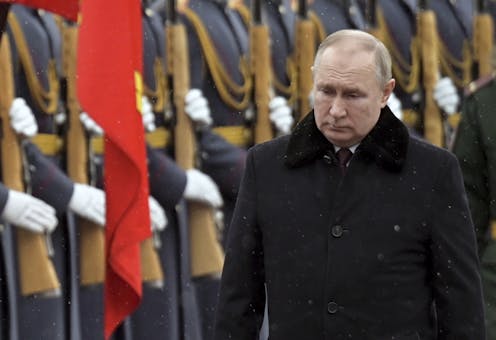
There is no shortage of speculation about what Russian President Vladimir Putin intends to do with the vast Russian military force now virtually encircling Ukraine, and why he has amassed it.
Its sheer size – the largest combat force assembled in Europe since the second world war[1] – suggests a maximalist approach[2]: erasing the humiliation of the Soviet Union’s breakup 30 years ago with a massive, bloody and swift invasion of Ukraine on multiple fronts.
Indeed, a full-scale attack looks increasingly imminent with an estimated 80% of Russian forces now in combat-ready position and separatist leaders in eastern Ukraine formally requesting help[3] combating what they falsely claim is aggression from the Ukrainian military.
Others see it differently, believing Putin will be content[4] with his gains so far. Some also consider Russia’s recognition of the breakaway regions of Donetsk and Luhansk in eastern Ukraine as signalling a muscular warning to Western leaders who have repeatedly ignored[5] Russian security concerns.
Another view suggests Putin will opt for a hybrid strategy similar to Russia’s playbook[6] in its 2008 war with Georgia: threatening to use force, formally recognising breakaway provinces, and destroying its adversary’s military – but stopping short of actual conquest.
Putin’s anger laid bare
Who is right? Each scenario is feasible, but the question of how to interpret Russian motives became clearer after Putin’s bizarre February 22 meeting[7] with his Security Council in Moscow.
At the meeting, he humiliated Russian spy chief Sergei Naryshkin[8] for forgetting the script and supporting the incorporation of Donetsk and Luhansk directly into Russia, instead of just recognising their independence.
The meeting was a pre-recorded[9] charade. Even the time shown on Putin’s own watch suggested the signing ceremony to recognise the independence of Donetsk and Luhansk had occurred before the meeting with his chiefs had even started.
But it was Putin’s angry speech afterwards that made clear just how personal this conflict might be.
He opined at length that Ukraine was a “colony with a puppet regime[10]” and had no right to exist. It recalled Putin’s 2021 essay[11] bemoaning the collapse of the USSR and claiming Russia and Ukraine were one people, hence denying Ukrainians sovereignty and identity.
His speech[12] this week also included the false claim that Russian revolutionary Vladimir Lenin created Ukraine, praise for strongman Joseph Stalin, and the fanciful charge that Ukraine would seek to develop nuclear weapons.
In doing so, Putin resembled more a Russian ultranationalist with a shaky grasp of history than a pragmatic master strategist.
A personal mission to rewrite history
The charade could be dismissed as domestic posturing – a president in absolute command appealing to the patriotic urges of a population wary of conflict[13]. But Putin seems to regard it as his personal mission to rewrite the history of the end of the Cold War.
This goes beyond concerns he may have about his legacy, or a desire to deliver on his promise to restore Russia to its former greatness[14].
This mission seems to be the real driver behind his aggression right now, not the narrative about the continued threat of NATO on Russia’s borders.
Read more: Putin’s erasing of Ukraine’s distinct history reveals his imperial ambitions[15]
In fact, his massive troop build-up on Ukraine’s borders (about 60% of Russia’s total combat power[16]) undercuts his perceived concerns over NATO and a potential Western invasion of Russia.
This has required him to shift whole garrisons, including from near the border with Estonia and Latvia, both of which are NATO members.
He has also decreed the 30,000 Russian military personnel in Belarus will stay[17] there indefinitely, ensuring Minsk also remains tightly bound to Moscow. This effectively adds new territory where Putin can station military forces and even potentially nuclear weapons.
Putin has calculated the economic risks
All of this indicates the conflict in Ukraine is more about expanding Russia’s territorial footprint than about the much-hyped NATO threat. In fact, it is deliberately pushing closer to NATO. And this has implications for how Putin is likely to calculate risk.
First, Putin knows NATO will not fight[18] for Ukraine.
Second, he would have gamed out the potential costs of Western sanctions and attempts to distract him with “off-ramps” to avoid conflict. Putin’s tactic of reducing gas supplies[19] over the last six months, encouraging EU members to deplete their reserves during winter, is evidence his plan has been in the works for some time.
So, too, has been his approach to diplomacy. Putin’s seeming willingness to negotiate over Ukraine has clearly been a pretence, given his refusal to budge on key issues and his swift discarding of the Minsk agreements[20] over the future status of the breakaway Donetsk and Luhansk regions.
Third, Russia previously adapted to sanctions the West imposed after its invasion of Crimea in 2014 by divesting from dollars into gold[21] and building a large sovereign wealth fund[22]. This will provide some insulation from new sanctions imposed by Western countries this week.
Putin may well calculate he will be able to ride out even a tough US and EU package. That already includes total blocks on Russian banks[23], Germany’s delayed certification of the Nord Stream 2[24] gas pipeline, and hints from the Biden administration that tough export controls[25] will be next.
Read more: Putin’s public approval is soaring during the Russia-Ukraine crisis, but it's unlikely to last[26]
How the West must respond
If Putin is undeterred by economic pressure, what about political and military risks?
It makes little sense for him to stop at securing Donetsk and Luhansk as they stand today, which is why he chose to recognise the far larger territory the separatists claim[27] but don’t yet control.
It also provides numerous opportunities for false-flag “provocations”, since 70% of the territory[28] the separatists have claimed is currently held by the Ukrainian military.
But it is doubtful whether Putin would even see this as a victory.
For one thing, he could have recognised Donetsk and Luhansk months, if not years ago. For another, he did not need to surround Ukraine with virtually every offensive military asset he has – including mobile missile launchers, tanks, special forces and civilian control units[29] – just to secure the two small breakaway regions.
If Ukraine is as personal for Putin as he is signalling, and his appetite for risk as high as his actions indicate, the West must assume he has loftier ambitions than the five-day war[30] with Georgia in 2008.
That means taking decisive coercive steps in response to Russia’s aggression. At the very least, the West will need a blisteringly tough sanctions package aimed at crippling the Russian economy.
It will also need to arm Ukraine and provide technical, on-the-ground expertise, and provide signals and other intelligence to the Ukrainian armed forces.
Providing this type of support will inevitably allow Putin to claim the West pushed him into a broader war, and plenty will believe him.
But all the signs indicate that is what he wanted anyway. It is therefore vital for the sake of Western credibility – and for the Ukrainians set to suffer once again from Putin’s expansionist urges – to ensure such behaviour does not come without significant costs.
References
- ^ since the second world war (www.theguardian.com)
- ^ maximalist approach (www.csis.org)
- ^ formally requesting help (www.bbc.com)
- ^ content (twitter.com)
- ^ repeatedly ignored (www.aspistrategist.org.au)
- ^ playbook (foreignpolicy.com)
- ^ February 22 meeting (www.themoscowtimes.com)
- ^ Sergei Naryshkin (www.youtube.com)
- ^ pre-recorded (www.ft.com)
- ^ colony with a puppet regime (www.theguardian.com)
- ^ essay (en.kremlin.ru)
- ^ speech (en.kremlin.ru)
- ^ wary of conflict (carnegiemoscow.org)
- ^ restore Russia to its former greatness (foreignpolicy.com)
- ^ Putin’s erasing of Ukraine’s distinct history reveals his imperial ambitions (theconversation.com)
- ^ 60% of Russia’s total combat power (edition.cnn.com)
- ^ stay (www.theatlantic.com)
- ^ not fight (www.reuters.com)
- ^ reducing gas supplies (www.bbc.com)
- ^ Minsk agreements (kyivindependent.com)
- ^ dollars into gold (www.bbc.com)
- ^ large sovereign wealth fund (www.reuters.com)
- ^ total blocks on Russian banks (www.theguardian.com)
- ^ Nord Stream 2 (www.politico.eu)
- ^ export controls (www.washingtonpost.com)
- ^ Putin’s public approval is soaring during the Russia-Ukraine crisis, but it's unlikely to last (theconversation.com)
- ^ claim (www.theguardian.com)
- ^ 70% of the territory (www.afr.com)
- ^ civilian control units (www.telegraph.co.uk)
- ^ five-day war (www.historyanswers.co.uk)