The Times Australia
Google AI
The Times World News

.

NZ's confirmed COVID case numbers are rising fast, but total infections are likely much higher – here's why

  • Written by Dion O'Neale, Project Lead - COVID Modeling Aotearoa; Senior Lecturer - Department of Physics, University of Auckland; Principal Investigator - Te Pūnaha Matatini, University of Auckland
NZ's confirmed COVID case numbers are rising fast, but total infections are likely much higher – here's why

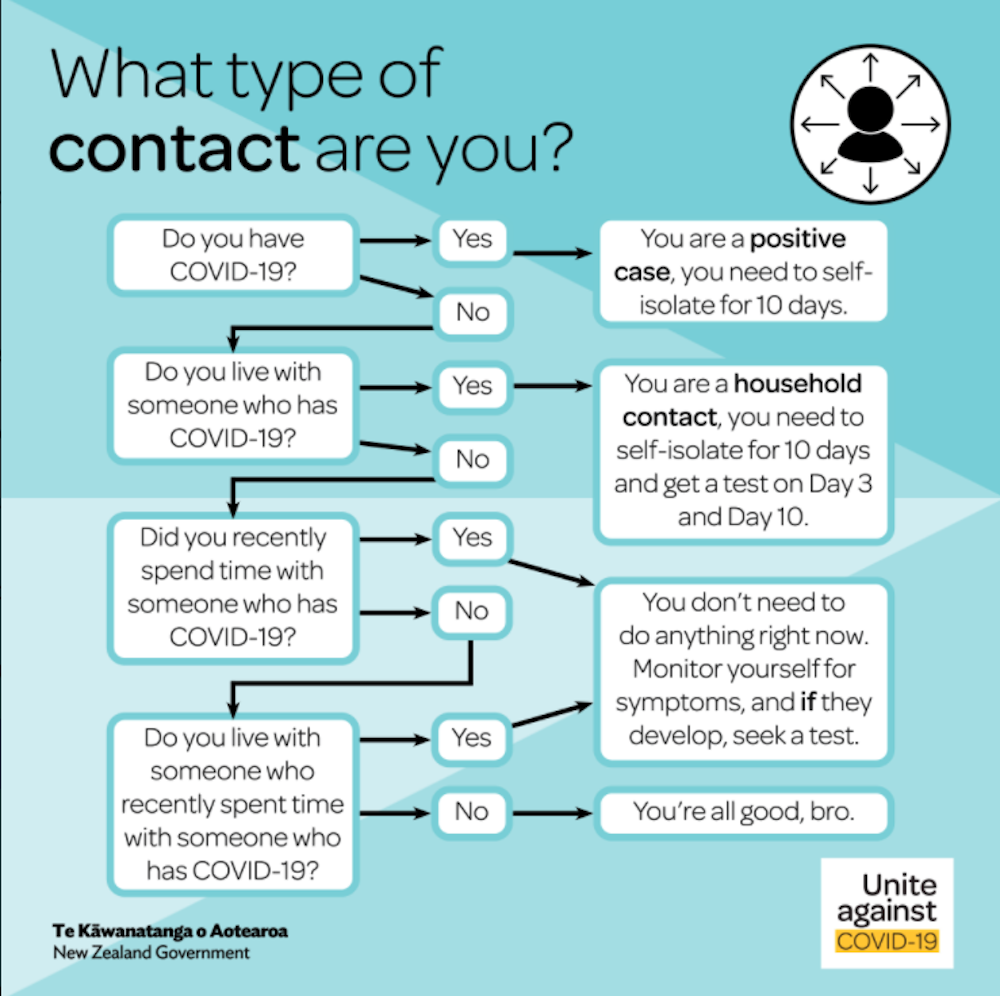
With Aotearoa New Zealand’s move into phase 3[1] of its response to the Omicron outbreak, new definitions and protocols for testing and isolation will mean new ways of measuring the impact of COVID-19.

Broadly speaking, there are two aspects to this new regime. The first relates to the changing definitions of who counts as a close contact, and what their isolation requirements are.

The second concerns testing processes, advice for who should get tested when, what sort of test they should take, and how the result is recorded. Switching to phase 3 means a switch to predominantly using rapid antigen tests (RATs).

Testing policy is important because the number of confirmed or probable cases informs our estimate of the number of underlying infections.

New confirmed cases are a lagging indicator of new infections, but a leading indicator of other important metrics like hospitalisations. The more we know about who is newly infected and where, the better we can plan individual and community responses to the outbreak.

RATs and risk

With the high case numbers[2] we’re now seeing with Omicron, speed is key in returning test results. Quick results mean people can modify their behaviour accordingly and isolate if necessary. The sooner people receive a positive result, the sooner they can notify recent contacts, and those people can also isolate.

When case numbers are high, the risk of a false positive from a RAT is very low. This means the extra value from having a more sensitive PCR test is reduced compared with when we had lower case numbers.

Read more: As New Zealand's Omicron infections rise rapidly, genome surveillance is shifting gears[3]

Conversely, when case numbers in the community are high, there is a risk of false negative results on a RAT for someone who either has symptoms or is a close contact of a confirmed case.

In such cases the prudent course of action would be to take a second test – either another RAT or a PCR test – and to assume there is still a decent chance you may be infected.

People who have no known exposure to a confirmed case, and no symptoms, can be relatively confident in the accuracy of a negative result from a RAT. And regardless of test results, anyone with COVID-like symptoms should be isolating until they recover from whatever is causing those symptoms, COVID or otherwise.

Estimating actual infection numbers

The move to phase 3 acknowledges that infection and confirmed cases are becoming high enough that many of the processes for monitoring and planning will be stretched and may become inaccurate.

As the number of infections rise, we can expect the “case ascertainment rate” (CAR) will start to fall. The CAR is a measurement of the percentage of total infections at a given point in time that are turned into confirmed cases.

Read more: 15 things not to do when using a rapid antigen test, from storing in the freezer to sampling snot[4]

That is, given an observed number of confirmed cases, how many infections do we think are actually in the community, including those that are unconfirmed?

Keeping track of this metric at different stages of the outbreak is important. When isolation requirements for close contacts relax, infections may increase, while fewer people will be eligible for testing.

Or, people may test positive on a self-administered RAT but not report it. Both of these lead to higher numbers of unconfirmed infections.

Why accurate numbers matter

The only way to accurately estimate the CAR is through an “infection prevalence survey”. An example is the UK’s Office of National Statistics (ONS) survey[5], one of the strongest aspects of the UK’s otherwise patchy COVID response.

This randomised survey tries to directly measure the fraction of people who are infected with COVID at any point in time. A well-designed survey makes sure to sample sufficient people in different demographic groups and with different infection risk factors.

Read more: How accurate is your RAT? 3 scenarios show it's about more than looking for lines[6]

Modelling can estimate the number of infections in different populations, subject to different assumptions. But without an infection prevalence survey, or equivalent data, only confirmed cases can be directly observed.

Since confirmed cases are an unknown fraction of total infections, and this fraction changes over time, it’s important to be able to accurately estimate the underlying infection numbers to validate such modelling.

And since infection numbers are a leading indication for hospitalisations, they are valuable for planning adjustments to processes or policies, such as testing or isolation.
Case numbers a fraction of the whole Without an infection prevalence survey it is necessary to fall back on less accurate measures of infection estimates. For example, the fraction of people admitted to hospital who test positive for COVID is an unreliable estimate of infection prevalence because it is biased by a large number of factors that are difficult to control for. Namely, people rarely turn up at hospital for random reasons. Many of the same factors that might drive hospital admissions, even for reasons not directly linked to COVID, are nonetheless related to COVID infection risk. Read more: How accurate is your RAT? 3 scenarios show it's about more than looking for lines[7] As an example of infection prevalence data in action, in early January 2022, the UK recorded an average of around 200,000 daily confirmed cases[8]. The ONS survey estimated just under 4 million[9] people were infected at the time. Details around the length of the survey period during which people might test positive can affect the exact value of the CAR. But the UK figures paint a picture of only a small fraction of infections being detected, even with RATs being provided frequently and free to every household. With access to testing in Aotearoa being more limited than in the UK, we might expect our CAR to be even lower, and hence the number of reported cases is likely to significantly undercount true infections. But without an infection prevalence survey, it’s difficult to tell exactly how much we are undercounting by. Kylie Stewart from Te Matatini o te Horapa[10] contributed to this article. References^ phase 3 (covid19.govt.nz)^ high case numbers (www.rnz.co.nz)^ As New Zealand's Omicron infections rise rapidly, genome surveillance is shifting gears (theconversation.com)^ 15 things not to do when using a rapid antigen test, from storing in the freezer to sampling snot (theconversation.com)^ survey (www.ons.gov.uk)^ How accurate is your RAT? 3 scenarios show it's about more than looking for lines (theconversation.com)^ How accurate is your RAT? 3 scenarios show it's about more than looking for lines (theconversation.com)^ 200,000 daily confirmed cases (coronavirus.data.gov.uk)^ 4 million (www.ons.gov.uk)^ Te Matatini o te Horapa (www.hrc.govt.nz)

Read more https://theconversation.com/nzs-confirmed-covid-case-numbers-are-rising-fast-but-total-infections-are-likely-much-higher-heres-why-177901

Times Magazine

IPECS Phone System in 2026: The Future of Smart Business Communication

By 2026, business communication is no longer just about making and receiving calls. It’s about speed...

With Nvidia’s second-best AI chips headed for China, the US shifts priorities from security to trade

This week, US President Donald Trump approved previously banned exports[1] of Nvidia’s powerful ...

Navman MiVue™ True 4K PRO Surround honest review

If you drive a car, you should have a dashcam. Need convincing? All I ask that you do is search fo...

Australia’s supercomputers are falling behind – and it’s hurting our ability to adapt to climate change

As Earth continues to warm, Australia faces some important decisions. For example, where shou...

Australia’s electric vehicle surge — EVs and hybrids hit record levels

Australians are increasingly embracing electric and hybrid cars, with 2025 shaping up as the str...

Tim Ayres on the AI rollout’s looming ‘bumps and glitches’

The federal government released its National AI Strategy[1] this week, confirming it has dropped...

The Times Features

Australians Can Choose Their Supermarket — But Have Little Independence With Electricity

Australians can choose where they shop for groceries. If one supermarket lifts prices, reduces q...

Sweeten Next Year’s Australia Day with Pure Maple Syrup

Are you on the lookout for some delicious recipes to indulge in with your family and friends this ...

Operation Christmas New Year

Operation Christmas New Year has begun with NSW Police stepping up visibility and cracking down ...

FOLLOW.ART Launches the Nexus Card as the Ultimate Creative-World Holiday Gift

For the holiday season, FOLLOW.ART introduces a new kind of gift for art lovers, cultural supporte...

Bailey Smith & Tammy Hembrow Reunite for Tinder Summer Peak Season

The duo reunite as friends to embrace 2026’s biggest dating trend  After a year of headlines, v...

There is no scientific evidence that consciousness or “souls” exist in other dimensions or universes

1. What science can currently say (and what it can’t) Consciousness in science Modern neurosci...

Brand Mentions are the new online content marketing sensation

In the dynamic world of digital marketing, the currency is attention, and the ultimate signal of t...

How Brand Mentions Have Become an Effective Online Marketing Option

For years, digital marketing revolved around a simple formula: pay for ads, drive clicks, measur...

Macquarie Capital Investment Propels Brennan's Next Phase of Growth and Sovereign Tech Leadership

Brennan, a leading Australian systems integrator, has secured a strategic investment from Macquari...