Russia a 'real threat' to Australia as well, Ukranian president Zelenskyy warns parliament
- Written by: Rowan Nicholson, Lecturer in Law, Flinders University
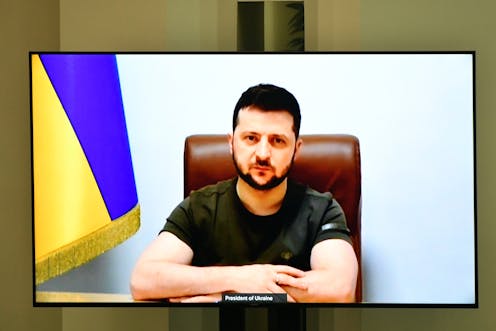
In his speech to the Australian parliament on Thursday evening, Ukrainian president Volodymyr Zelenskyy made an emotional appeal. He also appealed to Australia’s own interest in containing Russian aggression.
The appeals had a purpose: to persuade Australia to do more to support Ukraine against the Russian invasion.
An appeal to Australian emotions
One of Zelenskyy’s techniques was what the classical philosophers called “pathos”: awakening emotions in the hearts of his audience to prepare them to form the desired opinion.
He spoke about cities being shelled, children being killed, and the destruction of an aircraft evocatively called Mriya (“dream”). What matters, he said, is “the dream of bringing back a peaceful life”.
For first-generation Australians who have fled wars in other countries, the images might be viscerally familiar. But they are beyond the experience of most people in Canberra or elsewhere in Australia. Zelenskyy was asking his audience to see the Russian invasion of Ukraine through the eyes of Ukrainians and to feel (rather than intellectualise) the urgency of acting.
In speeches to other parliaments, Zelenskyy has gone further. He has tailored his appeal to their particular history. To the parliament of Japan, a country with its own experience of a nuclear accident, he spoke about Russia’s seizure of Chernobyl[1].
To the Israeli Knesset, he quoted former prime minister Golda Meir, who was born in Kyiv: “We intend to remain alive[2]”.
With Australia, Zelenskyy did not need to reach far back into history. He reminded his audience about a recent episode. In 2014, Russian-backed rebels in eastern Ukraine shot down Malaysia Airlines flight MH17. They killed almost 300 people, including 38 Australians.
Read more: The West owes Ukraine much more than just arms and admiration[3]
An appeal to Australian interests
The reminder about MH17 was an appeal not only to the emotions of Australians, but also to their interests. It reinforced Zelenskyy’s message that if a great power like Russia starts to use violence to achieve goals – instead of peaceful means like law, diplomacy, and trade – then no one is safe. Russia, he said, is “a real threat to your country, to your people as well”.
He added that if the world had punished Russia for its actions in Ukraine in 2014, it would not have been emboldened to invade in 2022: “unpunished evil comes back with inspiration”. This may align with Australian priorities. Since the war began, Australia (with the Netherlands) has launched an international legal action against Russia[4] about MH17.
On the same theme, Zelenskyy highlighted recent statements by Russian officials about the use of nuclear weapons. “Nuclear blackmailing”, he argued, ought to be resisted.
In their introductory remarks, the Australian prime minister and opposition leader emphasised another interest that Australia shares with Ukraine: preserving freedom and democracy. Zelenskyy has described the war in those terms many times. But it was noticeable that, in this speech, he said comparatively little about freedom and democracy.
That may be because he was seeking the best way to cut through to Australians. He perhaps calculated that his audience would be more receptive on a basic human level than to political ideals that, to people who have grown up taking them for granted, might seem abstract.
A plea for action
Zelenskyy expressed thanks for Australia’s efforts to support Ukraine so far, which have included imposing sanctions on Russia and providing military equipment and other supplies.
But the purpose of his speech was not to say “thank you”.
His speeches to parliaments are designed to persuade other countries to provide more support. In some speeches, he has been specific about the help he wants. If he has carried his audience with him up to this point, this is where he might start to lose lawmakers who are thinking about their own countries.
For example, he has asked European nations, such as Denmark earlier this week[5], to stop buying Russian oil and gas. That would come at an economic cost that some are hesitant to pay.
He has also asked the United States and its NATO allies for a no-fly zone. Experts dismiss that option because of the risk of triggering a war between NATO and Russia[6] (and because a war between nuclear-armed powers would be unthinkably worse than other scenarios).
Australia does not depend on Russian oil and gas and does not belong to NATO. That explains why Zelenskyy’s requests for help in this speech were somewhat generic. He asked for more sanctions and more military equipment, such as Bushmaster armoured vehicles. He also foreshadowed that Australia might, one day, be able to help rebuild Ukraine.
Read more: 'I have a need': How Zelenskyy's plea to Congress emphasized shared identity with US[7]
Australia’s response
In response to Zelenskyy’s request, the Australian government announced an additional A$25 million of military assistance to Ukraine. Australia will also take fiercer economic measures, including imposing additional tariffs on imports from Russia and its ally Belarus.
Will that make a big difference? Australia cannot achieve as much as nations with closer links to Russia. But Zelenskyy might hope every extra bit of pressure on Russia will help.
References
- ^ he spoke about Russia’s seizure of Chernobyl (www.nytimes.com)
- ^ We intend to remain alive (www.timesofisrael.com)
- ^ The West owes Ukraine much more than just arms and admiration (theconversation.com)
- ^ an international legal action against Russia (www.theguardian.com)
- ^ Denmark earlier this week (www.thelocal.dk)
- ^ the risk of triggering a war between NATO and Russia (www.nytimes.com)
- ^ 'I have a need': How Zelenskyy's plea to Congress emphasized shared identity with US (theconversation.com)