Sick of packing school lunches already? Here's how to make it easier
- Written by: Lauren Ball, Associate Professor and Principal Research Fellow, Menzies Health Institute, Griffith University
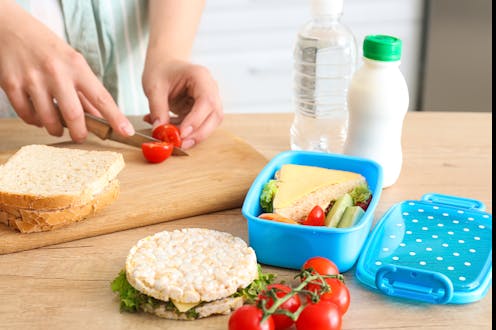
As academics and dietitians, we have a head start in making nutritious choices for our kids, but we also sometimes struggle with lunchboxes.
Even without a pandemic affecting our food supply chains, supporting a healthy diet for your whole family can be difficult.
Common issues include finding time to prepare food, making nutritious food appeal to kids, budgeting with the climbing price of fresh food after natural disasters[1], feeding picky eaters, buying sustainably, and reducing food waste.
On top of all that, there are considerations for food allergies and packing a lunchbox safely for food hygiene.
Read more: Swap shapes for rice crackers, chips for popcorn… parents can improve their kids’ diet with these healthier lunchbox options[2]
One way to improve kids nutrition at schools and reduce parental stress is to move to a system of providing children with school lunches.
Of course, this would come with a cost to taxpayers and, if adopted, would take time to implement.
So what can parents can do in the meantime?
Schools should encourage, not shame
Children’s eating habits are more malleable than adults and for more than a decade of their life, they spend a large proportion of their time at school.
These formative years of education should include[3] skills for children to make healthy choices throughout their lives.
Programs to promote nutritious school lunchboxes[4] are particularly important because can reach diverse groups of children across socioeconomic backgrounds.
Each state and territory has a school lunchbox guide about the types of food to include and avoid (Western Australia[5], Northern Territory[6], Queensland[7], New South Wales[8], Australian Capital Territory[9] Victoria[10], South Australia[11] and Tasmania[12]).
But following these guides can also be a challenge for parents. Some schools may “audit” lunchboxes and return home food that doesn’t comply with the guidelines, causing feelings of shame for some families[13].
Schools should consider providing food for children
Many countries around the world have school lunch programs that provide food to kids, meaning families don’t need to pack a lunchbox each day.
Brazil[14] has the longest running program, starting back in 1954, and India[15] has one of the largest, feeding lunch to 140 million children in a year.
Depending on the country, these programs cost the government between US$54 and US$693[16] per child per year.
It’s something Australian policymakers should consider to equitably improve kids’ nutrition across the board and tackle childhood obesity. Among OECD countries, Australia ranks ninth[17] for obesity prevalence, with a rate of 34% among children aged five to 19.
Japan[18] stands out as the gold standard of programs. The school menus are planned by nutritionists, focusing on a balance of fresh, seasonal food including greens and seafood. Children are taught to respect the value of their food, how to prepare it safely, and understand where it comes from.
Japan’s universal school lunch programme has helped close the socioeconomic gap[20] in fruit and vegetable intake in Japanese children.
With the lowest incidence of childhood malnourishment and obesity in OECD countries, Japan presents an ideal case for implementing school-based food programs.
The NSW and Victorian governments[21] do currently have breakfast “clubs” or programs for children, and both have plans for expansion to feed more children.
However a universal school-provided lunch model[22] is needed to improve the health and well-being rankings of our children. Research shows[23] insufficient government support is a barrier to such a model.
So what can parents do now?
Here are our top tips for reducing parents’ lunchbox anxiety and increasing the healthiness of kids’ lunches:
Plan for the week ahead: Use the weekend to plan and shop for lunchboxes and make what you can ahead of time. Wash and cut up fruit and veggie sticks, bake with your kids, or make sandwiches with fresh bread and freeze individually, ready for kids to pull one out each day.
Involve your kids: Encourage your kids to make their own lunch from as young an age as possible. This will help their food knowledge and independence. Help them to choose items from each food group and category (for example, a fruit, a vegetable, sandwich or wholegrain crackers, cheese or yogurt). An added benefit is they will be more likely to want to eat the food they pack.
Read more: Forget quinoa and kale, these basic foods for your kids' lunch box will give them the nutrition they need[24]
Reduce pre-packaged foods: Packaged, highly processed foods such as muesli bars and chips are often high in salt and saturated fat, and low in fibre and nutrients. Replace these with fresh fruit or vegetables, homemade dips, seeds, popcorn, wholegrain rice crackers or boiled eggs.
Balance cost with convenience: It’s cheaper to buy in bulk and prepare items for your kid’s lunches, but if cost is not an issue, save time by buying items pre-prepared. For example, you can buy block cheese and slice yourself, but pre-sliced cheese will save time. Having suitable containers available to store items will make your life easier and will also benefit the environment through minimising single-use plastics.
Give your kids lunchbox accountability: Being responsible for what comes out of a lunchbox is just as important as what goes into it. When your kids come home from school, make it their responsibility to dispose of spoiled food and clean their containers. Also, if the food is still good, put it out on the table as afternoon tea, or as a pre-dinner snack.
References
- ^ natural disasters (www.abc.net.au)
- ^ Swap shapes for rice crackers, chips for popcorn… parents can improve their kids’ diet with these healthier lunchbox options (theconversation.com)
- ^ should include (ijbnpa.biomedcentral.com)
- ^ school lunchboxes (www.tandfonline.com)
- ^ Western Australia (www.waschoolcanteens.org.au)
- ^ Northern Territory (education.nt.gov.au)
- ^ Queensland (education.qld.gov.au)
- ^ New South Wales (education.nsw.gov.au)
- ^ Australian Capital Territory (www.health.act.gov.au)
- ^ Victoria (heas.health.vic.gov.au)
- ^ South Australia (www.sahealth.sa.gov.au)
- ^ Tasmania (www.education.tas.gov.au)
- ^ families (www.abc.net.au)
- ^ Brazil (pulitzercenter.org)
- ^ India (pubmed.ncbi.nlm.nih.gov)
- ^ US$54 and US$693 (journals.sagepub.com)
- ^ ninth (www.unicef.org)
- ^ Japan (www.unicef.org)
- ^ Shutterstock (www.shutterstock.com)
- ^ close the socioeconomic gap (www.researchgate.net)
- ^ NSW and Victorian governments (theconversation.com)
- ^ universal school-provided lunch model (www.mdpi.com)
- ^ Research shows (www.mdpi.com)
- ^ Forget quinoa and kale, these basic foods for your kids' lunch box will give them the nutrition they need (theconversation.com)
- ^ How to keep school lunches safe in the heat (theconversation.com)