The story of 'us': there's a great tale Labor could tell about how it would govern
- Written by: Frank Bongiorno, Professor of History, ANU College of Arts and Social Sciences, Australian National University
Election campaigns are exercises in storytelling. Yes, they are about images, but these are usually attached to words. The stories are not normally outright lies, although we’ll certainly see a few of those on the way to May 21. Rather, the campaigners engage in a kind of creative non-fiction, with coloured illustrations; or perhaps costume drama for television.
That job of storytelling is a particularly difficult one for an opposition. Inevitably, there is a whole aspect of the work it has done over the years that will be of little or no interest to voters. “We have held the government to account for the last nine years”, won’t cut it. Oppositions need to look elsewhere for material, but they lack a story of incumbency – of doing things – to narrate.
The politics of the pandemic have ensured that for long periods, the opposition leader will have been invisible to most members of the public. It was the prime minister, along with the state premiers, who stole the show.
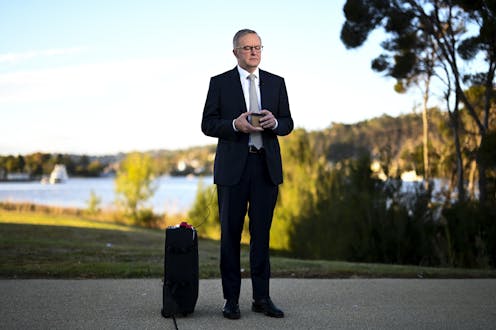
So what story might Labor and Anthony Albanese tell, now that the election campaign has started?
Read more: View from The Hill: Morrison talks risk, Albanese spruiks opportunity, in opening pitches[1]
Tell the story of ‘us’
Labor could present the story of Australia’s pandemic as a grand collective achievement, one that expressed the intelligence, adaptability and resilience of the Australian people. It was an achievement in which nurses, doctors and other health professionals kept the hospitals and aged care residences running, teachers, academics and support staff strained to ensure students continued to learn in front of their screens, and workers, business-owners and assorted professionals kept the economy going. People cared for family, friends and neighbours.
Albanese might argue that “our achievement” – it must be framed this way – is an indication of what government and people can do together in the uncertain times we face. Albanese could underline that Labor governments are not about doing things for or to people. They are about doing things with people.
Labor, he might say, will continue to work with Australians to take forward the spirit they showed in the pandemic in meeting the many challenges ahead – challenges that will require greater competence, capacity and faith in ordinary Australians than any federal government has shown for a generation or more. (Yes, Labor should be willing to engage in self-criticism.)
This would be a message about collective endeavour consistent with the most traditional of Labor values. It is consistent, too, with Australia’s long history of democracy.
Governments have never achieved anything much in this country without the mobilisation of people with energy and ideas behind change. This was as true of the movements for democratic and social reform of the 1840s and 1850s, for federation and labour reform in the 1890s and 1900s, for postwar reconstruction in the 1940s, and for the massive transformation in social, cultural and economic policy from the late 1960s through to the mid-1990s.
There are other reasons why this should be Labor’s message. It is clear Scott Morrison’s pitch at this election is to present his government as a sometimes imperfect but mainly successful custodian of the public interest through difficult times. His slogan might as well be: I saved you from the pandemic and the recession. He has appealed to voters’ selfhood, and perhaps their self-interest.
The election, he says, is about “you”. Labor should not underestimate the possible resonance of this appeal, but Albanese might say instead that this election – and all elections – are about “us”.
Yes, the government failed in vaccine procurement, and then vaccination itself, and then in securing a supply of testing kits. It failed in aged care. It handed out a vast sum of money to businesses that didn’t need it, and it refused to support the universities and the arts. Morrison is telling people he saved 40,000 lives, but if he had had his way at various moments during the pandemic, it would likely have killed many more people than it did.
However, there is little point in Labor getting down into these weeds now. People don’t want another fight between politicians about COVID-19. Nor is it likely they want contention over the recent performance of the economy. Labor will likely lose an argument about the economy that deals with macro-issues: the old mantra of jobs and growth. All things considered, on these measures the economy has done much better in recent times than any commentators could have predicted in the first year of the pandemic.
Labor, on the other hand, will draw attention to the failure of the economy and government to deliver wages growth, ensure affordable goods, services and housing, and provide dignity to the elderly in care.
Labor’s message must always be that lives were saved, and the economy weathered the storm, because with the government support they deserved, communities showed a remarkable self-discipline, and worked hard and smartly in adversity. They did what governments asked of them, and what their fellow-citizens needed of them – to protect themselves and their families, and for the common good. It would be hard to imagine a more “Labor” message.
Read more: How Labor can win the 2022 election[2]
Resist taking the low road
There will be plenty of mud thrown about in this campaign, and the temptation to negative campaigning and scaremongering will be strong as usual. It is obvious, for instance, the parties’ research is telling them that Morrison’s jaunt to Hawaii has stuck in voters’ minds, as an example and a symbol of the wider frailties of his leadership. Albanese reminded voters not to forget Hawaii on the day the campaign was called. Penny Wong did the same on ABC Radio on the following day.
Labor would do well to stop this. Voters do not need to be reminded of Hawaii – it is already implanted in the minds of anyone who is ever likely to be interested in it. What voters do need to be reminded of is that Labor believes in rebuilding the capacity of a federal government to work with the Australian people to grapple with the nation’s challenges.
That capacity was often found wanting over the last two years, and the reason for that deficiency is a story much larger than that of the Morrison government, or even the Liberal-National Party government of the period since 2013.
It is the product of a bipartisan leaching of government capacity over several decades. If there is to be a change of government, voters will need assurance that Anthony Albanese and his team – but also the federal government in the widest sense – are up to meeting the worst that the years ahead will throw at us all.
References
- ^ View from The Hill: Morrison talks risk, Albanese spruiks opportunity, in opening pitches (theconversation.com)
- ^ How Labor can win the 2022 election (theconversation.com)