How the election could affect the future of a First Nations Voice to Parliament
- Written by: Eddie Synot, Lecturer, Griffith Law School, Griffith University
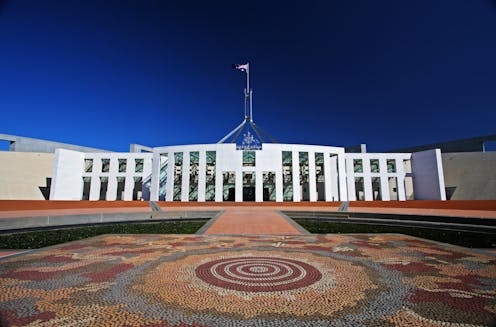
The result of the federal election will be key for a voice to parliament protected by the Constitution as called for by the Uluru Statement from the Heart[1]. The election will also be crucial for Indigenous affairs more broadly.
The Uluru Statement calls for structural reform of the Australian Constitution. This means a First Nations Voice to Parliament so Indigenous peoples can be appropriately recognised and have a say about the laws and policies that affect them. The second step of the Uluru Statement is a Makarrata Commission to oversee a process of agreement-making (treaty) and truth-telling.
Scott Morrison acknowledged significant problems with past government approaches to Indigenous affairs in his 2019 Closing the Gap[2] address. Morrison promised to do things differently,
“Despite the best of intentions; investments in new programs; and bi-partisan goodwill, Closing the Gap has never really been a partnership with Indigenous people. We perpetuated an ingrained way of thinking, passed down over two centuries and more, and it was the belief that we knew better than our Indigenous peoples. We don’t.”
Following details of these failures, including how closing the gap targets have been set, Morrison promised,
“There remains much to do. And we will do it differently”
Morrison’s promise however has proven lacklustre. This is despite the much-praised Council of Australian Governments partnership[3] with the Coalition of Aboriginal and Torres Strait Islander Community-Controlled Peak Organisations (the Coalition of Peaks). This partnership produced the re-negotiated closing the gap agreement[4].
Despite these promises, First Nations communities have witnessed much of the same, with advice being ignored and funding cut. Pat Turner[5], CEO of the National Aboriginal Community Controlled Health Organisation, described the recent budget as “business as usual” that won’t help close the gap.
Read more: Non-Indigenous Australians shouldn't fear a First Nations Voice to Parliament[6]
The current government’s plans around a voice to parliament
The current government has made its intention to pursue a legislated voice to government clear. This was confirmed with A$31.8 million[7] being allocated in the budget to the next stage of local and regional voice structures following the government’s final Voice Co-Design report. If the government is re-elected, we can expect voice legislation to be introduced.
The pursuit of a legislated body before constitutional reform is a mistake[8]. It is contrary to the Uluru Statement[9] and the support that was received by the government’s own process for constitutional enshrinement.
The government legislating a model without first enshrining the First Nations Voice in the Constitution ignores how important structural reform is. Australia’s institutions can only make real and lasting change in Indigenous affairs by empowering First Nations people to achieve meaningful and effective treaty and truth-telling outcomes.
However there are issues with the government’s Voice Co-Design report[10] and the limited legislated voice model it is pursuing. The proposed model will gag Indigenous communities by restricting what they can and can’t raise to the national level. This means issues that involve local or state matters cannot be elevated to the national body. Elevating matters to the national body and using its position and resources may be exactly what is required to force change.
The current proposed models state the government will decide what is a local issue and when advice may be given. This will further entrench Indigenous dis-empowerment and limit government accountability.
The 1967 referendum[11] was supposed to address this very issue. The Commonwealth were given the power by the most successful referendum in Australian history to legislate for Indigenous peoples and address the failure and inaction of state governments. And yet the federal government will not make use of this power to support First Nations voices in state governments.
Where does Labor stand?
The opposition under Anthony Albanese and Linda Burney has promised to implement the Uluru Statement from the Heart in full. This was confirmed in Albanese’s budget reply speech[12] where the opposition leader stated,
“I want to build a strong Australia […] An Australia that embraces the generous Uluru Statement from the Heart, including a constitutionally recognised Indigenous Voice to Parliament.”
Labor has said it is committed to a referendum in its first year of parliament but has said it would look to simultaneously pursue the implementation of a Makarrata Commission[13]. This is problematic because this does not follow the sequence set out in the Uluru Statement from the Heart.
Beginning a Makarrata Commission in the current climate would mean relying on the same institutions Indigenous affairs are currently having issues with. One example of this is the new closing the gap agreement with the Coalition of Peaks that has been mostly ignored. As a result, gaps in health, education and socio-economic status in First Nations communities continue to exist.
Labor has made other promising commitments since the last federal election. These include earlier promises to end[14] the cashless welfare card and the Community Development Program[15]. The Community Development Program has forced generations of unemployed Indigenous peoples to work for less than minimum wage to receive support. It’s being scrapped by the government in favour of a new employment program in 2023[16] but with little detail or promise of being any better for Indigenous communities.
Many have doubts over Labor’s commitments, particularly with strong memories of Labor’s continuance of the widely condemned Northern Territory Intervention[17]. The Intervention, in response to conflated reports of child sex abuse in communities, communities that had otherwise been asking for the resources to address these issues over decades, saw the Australian Army sent into Indigenous communities without notice.
The Intervention forced the handover, management and leasing of Indigenous property and communities. It put in place strict restrictions on movement and prohibited goods such as alcohol and pornography, while also implementing strict income management. Despite the many known problems and backlash from the community, Labor continued the program under the new “Stronger Futures”[18] program in 2012.
Read more: Indigenous recognition is more than a Voice to Government - it's a matter of political equality[19]
The Greens and Independent parties
The Greens have troublingly revised[20] their support for the Uluru Statement, after handing their Indigenous affairs portfolio to Lidia Thorpe. This has resulted in the Greens insisting on a reversal of the sequence of reforms (Truth, Treaty and Voice rather than Voice, Treaty and Truth). Something contrary to the Uluru Statement and evidence of what will work in the Australian context.
Most independents [21] are supportive of the Uluru Statement and have expressed their commitment publicly. This commitment is also shared with a general commitment to achieve lasting reform in Indigenous affairs.
National leadership on the Uluru Statement and Indigenous affairs is important if we are to make lasting, meaningful change. Unfortunately, the federal government has been actively limiting its role while disingenuously emphasising the importance of state and local groups. These groups are then heaped with the burden of responsibility without genuine empowerment, government support or resources to achieve change.
Professor Megan Davis has written[22] on this phenomenon. This policy practice sees the federal government walk back from their leadership in Indigenous affairs, something that was hard fought for in the successful 1967 referendum. Michael Dillon[23] from Australian National University’s Centre for Aboriginal Economic Policy Research explains that:
“It is the culmination of a decade-long push to shift Indigenous policy responsibilities away from the Commonwealth and towards the states and territories, and away from Indigenous-specific programs and towards mainstream programs.”
States and territories are doing some good work, including work towards treaty in Victoria, Queensland and the Northern Territory. Victoria is often said to be the only jurisdiction moving ahead with the Uluru Statement reforms. The new Malinauskas government in South Australia has recently made similar promises.
However, the Uluru Statement is deliberately a federal reform – it is a reform of our nation, and no state or territory can implement that alone. The reality of our political, legal and cultural institutions is woven with the character of our nation, including its hierarchical makeup.
Whoever wins the coming election will need to actively lead on improving Indigenous affairs if we are to make meaningful and lasting change.
References
- ^ Uluru Statement from the Heart (ulurustatement.org)
- ^ 2019 Closing the Gap (www.pm.gov.au)
- ^ partnership (coalitionofpeaks.org.au)
- ^ agreement (www.closingthegap.gov.au)
- ^ Pat Turner (www.theguardian.com)
- ^ Non-Indigenous Australians shouldn't fear a First Nations Voice to Parliament (theconversation.com)
- ^ A$31.8 million (ministers.pmc.gov.au)
- ^ mistake (theconversation.com)
- ^ Uluru Statement (ulurustatement.org)
- ^ report (voice.niaa.gov.au)
- ^ 1967 referendum (aiatsis.gov.au)
- ^ budget reply speech (anthonyalbanese.com.au)
- ^ Makarrata Commission (www.lindaburney.com.au)
- ^ end (www.abc.net.au)
- ^ Community Development Program (theconversation.com)
- ^ new employment program in 2023 (www.theguardian.com)
- ^ Northern Territory Intervention (theconversation.com)
- ^ “Stronger Futures” (www.dss.gov.au)
- ^ Indigenous recognition is more than a Voice to Government - it's a matter of political equality (theconversation.com)
- ^ troublingly revised (theconversation.com)
- ^ independents (www.zalisteggall.com.au)
- ^ written (www.themonthly.com.au)
- ^ Michael Dillon (insidestory.org.au)