Climate bill front and centre when parliament starts but it's the least of Albanese's problems
- Written by: Michelle Grattan, Professorial Fellow, University of Canberra
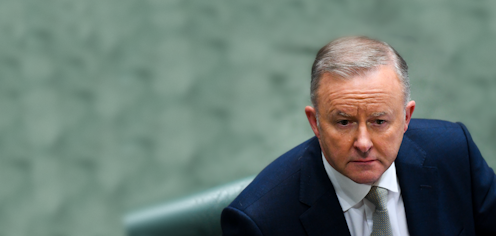
If you’re outside staring in, you’d probably say the Albanese government is looking good. If you’re inside gazing out, you’d likely think its challenges appear little short of dire.
Next week the new parliament will commence with a fortnight’s sitting. There’ll be focus on the government-Green negotiations on the legislation for Labor’s 43% climate target. But it’s the economy and COVID that will actually be the more immediately worrying issues.
Treasurer Jim Chalmers, perhaps with an eye to the politics, has been using a megaphone to say he’ll have bad news when he gives a state-of-the-economy address to the House of Representatives on Thursday – a day after the release of the latest inflation figure, expected to be a shocker.
The revised economic projections will be affected by a range of factors, including to an extent the current, still-worsening, COVID wave, which governments are trying to manage without the imposition of restrictions people would no longer accept.
As we confront this wave, it would be desirable for the new parliament to have a repeat of the COVID Senate committee that did good work in the last term in questioning officials and extracting information.
Determined to show it is serious about its promises, the government released on Wednesday a list of the first pieces of legislation it will introduce.
These are bills for aged care reform, a new jobs and skills statutory body, domestic violence leave, and the climate change target. The integrity commission legislation will wait for the September sitting.
Bringing in the bills is the easy bit. Take aged care. The government says its legislation “will put nurses back into nursing homes, it will put a stop to high administration and management fees for home care [ .. ] and it will improve integrity and accountability for residential aged care homes”.
But finding all the needed nurses – to say nothing of the increased number of other staff vital for effective reform – will be enormously difficult.
Those who might have seen Labor’s win as an end to our national climate wars were prematurely optimistic. Ironically, the early days of the new parliament will see another stage in this battle.
Labor doesn’t need to legislate its new target, but wants to do so to underline its intentions and send strong signals to investors and the world in general. To get the legislation through will require the support in the Senate of the Greens and one more senator.
The Greens party room on Wednesday reiterated its view that Labor’s policy is not ambitious enough, but gave leader Adam Bandt authority to negotiate.
After the meeting the Greens said: “Areas of concern remain the adequacy of the target, the need for targets to be ratcheted up and for the bill to operate as a floor not a ceiling, the lack of enforcement mechanisms, and new coal and gas projects that would lift pollution.”
One Greens source says “we’re at the diplomacy table, not in the trenches”.
Labor has indicated it is open to tinkering with detail but won’t budge on core substance. There will be no change in the target, no ban on new mines.
The government can’t afford to make sizeable concessions to the Greens, not least because that would cast doubt on the reliability of its word. It is also anxious to signal it is not hostage to the Greens, despite its dependence on them in the upper house when legislation is contested.
Can the Greens afford to give in to the government and not oppose the bill? They would disappoint their hard-line supporters. They too, in political terms, need differentiation. But if they were to sink the legislation, they’d be accused of putting purist ideology ahead of supporting progressive policy. The Greens have quite a lot on the line in their decision.
All this will take some time to play out. The legislation could go to a Senate committee. The final vote could be a way off.
The Coalition’s “internals” on the climate legislation will be interesting. Peter Dutton has flagged his opposition. “I’m making it very clear to the Labor Party now that we aren’t supporting the legislation,” he told the ABC in June. The much-reduced Liberal moderates are not happy with that “captain’s call” ahead of the party-room discussion. There is speculation one or two might cross the floor.
And what about the teals? Their votes are irrelevant in the lower house, but crossbencher David Pocock’s vote might be needed in the Senate. The government will want to be polite to the teals, but in the end it’s the numbers that count.
The parliamentary fortnight will be closely observed for its tone, its “vibe”, as well as its substance.
While the teals and other crossbenchers won’t be determining outcomes in the House of Representatives, the crossbench there, now numbering 16, will have a significant presence, including a reasonable opportunity to quiz and critique ministers.
When parliament is sitting an opposition has a platform, but the Coalition will be struggling to make the most of it, at least in the foreseeable future.
Dutton has a ragtag bunch to manage, with senior people having trouble finding their feet in their straitened political circumstances. There are still major arguments to be had about how the opposition positions itself.
This is not uncharted ground. Labor faced the same situation after its 2019 defeat when it was even more shattered, because the loss was unexpected. The lesson for Dutton (though it would go against the grain) should be to stay low-key for a while until he’s listened and thought things through. It’s a long road to the next election.
Presently the opposition is speaking with conflicting voices on current issues – for example, it has been divided over whether the border to Bali should be closed to keep out foot and mouth disease.
The government will spruik its own plans in parliament but it will also keep reminding the public of criticisms of the Morrison government. This will complicate the opposition’s attempts to pursue ministers. For instance, it would be logical for the opposition to home in on Minister for Aged Care Anika Wells, given the COVID crisis in residential facilities. But Labor would quickly hark back to the record of former minister Richard Colbeck.
In various areas, the government will be arguing “we can’t turn around a decade of neglect immediately”. That’s true enough although this crutch will reach its use-by date with many voters fairly soon. And it’s not just neglect the Albanese government is grappling with – fresh problems are emerging all the time.
Once Albanese sits in the PM’s chair at the parliamentary dispatch box, the reality of “accepting responsibility” will take on a new intensity.