


Albanese takes welcome first step but government needs to produce Voice detail
- Written by: Michelle Grattan, Professorial Fellow, University of Canberra
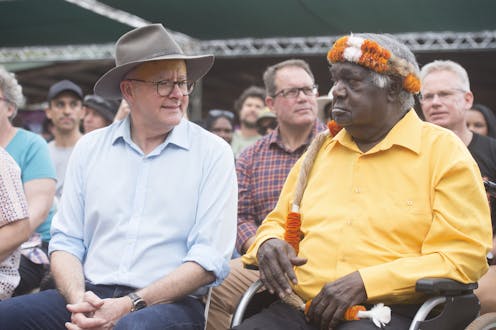
Prime Minister Anthony Albanese has made a good start on his push to enshrine an Indigenous Voice in the Constitution. But we shouldn’t delude ourselves: the path to success remains difficult, and hard decisions will have to be made on the journey.
Albanese’s mantra is: keep everything simple. This applies to the question. The content to be inserted into the constitution. And, on what he has been saying, the amount of detail the government needs to commit to before the referendum.
He told the ABC on Sunday he was trying to avoid the situation of the failed 1999 republic referendum with “people looking for all of the detail and saying, ‘Well […] if you disagree with one out of the 50 [clauses] but 49 are okay, vote no’”.
But it would be unwise to gamble on success coming from a wave of support for something that looks to be fair and just, but is vague and to be filled in later.
As in many complex matters, the devil is in the detail. The structure of the Voice should be worked out at an early stage.
We’ll return to why this is so. But on the positive side, Albanese’s proposed amendment to the constitution, which he announced at the Garma festival, covers the necessary bases.
It reads: “There shall be a body, to be called the Aboriginal and Torres Strait Islander Voice. The Aboriginal and Torres Strait Islander Voice may make representations to Parliament and the Executive government on matters relating to Aboriginal and Torres Strait Islander Peoples. The Parliament shall, subject to this Constitution, have power to make laws with respect to the composition, functions, powers and procedures of the Aboriginal and Torres Strait Islander Voice.”
The Voice would be able to make representations on what could be a wide range of matters. Indeed, it could argue most policies affect Indigenous people, although it probably would have greater clout if it kept its attention more narrow.
The wording also puts beyond any doubt the ultimate say belongs to parliament. Parliament would set the shape of the Voice, and the Voice’s role would be as advisor and advocate. Its advice could be rejected. It would have the potential to be very influential, but there is no confusion – it would not be some sort of “third chamber”, as critics have tried to claim.
Albanese’s draft question for the referendum ballot paper is also clear and uncluttered: “Do you support an alteration to the Constitution that establishes an Aboriginal and Torres Strait Islander Voice?”
So why can’t the plan for the Voice stay minimalist in the run up to the referendum? For multiple reasons.
Referendums are extremely hard to pass and seldom do. They have to achieve an overall majority of voters and a majority in four of six states. Since federation, only eight out of 44 questions have passed.
One of the messages from these results is that when people are unsure, they vote no. While there is a danger of detail putting some people off, there is a bigger risk in a lack of it. (This detail, it should be stressed, would not go into the constitution itself.)
Bipartisanship is usually considered a basic necessity for success. Opposition Leader Peter Dutton has not closed off the option of the Coalition supporting the referendum. But there will be division in its base, and it is significant that high profile new Indigenous senator Jacinta Nampijinpa Price is a sceptic, saying the issue is being “driven by elites”.
It is extremely unlikely there would be any chance of the opposition signing up – if it signs up at all – without detail.
Many voters will want detail too, as indeed will many Indigenous people, among whom there are also differences of opinion.
They will want to know, crucially, how the Voice will be chosen. Minister for Indigenous Australians Linda Burney says it will be elected. It will be important to get some precision about the system of election, given the complicated map of First Nations Australia.
Also, how the Voice will be run, the processes for gathering the views of the multitude of First Nations communities and presenting them to government and parliament, and the governance arrangements for the organisation, all should be flagged.
There have been extensive consultative processes in recent years, and most recently a 2021 report to the former government from Tom Calma and Marcia Langton. So it is not as if building blocks are not available – it is a matter of the government putting forward a structure.
Two very bad things could happen as we move along this path.
First, the referendum could fail, after a bitter campaign. That would leave the nation, and especially its Indigenous people, worse off than before. It would be a stain on Australia.
Second, the Voice could be established but then itself failed, because it didn’t operate properly, imploded internally, or could not convince governments.
Those who think this couldn’t happen should look at what has been a depressing history – and under well-intentioned Labor governments.
The Whitlam government established the National Aboriginal Consultative Committee, only for that body and the government to fall out disastrously.
The Hawke government set up the Aboriginal and Torres Strait Islander Commission (ATSIC). An ambitious project, ATSIC had both representational and administrative powers. The high hopes for it were dashed, when corruption and other issues led to both sides of politics losing faith in it.
The history doesn’t tell us a Voice can’t be a creative force for recognition, reconciliation, and progress on achieving better outcomes for disadvantaged Indigenous people.
It does tell us this will only happen if there is a robust model, fireproofed against failure. The public, including and especially the Indigenous public, deserve to be fully informed about how this model will work before they vote.










