The Times Australia
Google AI
The Times World News

.

Linguistics locates the beginnings of the Austronesian expansion – with Indigenous seafaring people in eastern Taiwan

  • Written by Victoria Chen, Senior Lecturer, Te Herenga Waka — Victoria University of Wellington

Linguistics locates the beginnings of the Austronesian expansion – with Indigenous seafaring people in eastern Taiwan

The study of Indigenous languages spoken in maritime South-East Asia today has shed new light on the beginnings of the Austronesian expansion. This was the last major migration of people spreading out across the Pacific Ocean and, ultimately, settling Aotearoa.

Scientists all agree that people speaking Austronesian languages started out from Taiwan and settled the Philippines around 4,000 years ago. They used sails as early as 2,000 years ago[1]. Together with other maritime technologies, this allowed them to disperse to the islands of the Indo-Pacific ocean.

There they assimilated with existing populations and eventually reached as far as Easter Island to the east, Madagascar to the west, Hawaii to the north and New Zealand to the south.

This map shows the direction of the Austronesian expansion from Taiwan into the Pacific.
This map shows the direction of the Austronesian expansion from Taiwan into the Pacific. PNAS 112/44 Matisoo-Smith et al, CC BY-ND[2][3]

But linguists had found little evidence about where precisely the migration started and which Indigenous group was involved in the expansion.

Our new research[4] provides this missing linguistic evidence, based on an overlooked grammatical affix. It suggests the Amis of eastern Taiwan are the closest relative of the Malayo-Polynesian people (including Māori) in the Austronesian language family.

This finding complements recent research in archaeology and genetics, which also suggests the Austronesian expansion likely began along the east coast of Taiwan. Contemporary Indigenous groups in this part of Taiwan are known to have long-standing seafaring traditions.

Landscape image showing a small settlement.
The Amis of eastern Taiwan are the closest relative of the Malayo-Polynesian people, including Māori. Author provided

The Austronesian language tree

Austronesian is the second-largest language family in the world. Austronesian languages are spoken from Madagascar to Polynesia, including te reo Māori, and have been the focus of considerable research. But many basic questions remain about the origin and primary dispersal of this language group.

The consensus over the past 50 years had been that Malayo-Polynesian is an Austronesian primary branch with no identifiable closer relationship with any language in the homeland:
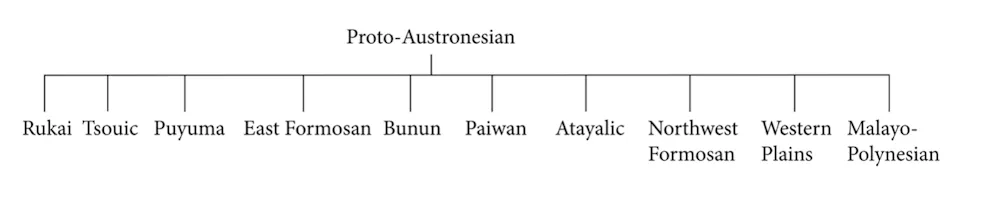
However, archaeological evidence indicates a 1,000-year pause[5] prior to the migration[6]. This suggests Malayo-Polynesian should have split off from a certain Indigenous group in Taiwan, rather than starting up as an independent branch. In our research, we discovered new evidence relating to Malayo-Polynesian’s root. It comes from a special use of the grammatical affix ma in four Indigenous Austronesian languages. Spreading along the east coast of Taiwan, all four languages (Amis, Kavalan, Basay-Trobiawan, Siraya) show a special use of ma that allows the actor of an action to be included in the sentence, for example: Amis: Ma-curah ni Kulas ku lumaq. Kulas burned the house. This sentence structure is strictly banned in all other Indigenous languages of Taiwan, but is widely observed in Malayo-Polynesian languages. Tagalog: Ma-sunog ni Kulas ang bahay. Kulas will burn the house. Strong seafaring traditions Intriguingly, all four languages have known seafaring traditions, and all belong to the East Formosan primary branch of Austronesian. Their shared use of ma with Malayo-Polynesian thus suggests a new subgrouping in which these two groups share a common origin. This hypothesis suggests the East Formosan people – including the Amis[7], the largest Indigenous group of Taiwan – are most closely related to Malayo-Polynesian, including Māori, in the Austronesian homeland. It also traces the starting point of Austronesian expansion to eastern Taiwan, where three of these four languages are still spoken today. Read more: What wind, currents and geography tell us about how people first settled Oceania[8] Our findings point to a revised linguistic subgrouping more consistent with the socio-historical view that a seafaring community began the out-of-Taiwan expansion. It coincides with recent findings in archaeology, which put the starting point of the Austronesian expansion[9] in eastern Taiwan[10]. It also aligns with three recent genetic studies[11]. All three reveal a particularly close connection[12] between the Amis and Malayo-Polynesian populations. Read more: Who were the Toaleans? Ancient woman's DNA provides first evidence for the origin of a mysterious lost culture[13] Exclusively shared vocabulary between Amis and Malayo-Polynesian languages lends further support to this idea. The Amis word poki for vagina, for example, is etymologically unrelated to equivalent words found in other Austronesian languages of Taiwan. Instead, it has the same linguistic derivation as the corresponding words in various Malayo-Polynesian languages. Papora (Taiwan) huci, Thao (Taiwan) kuti, Bunun (Taiwan) kuti, Paiwan (Taiwan) kutji, Puyuma (Taiwan) kuti. Amis (Taiwan) poki, Tagalog (Philippines) púki, Malay (Malaysia) puki, Javanese (Indonesia) puki, Tetun (Timor) huʔi-n, Gitua (Papua New Guinea) pugi. Future investigation of more shared traits between Malayo-Polynesian and East Formosan languages will shed further light on their relationships. References^ sails as early as 2,000 years ago (www.jstor.org)^ PNAS 112/44 Matisoo-Smith et al (www.pnas.org)^ CC BY-ND (creativecommons.org)^ new research (benjamins.com)^ 1,000-year pause (www.jstor.org)^ prior to the migration (www.wiley.com)^ the Amis (en.wikipedia.org)^ What wind, currents and geography tell us about how people first settled Oceania (theconversation.com)^ starting point of the Austronesian expansion (openresearch-repository.anu.edu.au)^ eastern Taiwan (www.journals.uchicago.edu)^ genetic studies (www.sciencedirect.com)^ close connection (www.nature.com)^ Who were the Toaleans? Ancient woman's DNA provides first evidence for the origin of a mysterious lost culture (theconversation.com)

Read more https://theconversation.com/linguistics-locates-the-beginnings-of-the-austronesian-expansion-with-indigenous-seafaring-people-in-eastern-taiwan-186547

Times Magazine

Shark launches SteamSpot - the shortcut for everyday floor mess

Shark introduces the Shark SteamSpot Steam Mop, a lightweight steam mop designed to make everyda...

Game Together, Stay Together: Logitech G Reveals Gaming Couples Enjoy Higher Relationship Satisfaction

With Valentine’s Day right around the corner, many lovebirds across Australia are planning for the m...

AI threatens to eat business software – and it could change the way we work

In recent weeks, a range of large “software-as-a-service” companies, including Salesforce[1], Se...

Worried AI means you won’t get a job when you graduate? Here’s what the research says

The head of the International Monetary Fund, Kristalina Georgieva, has warned[1] young people ...

How Managed IT Support Improves Security, Uptime, And Productivity

Managed IT support is a comprehensive, subscription model approach to running and protecting your ...

AI is failing ‘Humanity’s Last Exam’. So what does that mean for machine intelligence?

How do you translate ancient Palmyrene script from a Roman tombstone? How many paired tendons ...

The Times Features

5 Cool Ways to Transform Your Interior in 2026

We are at the end of the great Australian summer, and this is the perfect time to start thinking a...

What First-Time Buyers Must Know About Mortgages and Home Ownership

The reality is, owning a home isn’t for everyone. It’s a personal lifestyle decision rather than a...

SHOP 2026’s HOTTEST HOME TRENDS AT LOW PRICES WITH KMART’S FEBRUARY LIVING COLLECTION

Kmart’s fresh new February Living range brings affordable style to every room, showcasing an  insp...

Holafly report finds top global destinations for remote and hybrid workers

Data collected by Holafly found that 8 in 10 professionals plan to travel internationally in 202...

Will Ozempic-style patches help me lose weight? Two experts explain

Could a simple patch, inspired by the weight-loss drug Ozempic[1], really help you shed excess k...

Parks Victoria launches major statewide recruitment drive

The search is on for Victoria's next generation of rangers, with outdoor enthusiasts encouraged ...

Labour crunch to deepen in 2026 as regional skills crisis escalates

A leading talent acquisition expert is warning Australian businesses are facing an unprecedented r...

Technical SEO Fundamentals Every Small Business Website Must Fix in 2026

Technical SEO Fundamentals often sound intimidating to small business owners. Many Melbourne busin...

Most Older Australians Want to Stay in Their Homes Despite Pressure to Downsize

Retirees need credible alternatives to downsizing that respect their preferences The national con...