Opening 10 new oil and gas sites is a win for fossil fuel companies – but a staggering loss for the rest of Australia
- Written by: Samantha Hepburn, Professor, Deakin Law School, Deakin University
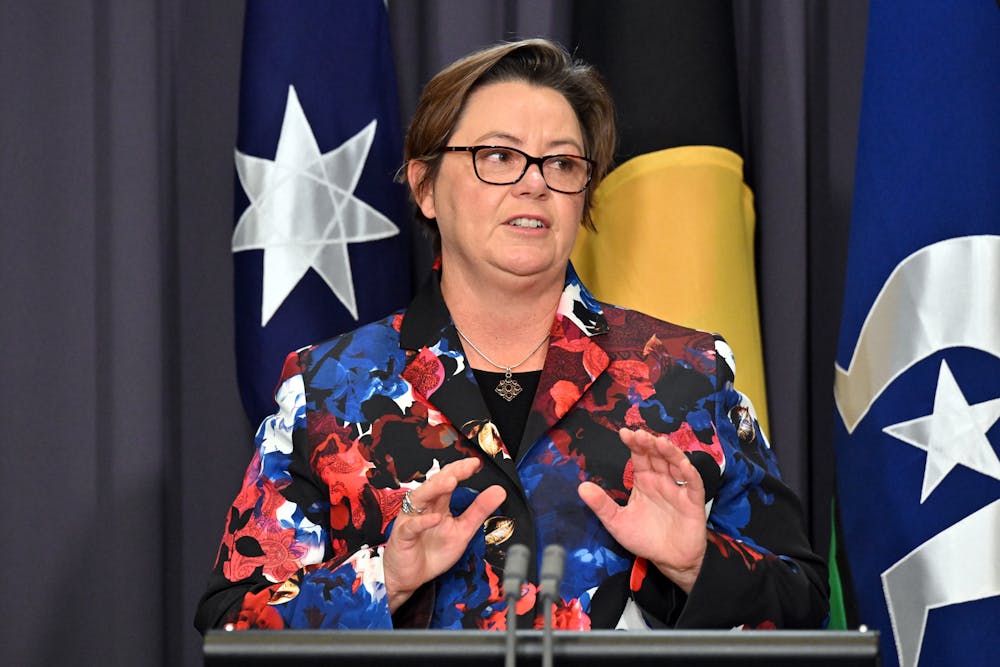
Federal Resources Minister Madeleine King yesterday handed Australia’s fossil fuel industry two significant wins.
The minister announced oil and gas exploration will be allowed at ten new Australian ocean sites – comprising almost 47,000 square kilometres. And she approved[1] two new offshore greenhouse gas storage areas off Western Australia and the Northern Territory, to explore the potential of “carbon capture and storage” (CCS) technology.
The minister said[2] the new oil and gas permits will bolster energy security in Australia and beyond, and ultimately aid the transition to renewables. King also said controversial carbon-capture and storage was necessary to meet Australia’s net-zero emissions targets.
The world’s energy market is going through a period of disruption, largely due to Russian sanctions and the Ukrainian war. But expanding carbon-intensive fossil fuel projects is flawed reasoning that will lead to greater global insecurity.
Research[3] shows 90% of coal and 60% of oil and gas reserves must stay in the ground if we’re to have half a chance of limiting global warming to 1.5℃ this century.
Ignoring the facts
The new sites for offshore gas and oil exploration comprise[4] ten areas off the coasts of the NT, WA, Victoria, and the Ashmore and Cartier Islands. King’s announcement came at a resources conference in Darwin, where she said:
Gas enables greater use of renewables domestically by providing energy security. Australian [liquefied natural gas] is also a force for regional energy security and helps our trading partners meet their own decarbonisation goals.
The problem with this assessment is that it ignores two things.
First, Australia exports nearly 90% of domestically produced gas and lacks robust export controls[5] to moderate this. Without these controls, increasing domestic production will not improve Australia’s energy security.
Second, gas can only enable greater use of renewables domestically and provide energy security where it is “decarbonised” through the use of carbon-capture and storage. If it isn’t decarbonised, using gas undermines energy security by risking further global warming.
However the deployment of CCS technology is complex, expensive and faces many barriers. To date it has a history of[6] over-promising and under-delivering.
Carbon-capture and storage typically involves capturing carbon dioxide at the source (such as a coal-fired power station), sending it to a remote location and storing it underground.
Offshore CCS involves injecting and storing CO₂ in suitable rock formations. Doing so safely requires robust monitoring and verification, but challenging ocean conditions can make this extremely difficult.
For example, Chevron allegedly failed[7] to capture and store CO₂ at its huge offshore Gorgon gas project, after the WA government approved the project on the condition the company sequester 80% of the project’s emissions in its first five years.
Read more: 1 in 5 fossil fuel projects overshoot their original estimations for emissions. Why are there such significant errors?[8]
A report in February[9] suggested the project emitted 16 million tonnes more than anticipated due to injection failure. King calls CCS a “proven[10]” technology, but Chevron’s experience indicates this is far from the case.
King did say[11] the federal government won’t rely entirely on CCS, adding “it’s one of the many means of getting to net-zero” and renewable energy remained central to Australia’s emissions reduction efforts.
But critics labelled[12] the technology a “smokescreen” behind which fossil fuel companies can continue to pollute.
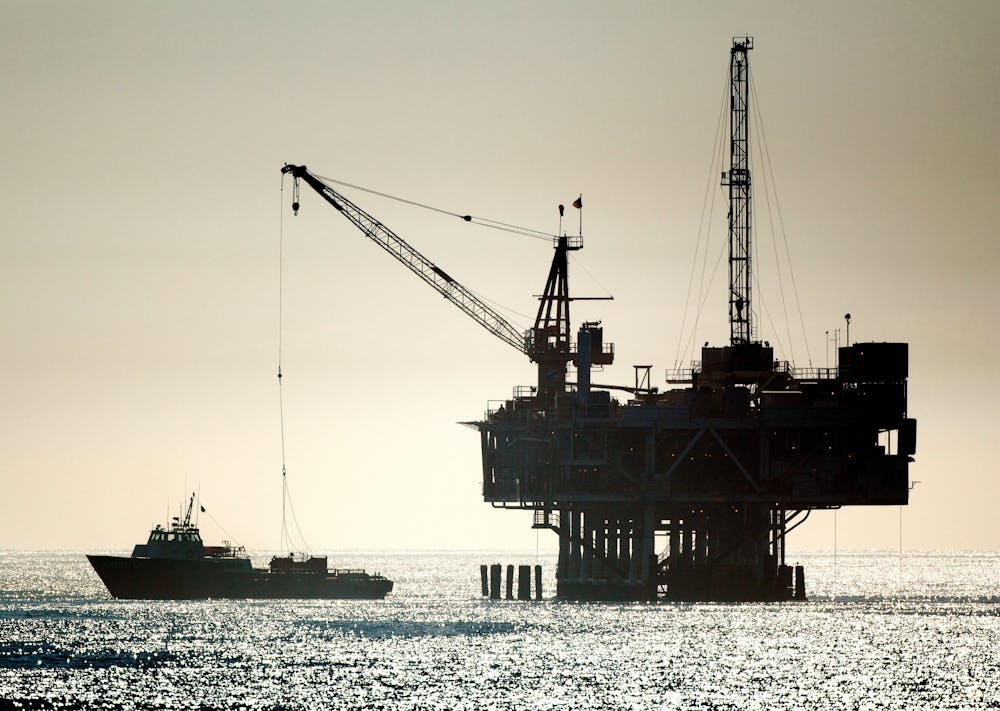 An oil drilling rig off California in 2018.
EPA/EUGENE GARCIA
An oil drilling rig off California in 2018.
EPA/EUGENE GARCIA
Fossil fuels are not the future
Putting gas in competition with renewable energy will end badly for the fossil fuel industry. As renewable energy’s market share expands, fossil fuels will become uneconomic[13] due to their environmental impacts and higher costs.
Eventually, natural gas will be used only[14] during periods of peak demand or when wind and solar are not producing electricity – in other words, when the sun isn’t shining and the wind isn’t blowing. It will not provide the steady, constant electricity supply that makes up our baseload power[15] system. This reality will significantly reduce gas demand and negate the need for carbon-capture and storage.
Read more: Why did gas prices go from $10 a gigajoule to $800 a gigajoule? An expert on the energy crisis engulfing Australia[16]
Opening up new gas and oil exploration is a reactive and dangerous move that does not support Australia’s long-term energy future. Many of our international peers already acknowledge this.
The United Kingdom, for example, now generates 33%[17] of its electricity from renewable sources such as onshore and offshore wind, solar and biomass. The subsequent decline of fossil fuels means the UK has reduced its greenhouse gas emissions by more than 50% on 1990 levels.
Gas in the UK[18] is valuable for its ability to provide rapid, flexible power supply during peak periods, to integrate with other renewable technologies and to improve system flexibility. During periods of high demand, storage devices can discharge into the grid and maintain security of supply.
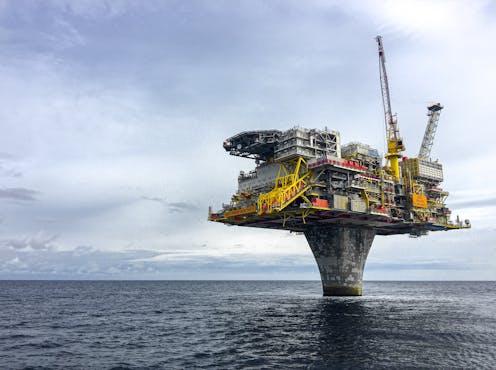
 Putting gas in competition with renewable energy will end badly for the fossil fuel industry.
Unsplash, CC BY[19]
Putting gas in competition with renewable energy will end badly for the fossil fuel industry.
Unsplash, CC BY[19]
Wrong way, go back
Clearly, Australia is heading in the wrong direction by opening up new fossil fuel exploration.
The move will damage our longer-term security and undermine our climate imperatives. It ignores the glaring economic realities that will eventually push gas out of the market.
And opening new gas fields while carbon-capture remains uncertain is dangerous for the planet.
Read more: Liquid marbles: how this tiny, emerging technology could solve carbon capture and storage problems[20]
References
- ^ approved (www.minister.industry.gov.au)
- ^ minister said (www.minister.industry.gov.au)
- ^ Research (theconversation.com)
- ^ comprise (www.abc.net.au)
- ^ export controls (theconversation.com)
- ^ a history of (www.eco-business.com)
- ^ allegedly failed (theconversation.com)
- ^ 1 in 5 fossil fuel projects overshoot their original estimations for emissions. Why are there such significant errors? (theconversation.com)
- ^ report in February (assets.nationbuilder.com)
- ^ proven (www.abc.net.au)
- ^ did say (www.abc.net.au)
- ^ critics labelled (www.abc.net.au)
- ^ uneconomic (www.theguardian.com)
- ^ used only (unece.org)
- ^ baseload power (ecos.csiro.au)
- ^ Why did gas prices go from $10 a gigajoule to $800 a gigajoule? An expert on the energy crisis engulfing Australia (theconversation.com)
- ^ generates 33% (www2.deloitte.com)
- ^ Gas in the UK (www.theccc.org.uk)
- ^ CC BY (creativecommons.org)
- ^ Liquid marbles: how this tiny, emerging technology could solve carbon capture and storage problems (theconversation.com)