It’s corn! How the online viral ‘Corn Kid’ is on a well-worn path to fame in the child influencer industry
- Written by: Crystal Abidin, Associate Professor & ARC DECRA Fellow, Internet Studies, Curtin University
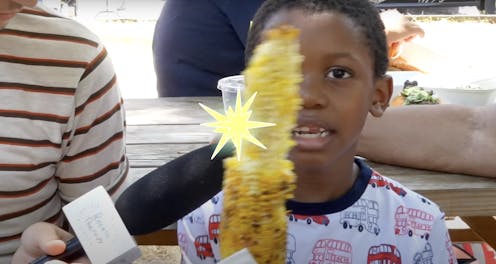
An American seven-year-old named Tariq went viral on the internet last month after appearing in an 85-second Instagram clip[1] professing his love for corn. His quirky quips, including the catchphrase “Have a cornstastic day!” quickly found favour with internet audiences, who turned him into the meme affectionately known as “Corn Kid”.
At the time of writing, the original Instagram clip has been viewed over 26 million times and has been widely reposted by several other accounts across Instagram, YouTube, Twitter and TikTok.
On the strength of accidental viral popularity, Corn Kid is now well on his way to becoming a child celebrity. His time in the limelight has followed a predictable path carved out over the past decade as the era of “cute videos of kids” has given way to a full-blown child influencer industry.
Turning accidental virality into commercial opportunities
Corn Kid’s humorous interview was auto-tuned into a catchy song “It’s corn![2]” by comedy music YouTubers The Gregory Brothers. He began featuring in a string of content collaborations[3] with notable influencers. He was even recently named “Corn-bassador[4]” – an ambassador of corn – for South Dakota in the US.
But Corn Kid’s serendipitous fame has also brought tangible commercial opportunities.
He starred in a social media ad for Chipotle[5] that went viral, and also registered an account on Cameo[6] – a video-sharing platform where users can pay for personalised video messages.
And it is here where what seems like fun on the internet can begin to have real-world consequences.
Accelerated pathways into ‘child celebrity’
If Corn Kid’s story sounds familiar, it is because this rapid pathway from “accidental virality” to “meme celebrity” to “influencer” has been a tried-and-tested recipe for more than a decade.
In 2011, British cousins Sophia Grace and Rosie (then aged 8 and 5, respectively) went viral with a short dance clip[7]. It led to regular appearances on The Ellen Show[8], followed by music and film opportunities, and careers as YouTube influencers.
In 2014, five-year-old Noah Ritter’s viral street interview[9] eventually led to regular fixtures on talkshows and appearances at cons, after similarly being picked up by The Ellen Show.
But there are also less wholesome examples, such as when 14-year-old Danielle Bregoli went viral[10] for her appearance on the Dr. Phil Show in 2016, after he had called out her bad behaviour and publicly shamed her. She went on to establish herself as a rapper and as a NSFW influencer who reportedly earned US$50 million[11] in her first year.
As I note in my book Internet Celebrity: Understanding Fame Online[12], young children who go viral on social media are quickly perceived by industry stakeholders as commercial investments to be “spotted and groomed”. And this initial period of instant fame is a critical moment for important decisions.
Some pitfalls of the influencer industry
Parents of children who go viral online often suddenly find themselves in a world of opportunity. Paid cameos, corporate partnerships, offers of talent brokerage and child influencer contracts can line up swiftly. In the growing market, even micro- and mid-tier influencers can demand thousands of dollars for a single post[13].
As parents are quickly pushed into the glitzy world of child celebrity, there is usually little time to make concerted and informed decisions. Tantalising offers may be short-lived and contingent upon wavering public interest.
Yet, it is important to consider the pitfalls and longer-term consequences in the child influencer industry.
Earlier this year, a TikTok-famous child was sexualised by fan accounts[14], leading to a public conversation about the safety and privacy of similar child influencers. In another instance, an influencer in my research reported she and her child were involved in a car chase by over-enthusiastic fans[15].
Read more: When exploiting kids for cash goes wrong on YouTube: the lessons of DaddyOFive[16]
As advertising opportunities expand in range, parents may also find themselves on a slippery slope as they move from child-centred products to less child-relevant recommendations like car decals and fast food[17].
Parents must also recognise when their children may no longer enjoy creating content[18], such as when they need to be “enticed by rewards for compliance to stay in the frame and continue filming”.
In some cases, parents have also been found to exploit and abuse their children[19] when creating sensational content to attract viewers.
In Australia, the industry is growing rapidly[20].
Navigating unregulated terrain
The child influencer industry is still largely unregulated terrain. One exception is in France, where the government passed a law in 2020[21] to regulate workable hours, safeguard the income of under-16s, and ensure that companies apply for permission to work with child influencers.
In the UK, a House of Commons committee conducted an inquiry[22] into the child influencer industry in 2021. The UK parliament is presently working on a response to calls for more regulation.
Formal regulations are beginning[23] to catch up with the industry.
In the meantime parents of aspiring child influencers are also doing more to protect their children.
Established “family influencers” on YouTube have role-modelled how to negotiate children’s involvement[24] in content creation – treating it as a reward rather than an obligation, and allowing them to opt out when they want.
Lessons from Asia
I am conducting a five-year ethnography of the influencer industry in Australia and East Asia[25], during which I have found many more examples of parents doing more to stand up for the interests of their children.
Parents in South Korea are requesting specific clauses in their child influencer contracts with sponsors to give their children more agency. These may accommodate “no shows” if a child refuses to participate in a client event at late notice, or flexibility to renegotiate advertising briefs if a child does not want to engage with the sponsored product or service.
In China, talent managers are trained professionals who act as mediators and brokers for child influencer services. They safeguard access to prominent child influencers, ensure client contracts are fair, educate parents by advising them on legal and contractual matters, and provide quality control for the content that child influencers deliver to clients.
Further, influencer agencies are contractually responsible for any faux pas. Thus, they work quickly to resolve issues that impinge on the welfare of the child.
Even the most loving and well-meaning parents may not have the capacity and skills to protect the interests of their children in the volatile influencer industry. And while change is coming, we can draw on lessons from the past.
References
- ^ 85-second Instagram clip (www.instagram.com)
- ^ It’s corn! (www.youtube.com)
- ^ content collaborations (www.tiktok.com)
- ^ Corn-bassador (www.huffpost.com)
- ^ social media ad for Chipotle (www.tiktok.com)
- ^ Cameo (www.cameo.com)
- ^ short dance clip (www.youtube.com)
- ^ regular appearances on The Ellen Show (thesocietypages.org)
- ^ viral street interview (www.eonline.com)
- ^ went viral (particle.scitech.org.au)
- ^ reportedly earned US$50 million (nypost.com)
- ^ Internet Celebrity: Understanding Fame Online (www.emerald.com)
- ^ thousands of dollars for a single post (honey.nine.com.au)
- ^ a TikTok-famous child was sexualised by fan accounts (www.rollingstone.com)
- ^ car chase by over-enthusiastic fans (www.cnet.com)
- ^ When exploiting kids for cash goes wrong on YouTube: the lessons of DaddyOFive (theconversation.com)
- ^ car decals and fast food (journal.media-culture.org.au)
- ^ may no longer enjoy creating content (www.taylorfrancis.com)
- ^ exploit and abuse their children (theconversation.com)
- ^ growing rapidly (www.abc.net.au)
- ^ passed a law in 2020 (www.bbc.com)
- ^ an inquiry (publications.parliament.uk)
- ^ are beginning (www.cnet.com)
- ^ negotiate children’s involvement (journals.sagepub.com)
- ^ in Australia and East Asia (wishcrys.com)