Why should we trust science? Because it doesn't trust itself
- Written by: John Wright, Adjunct Research Fellow in Philosophy, La Trobe University
Many of us accept science is a reliable guide to what we ought to believe – but not all of us do.
Mistrust of science has led to scepticism around several important issues, from climate change denial to vaccine hesitancy during the COVID pandemic. And while most of us may be inclined to dismiss such scepticism as unwarranted, it does raise the question: why ought we to trust science?
As a philosopher with a focus on the philosophy of science, I’m particularly intrigued by this question. As it turns out, diving into the works of great thinkers can help provide an answer.
Common arguments
One thought that might initially spring to mind is we ought to trust scientists because what they say is true.
But there are problems with this. One is the question of whether what a scientist says is, in fact, the truth. Sceptics will point out scientists are just humans and remain prone to making mistakes[1].
Also, if we look at the history of science, we find that what scientists believed in the past has often later turned out to be false. And this suggests what scientists believe now might one day turn out to be false. After all, there were times in history when people thought mercury could treat[2] syphilis, and that the bumps on[3] a person’s skull could reveal their character traits.

Another tempting suggestion for why we ought to trust science is because it is based on “facts and logic”.
This may be true, but unfortunately it is of limited help in persuading someone who is inclined to reject what scientists say. Both sides in a dispute will claim they have the facts on their side; it is not unknown for climate change deniers[4] to say global warming is just a “theory”.
Read more: Vaccine hesitancy: Why ‘doing your own research’ doesn’t work, but reason alone won’t change minds[5]
Popper and the scientific method
One influential answer to the question of why we should trust scientists is because they use the scientific method. This, of course, raises the question: what is the scientific method?
Possibly the best-known account is offered by science philosopher Karl Popper[6], who has influenced an Einstein Medal-winning mathematical physicist[7] and Nobel Prize winners in biology[8] and physiology and medicine[9].
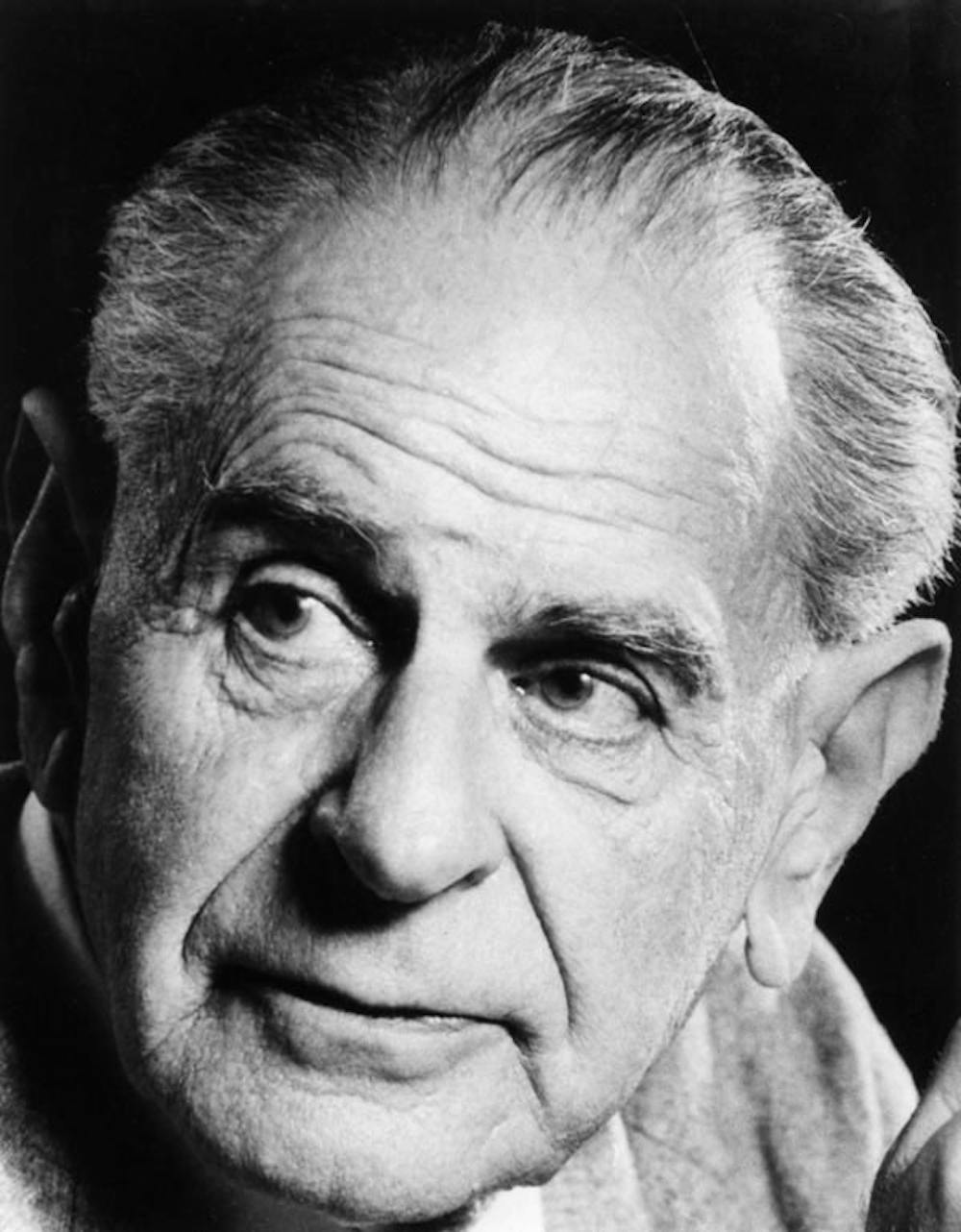 British-Austrian Karl Popper (1902-1994) was among the most influential science philosophers of the 20th century.
Wikimedia
British-Austrian Karl Popper (1902-1994) was among the most influential science philosophers of the 20th century.
Wikimedia
For Popper[10], science proceeds by means of what he calls “conjectures and refutations”. Scientists are confronted with some question, and offer a possible answer. This answer is a conjecture in the sense that, at least initially, it is not known if it is right or wrong.
Popper says scientists then do their best to refute this conjecture, or prove it wrong. Typically it is refuted, rejected, and replaced by a better one. This too will then be tested, and eventually replaced by an even better one. In this way science progresses.
Sometimes this process can be incredibly slow. Albert Einstein predicted the existence of gravitational waves more than 100 years ago, as part of his general theory of relativity. But it was only in 2015 that scientists managed to observe them[11].
For Popper, at the core of the scientific method is the attempt to refute or disprove theories, which is called the “falsification principle”. If scientists have not been able to refute a theory over a long period of time, despite their best efforts, then in Popper’s terminology the theory has been “corroborated”.
This suggests a possible answer to the question of why we ought to trust what scientists tell us. It is because, despite their best efforts, they have not been able to disprove the idea they are telling us is true.
Majority rules
Recently, an answer to the question was further articulated in a book[12] by science historian Naomi Oreskes. Oreskes acknowledges the importance Popper placed on the role of attempting to refute a theory, but also emphasises the social and consensual element of scientific practice.
For Oreskes, we have reason to trust science because, or to the extent that, there is a consensus among the (relevant) scientific community that a particular claim is true – wherein that same scientific community has done their best to disprove it, and failed.
Here is a brief sketch of what a scientific idea typically goes through before a consensus emerges it is correct.
A scientist might give a paper on some idea to colleagues, who then discuss it. One aim of this discussion will be to find something wrong with it. If the paper passes the test, the scientist might write a peer-reviewed paper on the same idea. If the referees think it has sufficient merit, it will be published.
Others may then subject the idea to experimental tests. If it passes a sufficient number of these, a consensus may emerge it is correct.
A good example of a theory undergoing this transition is the theory of global warming and human impact on it. It had been suggested as early as 1896 that increasing levels of carbon dioxide in Earth’s atmosphere might lead[13] to global warming.
In the early 20th century, another theory emerged that not only was this happening, but carbon dioxide released from human activities (namely fossil fuel burning) could accelerate global warming. It gained some support at the time, but most scientists remained unconvinced[14].
However, throughout the second half of the 20th century and what has so far passed of the 21st, the theory of human-caused climate change has so successfully passed ongoing testing that one recent meta-study found more than 99% of the relevant scientific community accept its reality[15]. It started off perhaps as a mere hypothesis, successfully passed testing for more than a hundred years, and has now gained near-universal acceptance.
The bottom line
This does not necessarily mean we ought to uncritically accept everything scientists say. There is of course a difference between a single isolated scientist or small group saying something, and there being a consensus within the scientific community that something is true.
And, of course, for a variety of reasons – some practical, some financial, some otherwise – scientists may not have done their best to refute some idea. And even if scientists have repeatedly tried, but failed, to refute a given theory, the history of science suggests at some point in the future it may still turn out to be false when new evidence comes to light.
So when should we trust science? The view that seems to emerge from Popper, Oreskes and other writers in the field is we have good, but fallible, reason to trust what scientists say when, despite their own best efforts to disprove an idea, there remains a consensus that it is true.
Read more: Curious Kids: what is the most important thing a scientist needs?[16]
References
- ^ prone to making mistakes (www.scientificamerican.com)
- ^ treat (pharmaceutical-journal.com)
- ^ the bumps on (www.britannica.com)
- ^ deniers (www.crikey.com.au)
- ^ Vaccine hesitancy: Why ‘doing your own research’ doesn’t work, but reason alone won’t change minds (theconversation.com)
- ^ Karl Popper (en.wikipedia.org)
- ^ mathematical physicist (ui.adsabs.harvard.edu)
- ^ biology (royalsocietypublishing.org)
- ^ physiology and medicine (www.innovation-intelligence.com)
- ^ For Popper (view.officeapps.live.com)
- ^ observe them (www.ligo.caltech.edu)
- ^ book (press.princeton.edu)
- ^ might lead (www.rsc.org)
- ^ unconvinced (press.uchicago.edu)
- ^ accept its reality (iopscience.iop.org)
- ^ Curious Kids: what is the most important thing a scientist needs? (theconversation.com)
Read more https://theconversation.com/why-should-we-trust-science-because-it-doesnt-trust-itself-188988