Curious Kids: How is lava made?
- Written by: Janice Crerar, Lecturer in Education, Charles Darwin University
How is lava made? – Leon, age 7, Sydney, Australia

Thank you for a great question Leon!
Have you ever seen lava? What does it look like to you? Lava can be red, fiery and liquid or cool, dark and solid, like in the picture above.
In the picture you can see red hot lava, flowing over black solid rock where the lava has cooled. Lava is molten rock, melted because of very high temperatures, much, much hotter than you would see on the surface of the earth.
Can you imagine how hot it must be to melt rock? This gives a clue about how lava is made, somewhere with very high temperatures below Earth’s surface.
While underground, the liquid rock is called magma; it becomes lava when it flows onto the planet’s surface, usually through a volcano. When the lava cools – that’s the dark solid ground you see in the image – it is called “igneous” rock. This means “fire” in Latin (scientists use a lot of Latin words), so it is fire rock.
To understand how lava is made and where it comes from, we need to journey below Earth’s surface – which we can’t do, because it would be too dangerous. Imagine trying to travel somewhere hot enough to melt rock, what would that do to you?
Instead, we can look at the structure of Earth in the image below and imagine the journey.
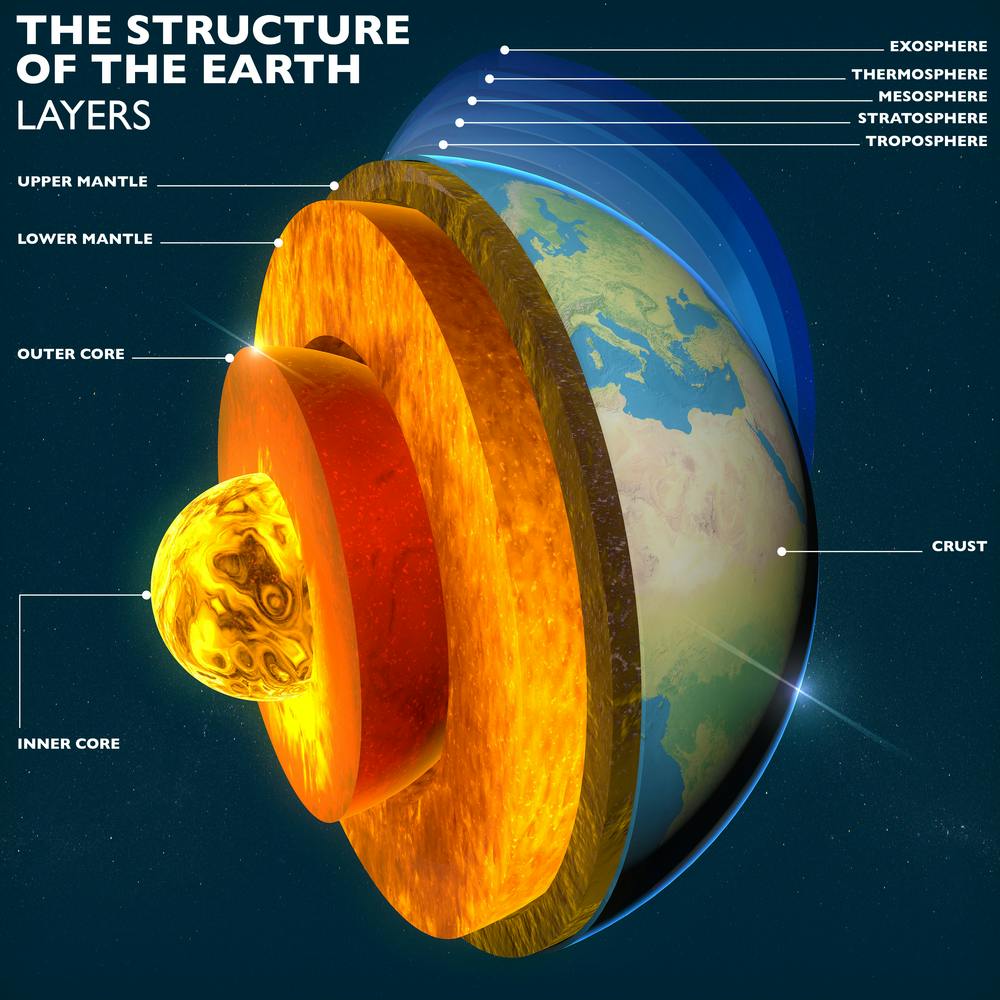
We would travel down through Earth’s crust, into the mantle and then into the core. Once there, we would discover that the crust and mantle are mostly solid rock. After the mantle we would notice the liquid outer core and then the solid metal inner core.
In Earth’s core the temperatures are very hot, usually between 5,000 and 7,000 degrees Celsius[1]. Think about this to compare: chocolate starts melting at around 80℃ and tap water boils at 100℃. This very hot core acts like an oven for Earth, heating it from within.
Along the way we might find some magma in the mantle where it is made, in a space between the outer mantle and Earth’s crust. Magma is formed through heat and pressure – imagine squeezing a ball of plasticine as hard as you can: that is you putting pressure on the ball. While the mantle is not as hot as the liquid core, there is a lot more pressure. The pressure is caused by movement in the rocky mantle, pressing against the crust.
This pressure, and the temperatures from Earth’s “oven” at the core, cause rock to melt and magma is formed. The magma moves to Earth’s surface through openings – sometimes these openings are volcanoes – and forms new crust.
Often the new crust forms into islands, like many of the Pacific islands. This happens because liquid comes out through openings on the sea floor and cools, forming land.
You can watch this video for the story from Mother Earth herself. But be warned: never put rocks in a fire to try and melt them, some might explode! I’ll let you ask about that another time.
References
- ^ usually between 5,000 and 7,000 degrees Celsius (www.nationalgeographic.com)
Read more https://theconversation.com/curious-kids-how-is-lava-made-190431