Australian thriller The Stranger puts anxiety centre frame
- Written by: Alex Munt, Associate Professor, Media Arts & Production, University of Technology Sydney
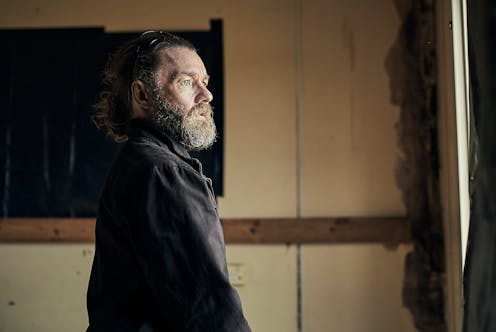
When I teach budding screenwriters, I will often use the “show don’t tell” rule as a quick-fix for students trapped in the more familiar mode of literary storytelling. The Stranger, an accomplished Australian thriller, written and directed by Thomas M. Wright, abides closely to this adage with visceral storytelling using images and sounds, the material of cinema.
While the film is adapted from Kate Kyriacou’s The Sting, based on the Daniel Morcombe murder[1], it fictionalises the specifics and leaves the heinous crime off-screen.
In The Stranger, Mark (Joel Edgerton), is at the centre of an elaborate undercover operation tasked with extracting a confession from key suspect Henry (Sean Harris).
Where true-crime books, and podcasts, have the capacity to re-tell timelines, circumstances, and characters in detail – filmmakers need to find imaginative ways to render these stories for the screen. Wright utilises a notion of interiority to do this, which works both literally and psychologically in the film.
Literally, in the sense that it unfolds mostly in underexposed interior spaces, and psychologically with its emphasis on the character’s anxiety manifested through professional work duties.

Interiors
The Stranger is bathed in darkness. In lieu of narrative detail, or exposition, Wright uses cinematic mood to do the work.
This kind of storytelling existed prior to cinema. Watching the film, I was reminded of the paintings of Caravaggio which portray violent scenes using chiaroscuro and an absence of light. This comparison is evident in the setup for the film, when Henry is recruited to work for the faux criminal mob. While this takes place on a remote bus, realism is put to one side with the scene staged in a dark, abstract abyss devoid of background detail.
What follows is a range of dread-inducing scenes that unfold in drab domestic and industrial interiors. In these spaces, curtains and blinds are inevitably drawn denoting the secrecy of the operation and the thematic darkness of the scenario.
Cinematography from Sam Chiplin is bold. And in repeated driving scenes, featuring Mark and Henry, the car itself functions as a chamber for the anticipated confession. Whilst the remote exterior landscape may be visible through the window, it is at a remove, with the two mirrored characters (one good, one evil) remaining trapped within a dark interior cabin.
I saw the film in a theatre, it will be interesting to see if audiences think the film is too dark streaming on Netflix, a controversy of late in relation to Game of Thrones[2].
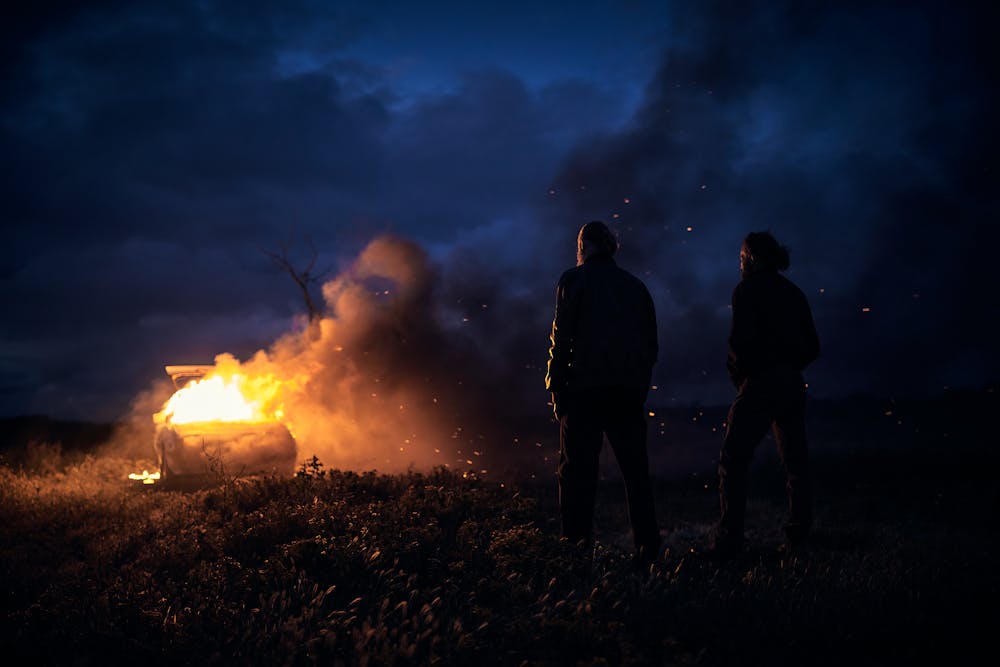 The Stranger is bathed in darkness.
Netflix
The Stranger is bathed in darkness.
Netflix
Anxiety
On one hand, anxiety is a pre-condition for an undercover cop story. We’ve seen this in Donnie Brasco (1997) with Johnny Depp or, even better, in Martin Scorsese’s The Departed (2006) featuring a gripping performance from Leonardo Di Caprio.
But The Stranger goes one step further in situating anxiety centre frame. Joel Edgerton’s interest in the story, as a producer, was to reveal the sacrifice, and indeed the trauma, which some professions subsume for the greater good.
Mark’s trauma from his police work is ever-present: we see his nightmares, his over reliance on alcohol and his short temper when taking care of his young son. The film explores a mode of psychological interiority in which our deepest and darkest thoughts reside.
In the trailer[3] Mark (Edgerton) models a breathing exercise, drawn from psychological therapy, for his young son (Cormac Wright) saying “Do you want me to teach you something I learned at work?” The character’s panic attacks must ring true for Edgerton, who has spoken publicly[4] about his own experience with anxiety to alleviate the stigma attached to mental health.
Style
The Stranger exhibits a tendency in Australian cinema that has become a recipe for success: true-crime stories which show hypermasculinity played out against a periphery of (off-screen) violence. From The Boys (1998) to Nitram (2021) there is a strong lineage here.
Yet while the market always awards familiarity or brand recognition – will this recipe prove creatively restrictive to Australian filmmakers in the long run? To my mind, Thomas M. Wright’s debut Acute Misfortune (2018) offered something more unorthodox, more vital in Australian cinema. That film, on the late Australian painter Adam Cullen, unfolded within a boxy, claustrophobic frame and delivered a more exploratory, artisanal filmmaking process.
It would be a shame for Wright to be subsumed entirely within a successful, if at times predicable, Australian house style.
References
- ^ Daniel Morcombe murder (www.theguardian.com)
- ^ Game of Thrones (www.vice.com)
- ^ trailer (www.youtube.com)
- ^ spoken publicly (www.abc.net.au)
Read more https://theconversation.com/australian-thriller-the-stranger-puts-anxiety-centre-frame-190903