


Why a First Nations Voice should come before Treaty
- Written by: Pat Anderson, Chairperson, Batchelor Institute of Indigenous Tertiary Education
Since the advent of colonisation, the absence of an effective process for conducting dialogues between the broader community and First Nations people has been a festering sore at the heart of Australian society.
The notorious doctrine[1] of terra nullius not only led to the denial of the legitimate rights of First Nations people, but also ensured they could never be heard. This malign strategy has produced centuries of unspeakable suffering, sickness and death. Many Australians feel the time has come to start to heal the wound.
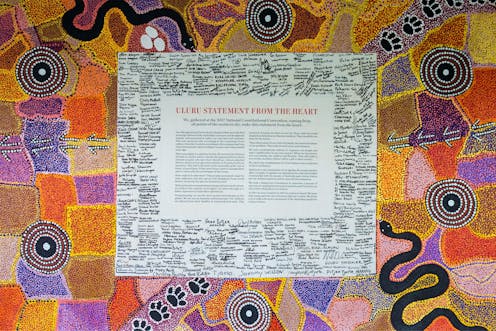
The Uluru Statement from the Heart[2] advocates for a process of dialogue to set us on a path towards a new way of living together. The statement was agreed to in 2017 by a convention of more than 250 First Nations people after an inclusive and rigorous process of regional dialogues. It proposes a First Nations Voice to Parliament to guide a passage both to a new “coming together” and to the clear articulation of the long-suppressed truth.
As Prime Minister Anthony Albanese said when announcing the forthcoming referendum that seeks to incorporate these key proposals into the Australian Constitution, the statement is a generous offer to the entire Australian community. It does not harbour grudges and does not seek vengeance. It asks for a secure mechanism whereby the voices of First Nations people can at last be heard – by each other, by the parliament and by the wider Australian public.
While support for the statement is widespread, some sections of the population – both Aboriginal and non-Aboriginal – have dismissed the Voice as inconsequential, arguing the focus should instead be on establishing a “treaty”. They have argued a Voice will lead only to talk, whereas the real goal should be a law that guarantees the civil rights of First Nations peoples.
This argument fails to understand the potential power of the Voice. It can not only lay a foundation for a movement towards reconciliation and truth, but also act as a tool to craft novel solutions to the problems created by the unique circumstances of Australia’s history and culture.
In this connection, it is notable the statement does not actually use the term “treaty”. Instead, it proposes the distinctly Aboriginal concept of “Makarrata”, which refers to a process of learning from the past to create new ways of interacting with each other based on dialogue. Voice, Makarrata and Truth are inseparable, but Voice is the motor that drives all of them forward.
Read more: The power of yindyamarra: how we can bring respect to Australian democracy[3]
Establishing the Voice will lead to immediate, important outcomes. It will set the scene for addressing the centuries of injustice. It will create an effective process to address the intergenerational disadvantage many communities suffer. It will help overcome the historical exclusion of First Nations people from public forums. And crucially, it will offer an important symbolic gesture of acknowledgement and recognition that the days of vox nullius (“voicelessness”), the primary intention and consequence of terra nullius, are at last over.
It is, of course, unlikely that all First Nations people will speak with one voice – indeed, that would be undesirable. However, creation of a secure channel of communication will open up new ways for all members of the Australian community to negotiate their differences and discover novel solutions to our common challenges.
First Nations people will therefore not be the only ones to gain from the Voice. A vibrant, living platform for vigorous dialogue that addresses fundamental political issues will also benefit the wider society. It will help revive the ailing public sphere in Australia, restoring trust in institutions that have been degraded and depleted as a result of a deeply-established focus on personal ambition, vested interests and loss of shared ethical vision.
While some form of treaty will undoubtedly remain an important goal, the joint concepts of Voice, Makarrata and Truth are deeper, and more complex and enduring.
On its own, a treaty would operate only as an element within the system of colonially-derived law. This means it would utilise concepts within a system of thought that few would argue has served our country well in relation to the treatment of First Nations people, let alone of refugees and other vulnerable minorities.
Read more: Grattan on Friday: Defeat of the Voice would be a body blow for achieving a republic[4]
The statement provides an approach to a consensus process that goes much further than this. Drawing on the creative resources of dialogue so fundamental to Aboriginal and Torres Strait Islander cultures, it will establish a framework that allows us to move forward to create new ethical bonds and fresh communal relationships that reactivate trust, reinvigorate public, cooperative action and support the resolution of conflicts through peaceful dialogue.
As we move towards the referendum, it is important for us to think carefully about the vision we wish to hold for Australia. About whether we are, collectively, ready to accept the invitation offered in the Uluru statement.
We have to decide whether we are ready to break the silence of our shared histories and take up the challenge to talk with each other, openly, frankly and with respect.
References
- ^ notorious doctrine (australian.museum)
- ^ Uluru Statement from the Heart (fromtheheart.com.au)
- ^ The power of yindyamarra: how we can bring respect to Australian democracy (theconversation.com)
- ^ Grattan on Friday: Defeat of the Voice would be a body blow for achieving a republic (theconversation.com)
Read more https://theconversation.com/why-a-first-nations-voice-should-come-before-treaty-192388










