


the one factor that makes us less likely to emulate our neighbours on climate action
- Written by: Andrea La Nauze, Lecturer, The University of Queensland
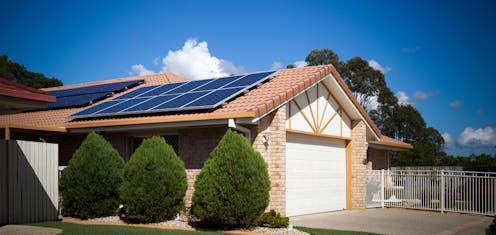
About 30% of Australian homes have rooftop solar panels installed – the highest uptake of any nation. Their popularity has been helped along by government subsidies that reduce the upfront costs of the technology.
But these subsidies may not always have a positive climate impact. While people like to “keep up with the Joneses” on climate action, my recent research[1] suggests this is not always the case when large solar subsidies are being offered.
It found if someone is perceived as having installed solar panels primarily for a financial benefit, their non-solar neighbours may actually be deterred from reducing their own climate impact – such as by signing up for so-called “green” retail electricity schemes.
Subsidies are often a policy go-to for governments wanting to encourage more climate-friendly behaviours. But my findings indicate they should be used with caution.
A spotlight on buyer behaviour
Examining subsidies for rooftop solar systems is valuable because it can tell us about consumer behaviour more broadly.
For the past 20 years or so, state and federal governments have subsidised the cost of installing rooftop solar by offering a range of rebates and other financial incentives to consumers. In recent years these subsidies have fallen, in part because the cost of the technology has become so cheap that consumers can recoup the cost fairly quickly through reduced power bills.
But some subsidies for rooftop solar and home batteries[2] still exist. Some governments also apply them to energy efficiency measures and electric vehicles[3].
Such subsidies come at great cost to the public purse. So will they help Australia reach its emissions reduction targets? My research suggests in some cases, they can be counterproductive.
Read more: Heat pumps can cut your energy costs by up to 90%. It’s not magic, just a smart use of the laws of physics[4]
Signing up for GreenPower
Neighbours influence each other’s behaviour. Living near lots of homes with solar panels can change people’s beliefs[5] about the science of climate change. It also makes people more likely[6] to install solar panels on their own home.
However, research[7] focused on water conservation suggests the “peer pressure” effect is muted if the behaviour change doesn’t also come with a financial benefit.
There remain gaps in our understanding[8] of how neighbours influence each others’ energy use. For example, we don’t know if installing solar panels influences the energy behaviours of people who can’t install panels because, say, they live in an apartment.
My research[9] examined the uptake of GreenPower to help us close that knowledge gap.
GreenPower[10] is government-accredited electricity generated by renewable sources and offered for sale to consumers.
Like installing solar panels, GreenPower can be considered a “public good” in that it helps tackle climate change. But GreenPower is not subsidised and is not visible to neighbours. And users also don’t get the financial benefit of selling surplus electricity from rooftop solar back to the grid.
The number of GreenPower users in Australia has fallen dramatically[11] in recent years: from about 1 million customers in 2009[12] to 100,000 in 2019[13].
Much of this may be explained by people switching to rooftop solar during that period. But it was also possible that rooftop solar installations were influencing decisions by non-solar neighbours of whether to sign up to GreenPower schemes. My research aimed to distinguish between these possibilities.
Read more: Small communities could be buying, selling and saving money on electric power right now – here’s how[14]
What the research found
I studied the electricity plan choices of about 300,000 customers in Victoria from 2009-2016. I matched each contract to the number of solar panels installed in that postcode in the quarter the contract was signed.
I found on average, solar panel installation increases the number of non-solar homes purchasing GreenPower. But economic incentives – like subsidies – actually reduced the peer effect.
During periods of high solar subsidies, an additional 1,000 homes with solar panels reduced the share of GreenPower contracts by 0.08 – or 400 for every 5,000 new electricity contracts taken out by non-solar customers.
During periods of low solar subsidies, an additional 1,000 homes with solar panels increased the share of GreenPower contracts by 0.02, or 100 for every 5,000 new electricity contracts.
This suggests economic incentives compromise the signal that a neighbour is acting in the public good – and so reduces pressure on neighbours to follow their lead.
This may then mean neighbours feel less pressure to address their own electricity-related greenhouse emissions by purchasing GreenPower, or taking other climate-friendly measures.
Other factors are also likely to have contributed to the decline in the popularity of GreenPower. These include its cost relative to electricity from other sources, and debate around the introduction and removal of Australia’s carbon price.
Read more: So long, Loy Yang: shutting Australia’s dirtiest coal plant a decade early won’t jeopardise our electricity supply[15]
Proceed with care
Subsidies affect technology adoption, and subsidies for “green” technologies such as solar panels do lower carbon emissions.
But subsidies also have indirect effects that must be considered when thinking about the costs and benefits of various policy options.
Alternatives to these subsidies exist. These include an economy-wide price on carbon, emissions ceilings on vehicles[16], and mandatory renewable energy targets. These policy options could avoid the downsides of subsidies to consumers.
References
- ^ recent research (direct.mit.edu)
- ^ rooftop solar and home batteries (www.solar.vic.gov.au)
- ^ electric vehicles (business.gov.au)
- ^ Heat pumps can cut your energy costs by up to 90%. It’s not magic, just a smart use of the laws of physics (theconversation.com)
- ^ change people’s beliefs (link.springer.com)
- ^ more likely (pubsonline.informs.org)
- ^ research (www.aeaweb.org)
- ^ gaps in our understanding (www.nature.com)
- ^ My research (direct.mit.edu)
- ^ GreenPower (www.greenpower.gov.au)
- ^ fallen dramatically (www.greenpower.gov.au)
- ^ 2009 (www.greenpower.gov.au)
- ^ 2019 (www.greenpower.gov.au)
- ^ Small communities could be buying, selling and saving money on electric power right now – here’s how (theconversation.com)
- ^ So long, Loy Yang: shutting Australia’s dirtiest coal plant a decade early won’t jeopardise our electricity supply (theconversation.com)
- ^ emissions ceilings on vehicles (theconversation.com)










