


What is the 'carnivore diet' and is it a bad idea?
- Written by: Katherine Livingstone, NHMRC Emerging Leadership Fellow and Senior Research Fellow at the Institute for Physical Activity and Nutrition, Deakin University
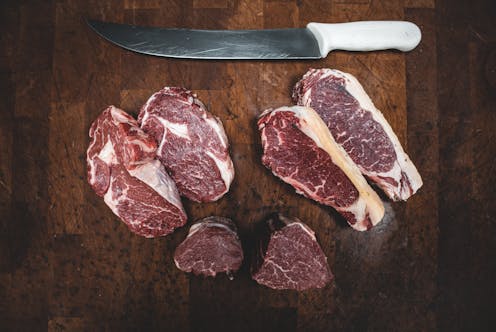
You may have heard of the carnivore diet, and the claims it is beneficial for our health.
Many diet trends, such as the paleo and Atkins diets, advocate high protein and low carbohydrate intake. But the carnivore diet takes this trend to the extreme.
So what is it, and is it bad for your health?
What is the carnivore diet?
As the name implies, the carnivore diet involves only eating meat and animal products.
There is no official definition, but followers of this diet advocate eating red meat, pork, chicken and other poultry, eggs, fish and seafood. Some low-lactose dairy can be included, such as cheese and yoghurt.
All plant foods are typically excluded. So no fruit, vegetables, legumes, grains or nuts and seeds.
An example of what you could eat on a typical day might be:
Breakfast: eggs and bacon (without toast)
Lunch: lamb burger (without the bun)
Dinner: rib eye steak (with no sides)

Are there any nutritional benefits?
The short answer is no.
It may be theoretically possible to get all essential vitamins and mineral from animal products. For example, lean red meat[2] is a good source of iron, zinc and vitamin B12, while oily fish is a good source of essential fatty acids, such as omega-3s.
But unless your diet is very well planned, eating only animal meat could lead to insufficient intake of certain vitamins and minerals. This is especially the case with vitamin C and folate, where the main food sources are fruits[3], vegetables and wholegrains.
Importantly, dietary fibre is noticeably absent from a carnivore diet. This is a problem because a low-fibre diet[4] can increase your risk of diabetes, heart disease and some cancers.
To avoid any dietary deficiencies, the Australian Guide to Healthy Eating[5] recommends eating from the five core food groups: fruits, vegetables, cereals, lean meats and dairy.
Read more: What's this 'longevity' diet, and will it really make you live longer?[6]
Is it bad for your health?
Most likely.
Most evidence for benefits of this diet is anecdotal – based on personal experiences, rather than scientific evidence.
A recent article[7] identified self-reported health benefits and high satisfaction among adults who followed a carnivore diet for six months or more. However, since the study involved asking people how much they liked a diet they had chosen to put themselves on, we can’t conclude much from its findings.
When it comes to high protein diets in general, we know the amount and quality of protein matters.
Research[8] tells us sustaining a high protein diet over a long period of time (six months or more) could impair the ability of our liver, intestine and kidneys to detoxify ammonia, which is the waste product made by our body during the digestion of protein.
For example, a 12-month randomised controlled trial[9] looked at how protein affects kidney function. Researchers prescribed adults to either an Atkins diet (30% of total energy intake from protein) or a control diet (15% of total energy intake from protein, which is close to the typical Australian diet[10]).
The trial reported a rise in clearance of creatinine (a product of protein digestion) in adults on the Atkins diet at 12 months, but not 24 months. This could suggest that after a time, the kidneys became less able to clear away potentially harmful byproducts of excess protein, leading to kidney injury[11].
 The only study on the carnivore diet was a self-reported survey of people who had chosen to go on the diet.
Emerson vieira/Unsplash, CC BY[12]
The only study on the carnivore diet was a self-reported survey of people who had chosen to go on the diet.
Emerson vieira/Unsplash, CC BY[12]
However, because of the limited food selection, high cost of meat, repetitive nature of many high protein diets, and concerns over whether it would be ethical, there aren’t many long-term trials.
That said, evidence from large and long-term observational studies tells us diets high in red meat and processed meats increase our risk of heart disease[13] and many cancers[14].
While one person may be able to sustain a carnivore diet for months, or even years, without any health complications, that’s certainly not going to be the case for everyone.
Read more: What are 'fasting' diets and do they help you lose weight?[15]
How much meat is too much?
For an adult, a high-protein diet[16] is generally defined as consuming 2 grams or more of protein per kilogram of body weight per day.
So for an 80kg male, this would be 160g of protein per day. And what does 160g of protein in whole foods look like? It’s about equivalent to six medium lamb chops a day (550g of meat[17]).
Read more https://theconversation.com/what-is-the-carnivore-diet-and-is-it-a-bad-idea-189464










