can Aussie TV become good friends with streaming?
- Written by: Tessa Dwyer, Lecturer in Film and Screen Studies, Monash University
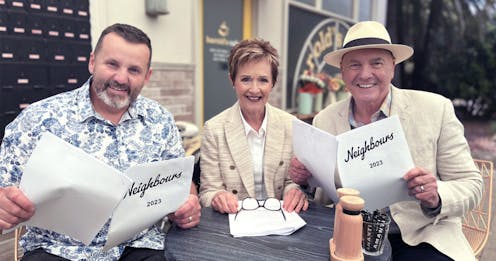
Many were shocked by the announcement last Friday[1] that Australian soap opera Neighbours would return to screens in 2023, courtesy of a new deal between production house Fremantle Australia and multinational digital streamer Amazon. Significantly, this announcement overturns many expectations about television in the age of streaming.
When news of Neighbours’ cancellation[2] broke earlier this year, streamers declined to offer a lifeline, with veteran cast member Stefan Dennis (aka Paul Robinson) lamenting that soaps seemed out-of-kilter[3] with the demands of streaming.
Back in February, journalist Michael Idato noted[4] streamers were focused on “short-order, very high quality” blue-chip programming, with long-running, continuing soaps like Neighbours presenting a less attractive option despite loyal fans and healthy audience numbers. After all, when axed by UK Channel 5, Neighbours was still attracting 1 million daily viewers in the UK alone.
So what has changed? Why is Melbourne’s own beige yet beloved (by some) Neighbours positioned at the precipice of a new dawn in streaming’s evolution?

What’s the value of Neighbours to a streamer?
Amazon’s resuscitation of Neighbours is unprecedented in the Australian context, as it represents the first time a multinational streaming service has commissioned a stripped (weeknightly), continuing soap. Yet, in a global context, Neighbours seems to be part of a recent trend. This year, soaps in other significant Anglophone markets shifted from daily broadcast to online streaming: Hollyoaks in the UK and Days of Our Lives in the US.
No one knows how this will play out for the US-based streamer and its new ad-supported, free streaming service Amazon Freevee[5]. What we do know is there are very good reasons why a streaming platform could be interested in a show like Neighbours.
The value of soaps is entrenched in industry lore. Since their transition from radio to television in the US during the 1950s, continuing soap operas have provided the backbone of many a network, ensuring consistent, returning and ardently loyal audiences. In doing so, soaps have a proven ability to weather the storms of radical technological and industrial change.
A similar logic prevailed presumably in 2011, when Network 10 shifted Neighbours onto its new free-to-air channel 10 Peach[6]. On the one hand, this move signalled a marginalisation of the prime-time soap. On the other hand, it was a means to lure a valuable audience to the fledgling multichannel.
Idato refers to Neighbours as a “library series[7]”: one with an extensive back catalogue of content. With 37 seasons and more than 8,000 episodes under its belt, Neighbours puts supposedly mega-series like Game of Thrones, The Simpsons and Supernatural to shame. Library series bring inventory and depth to a streaming service in a way that new content cannot, no matter how heavily promoted or highly produced it might be.
Read more: The loss of Neighbours is a loss of career pathways for Australia's emerging screen professionals[8]
Currently, streamers are looking not just to attract new subscribers, but to retain them by keeping them engaged with the platform. Series that come with their own in-built library of content developed over multiple years or decades can benefit streamers precisely by bringing with them their large, loyal audiences while offering countless episodes for fans to explore.
The Fremantle/Amazon deal seems to signal something quite the opposite of previous predictions, pointing to the increase of “low-prestige” programming on streaming platforms and the rising tendency for streamers to adopt and adapt pre-existing televisual logics and strategies. We are seeing the resumption and resurrection of patterns of broadcast, free-to-air programming, not its demise.
In the context of Amazon, one reason for this shift is likely the Federal Arts Minister Tony Burke’s confirmation last Thursday of government plans to introduce local content quotas for streaming[9] services. At the 55th annual Australian Writers Guild Awards, Burke stated he had already met with streamers to inform them of the forthcoming policy. In light of this development, Amazon’s renewal of Neighbours will help it to meet Australian content requirements.
Has TV streaming reached maturity?
It seems we are moving into a new, more mature phase of streaming television. Initially, streamers sought to loudly distinguish themselves from older forms of television, but they now seem less focused on branded distinction and more concerned with getting down to business.
Like the networks that dominated TV in the 20th century, streamers now pursue multiple interests, popular taste communities and tried and tested formulas, alongside edgier-style, prestige programming like Sex Education and this year’s Australian reboot Heartbreak High[10].
Similarly, streamers are now reverting to old-style revenue models through the introduction of ad-supported subscription tiers[11].
Television is changing, most notably in its separation from the broadcast programming schedule. But the logics of what attracts and retains audiences are far from obsolete – they are merely being updated for digital delivery. Soap operas are widely denigrated, but they can prove to be a guiding light in moments of media transformation.
References
- ^ announcement last Friday (www.theguardian.com)
- ^ news of Neighbours’ cancellation (www.abc.net.au)
- ^ out-of-kilter (theconversation.com)
- ^ Michael Idato noted (omny.fm)
- ^ Amazon Freevee (www.amazon.com)
- ^ 10 Peach (en.wikipedia.org)
- ^ library series (omny.fm)
- ^ The loss of Neighbours is a loss of career pathways for Australia's emerging screen professionals (theconversation.com)
- ^ government plans to introduce local content quotas for streaming (www.afr.com)
- ^ Heartbreak High (theconversation.com)
- ^ introduction of ad-supported subscription tiers (www.theage.com.au)