Can customary harvesting of NZ's native species be sustainable? Archaeology and palaeo-ecology provide some answers
- Written by: Nic Rawlence, Senior Lecturer in Ancient DNA, University of Otago
Aotearoa’s wilderness areas are the jewel in our ecotourism crown. But conservation laws may soon be in for a radical shake-up.
Recent proposals[1] would, among other things, allow Māori to resume traditional harvesting practices (mahinga kai) on conservation land.
This has elicited heated emotions[2] from some conservationists, who fear that biodiversity protection will be compromised, as well as from proponents of mahinga kai, who have been alienated from their traditional lands and customs for more than 130 years.
What does this all mean for our native species?
The times are a-changing
Article Two of Te Tiriti o Waitangi[3] guaranteed Māori authority over natural resources. But, with government-administered and legally enforced[4] “no take” policies covering most conservation land and native species, it is little wonder that many Māori feel alienated from their traditional lands and practices.
Article Four of the Conservation Act 1987[5] states the government must give effect to the principles of Te Tiriti. In 2022, in response to these disparities, the Department of Conservation released a report[6] calling for an overhaul of Aotearoa’s conservation laws to have Māori at their heart. This was a move away from “preservation and protection” to “maintenance, enhancement and sustainable use”.
The report received a lukewarm reception from the government. But it is likely only a matter of time before many of these changes begin to be implemented.
Read more: Fishing with Elders builds these children’s Oji-Cree language, cultural knowledge and writing[7]
There are many precedents. Indigenous peoples in many countries lawfully practice traditional harvesting[8] of some protected species. Customary management areas[9] in Aotearoa, such as mātaitai reserves and taiāpure, demonstrate that community and Indigenous leadership can be effective at managing resources.
In many instances, communities may be more motivated to support conservation measures if species can also be used as a resource, such as the harvesting of tītī (sooty shearwaters).
How do we ensure any harvesting is sustainable in this fast-changing world? Mātauranga (knowledge) and tikanga (custom) Māori, developed over centuries, can provide many of these answers. Combined with scientific methods and data, these bodies of knowledge create a powerful base from which managers can make robust and evidence-based decisions about harvest practices.
Read more: Indigenous hunters are protecting animals, land and waterways[10]
The past is the key to the present
Kia whakatōmuri te haere whakamua – I walk backwards into the future, with my eyes fixed on my past.
Palaeo-ecology, archaeology and matāuranga Māori share the philosophy that we can learn from the past. All three allow us to reconstruct how past ecosystems functioned, how people and species adapted to harvest pressures[11] and climate change, and how we can use this information moving forward.
Palaeo-ecology and archaeology draw on many tools:
radiocarbon-dating[13] anchors archaeological and fossil remains in time
stable dietary isotopes[14] help determine diet and where animals fitted into the food chain
ancient DNA[15] is used to determine how and when genetic diversity and population sizes changed through time
statistical modelling[16] can show how abundance and distributions of plants and animals have changed, and may continue to change in the future.
This information can paint a picture of how past ecosystems responded to human impacts as well as predicting how future impacts may affect species and populations.
To harvest or not to harvest?
Globally, waves of human settlement generally correlated with the rapid extinction of local species. Hunting rates that would have been sustainable for closely related species still culminated in the flightless great auk’s extinction[17].
Many of Aotearoa’s plants and animals are slow to reproduce. Ancient DNA analysis and modelling[18] have shown even very low levels of human harvesting resulted in the rapid decline and extinction of numerous New Zealand sea lion lineages. Less than one sea lion killed per person per year, despite a small human population at the time, was enough to seal their fate.
Other charismatic, slow-breeding animals that would be similarly vulnerable to even low levels of harvest, even if we managed to restore their populations to moderately “healthy” levels, include kākāpō[20], tawaki[21] (Fiordland crested penguin[22]), hoiho[23] (yellow-eyed penguin[24]) and matapo[25] (Otago shag[26]).
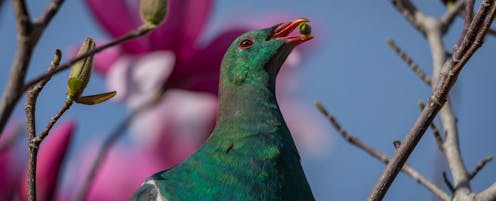
Conversely, several locally abundant species, such as weka[27], kererū[28] and kakīānau[29] (black swan) could probably be sustainably harvested[30] in some areas as long as careful guidelines are in place. The archaeological record shows some of these species were regularly hunted for hundreds of years with little evidence of population decline.
Looking to the future
No-one is proposing free-for-all harvesting. Poorly managed and unregulated harvest would be a terrible set-back to recent restoration and conservation efforts. But conservation and mahinga kai principles are not mutually exclusive. Both stand to benefit from ecosystem restoration.
Palaeo-ecological tools and insights from archaeology can help inform ecosystem restoration projects by establishing which species or lineages[31] were present in a region. They can also facilitate translocations without unexpected ecological consequences[32] or failure due to lack of suitable habitat or food[33].
Modern ecosystems in Aotearoa are highly degraded and not comparable to those of centuries ago. They are vulnerable to a range of old and new threats[35], including invasive predators, habitat loss or modification, and climate change.
An open-ended ethical question driving much of the controversy is whether endangered species should ever be intentionally killed.
Some endangered species might eventually sustain a harvest of, at most, only one or two individuals per year. Such exceedingly limited harvest may be enough to preserve some of the tikanga and mātauranga associated with mahinga kai.
In Te Tiriti, Māori were guaranteed the right to manage and use natural resources. Integrating traditional management practices with a range of scientific tools could enable communities to make evidence-based decisions around what constitutes “sustainable” harvesting. Mahinga kai, science and conservation need not be at odds with one another: they all have a future in Aotearoa.
References
- ^ proposals (www.doc.govt.nz)
- ^ elicited heated emotions (northandsouth.co.nz)
- ^ Te Tiriti o Waitangi (waitangitribunal.govt.nz)
- ^ legally enforced (www.odt.co.nz)
- ^ Conservation Act 1987 (www.legislation.govt.nz)
- ^ report (www.doc.govt.nz)
- ^ Fishing with Elders builds these children’s Oji-Cree language, cultural knowledge and writing (theconversation.com)
- ^ traditional harvesting (theconversation.com)
- ^ Customary management areas (www.mpi.govt.nz)
- ^ Indigenous hunters are protecting animals, land and waterways (theconversation.com)
- ^ species adapted to harvest pressures (onlinelibrary.wiley.com)
- ^ CC BY-ND (creativecommons.org)
- ^ radiocarbon-dating (www.rnz.co.nz)
- ^ stable dietary isotopes (newzealandecology.org)
- ^ ancient DNA (theconversation.com)
- ^ statistical modelling (onlinelibrary.wiley.com)
- ^ great auk’s extinction (hakaimagazine.com)
- ^ analysis and modelling (www.rnz.co.nz)
- ^ CC BY-SA (creativecommons.org)
- ^ kākāpō (nzbirdsonline.org.nz)
- ^ tawaki (www.sciencedirect.com)
- ^ Fiordland crested penguin (nzbirdsonline.org.nz)
- ^ hoiho (onlinelibrary.wiley.com)
- ^ yellow-eyed penguin (nzbirdsonline.org.nz)
- ^ matapo (onlinelibrary.wiley.com)
- ^ Otago shag (nzbirdsonline.org.nz)
- ^ weka (nzbirdsonline.org.nz)
- ^ kererū (nzbirdsonline.org.nz)
- ^ kakīānau (nzbirdsonline.org.nz)
- ^ sustainably harvested (besjournals.onlinelibrary.wiley.com)
- ^ species or lineages (royalsocietypublishing.org)
- ^ unexpected ecological consequences (newzealandecology.org)
- ^ suitable habitat or food (theconversation.com)
- ^ CC BY-SA (creativecommons.org)
- ^ old and new threats (www.newsroom.co.nz)