who is winning the ideological war over the future of Ukraine?
- Written by: Robert G. Patman, Professor of International Relations, University of Otago
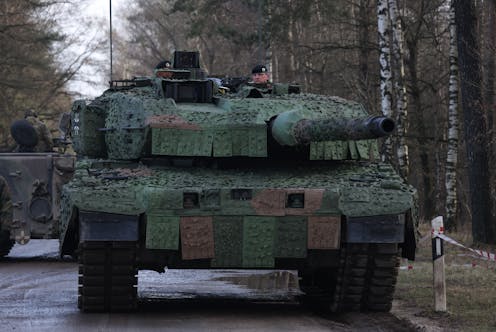
The recent decision by Olaf Scholz’s German government to supply Ukraine with Leopard 2 tanks[1] – after weeks of clear reluctance[2] to provoke Vladimir Putin – was more than a domestic policy shift.
It also demonstrated how Russia’s invasion of Ukraine could prove to be a tipping point in a long-running battle of ideas between two schools of thought in the field of international affairs.
Scholars refer to the two camps as liberals and realists. A defining characteristic of liberalism is its view that global politics is an arena where moral values, legal norms and institutions are crucial for regulating the behaviour of states, and increasing the prospects of cooperation and peace.
The classical realist or “realpolitik” tradition, by contrast, remains sceptical about peace. It believes states are essentially driven by the pursuit of power and national interests through a reliance on military might. It views the international arena as essentially anarchic.
These two approaches have been visible in much of the commentary following Russia’s full scale invasion in February 2022. In particular, the two camps have clashed over how the war in Ukraine should end.
Appeasement or resistance?
On the one hand, many realists believe the only way out of the current conflict is a negotiated peace. That involves recognising, in the words of US political scientist John Mearsheimer[3], the “taproot of the current crisis is NATO expansion”.
Ukraine must be encouraged, in some shape or form, to concede territory to Russia in order to end the invasion. Realists say it’s important for the West to recognise the legitimate security interests of a great power in Ukraine, and to avoid running the risk of Moscow forming a permanent alliance with China.
Read more: US will give military tanks to Ukraine, signaling Western powers' long-term commitment to thwarting Russia[4]
Moreover, they claim Ukraine cannot defeat the Russian occupation force because, if necessary, Putin will use nuclear weapons to ensure a “victory” – a prospect that worsens the stability of Europe and the world.
On the other hand, liberal hawks – sometimes called neo-idealists – maintain Russia’s Ukraine invasion is such a fundamental violation of the UN Charter that it has eliminated the moral and practical scope for a diplomatic compromise.
Negotiation in this context would only reward Putin’s aggression and undermine an international rules-based order that sought to uphold the territorial integrity and political independence of all states.
Hawks and doves
Liberals acknowledge there are two ways of ending Putin’s annexation attempt in Ukraine. First, the Putin regime has the option of belatedly recognising its invasion is illegal, and withdrawing its troops to the internationally recognised borders of Russia.
Second, allies and supporters of Ukraine should ensure that Kyiv is sufficiently armed and equipped to fight a just war. Putin’s invading army is either defeated or the costs of the invasion become too high and Moscow is obliged to end its occupation.
Read more: Ukraine recap: supply of German and US tanks to make Kyiv 'a real punching fist of democracy'[5]
Nearly 12 months on, it’s clear among the states supporting Ukraine that the hawkish liberal view – that Putin’s military venture must fail – has steadily edged out the dovish realist perspective that Putin should be appeased with some sort of land for peace deal.
Germany’s decision to supply tanks to Ukraine exemplifies the shift in thinking. But the ascendency of the liberal hawks is the product of long and short-term trends before and during the Ukraine conflict.
For one thing, a realist worldview has not sat comfortably with an increasingly interconnected world. Having struggled to explain events like the end of the Cold War and 9/11, realist diplomats and scholars have nevertheless insisted that great powers still call the shots in world politics.
The NATO factor
The Russian invasion has also significantly eroded the realist case for ending the conflict.
The argument that NATO enlargement[6] caused the Putin regime to attack looks unconvincing. It was not Washington but the states of Eastern Europe, historically fearful of Russian dominance, that clamoured for NATO membership.
Indeed, many neighbouring states have backed President Volodymyr Zelenskyy’s view that Putin’s invasion is part of a Russian imperial project that can be traced back to Peter the Great and which seeks to reestablish a Russian sphere of influence in Eastern Europe.
Furthermore, Zelenskyy has successfully rejected any suggestion of moral equivalency between his democratically elected government and Putin’s authoritarian regime, whose invading troops are suspected of committing war crimes.
The Zelenskyy government has vowed it has the right to fight “until it regains all its territories” from Moscow, and the Biden administration in the US has swung strongly behind[7] this position.
Read more: Why Russia's war in Ukraine today is so different from a year ago[8]
Great powers can lose
The Biden stance reflects US respect for the outstanding performance of the Ukrainian military on the battlefield and also the growing resistance to appeasing an outright aggressor.
That would be a recipe for encouraging more territorial demands from the Putin regime, and perhaps embolden China to put even more pressure on Taiwan.
At the same time, the successful Ukrainian counteroffensive[9] in the last quarter of 2022 was a reminder to its supporters in NATO and elsewhere that great powers can and do lose wars against smaller adversaries.
With the right level of military support in 2023, Ukraine could realistically defeat Putin’s invading army.
Ultimately, the hawkish liberal vision of helping to ensure Putin’s defeat has seemingly prevailed because it offered the best prospect of justice for the victim of aggression. It also bolsters an international rules-based order threatened by the illegal use of force.
References
- ^ supply Ukraine with Leopard 2 tanks (www.theguardian.com)
- ^ clear reluctance (www.bbc.com)
- ^ words of US political scientist John Mearsheimer (www.nytimes.com)
- ^ US will give military tanks to Ukraine, signaling Western powers' long-term commitment to thwarting Russia (theconversation.com)
- ^ Ukraine recap: supply of German and US tanks to make Kyiv 'a real punching fist of democracy' (theconversation.com)
- ^ NATO enlargement (theconversation.com)
- ^ swung strongly behind (www.theguardian.com)
- ^ Why Russia's war in Ukraine today is so different from a year ago (theconversation.com)
- ^ Ukrainian counteroffensive (www.aljazeera.com)