People blame and judge parents for children's heavier weights
- Written by: Jaimie Arona Krems, Assistant Professor of Psychology, Oklahoma State University
The Research Brief[1] is a short take about interesting academic work.
The big idea
Americans stigmatize parents of heavier children, specifically blaming them for their children’s weights[2], according to experiments conducted by our[3] team[4] of psychologists[5].
The more a person views parents as responsible for a child’s excess weight, the more likely they are to view such parents as bad parents[6] who are lazy, overindulgent and incompetent.
Our findings corroborate what parents of children with higher weights have reported for years: that other people – friends, other parents, strangers or even their pediatricians[7] – might blame them, dislike them and think they are poor parents[8].
Why it matters
In the U.S., about 1 in 3 children[9] have body mass indexes that would be categorized as overweight or obese. The number has grown during the COVID-19 pandemic[10], meaning an increasing number of parents face stigma on account of their child’s weight.
This parental weight stigma[11] is just beginning to receive serious scientific attention but could have major effects on parents, children and families.
For example, family courts[12] across the U.S.[13] and internationally[14] have removed children with obesity from parental custody in large part due to their children’s weights. Family separation can have massive negative effects on children[15]. Our work[16] suggests that if judges react as our study participants did, they may view parents of heavier children as being bad parents simply because their children are heavier.
In reality, weight is not solely[17] under personal control[18]. In fact, dieting can[19] cause weight gain[20]. Excess weight arises from a complex interplay of genes, environment, diet and activity[21].
Psychologists also know that weight stigma is associated with pervasive negative consequences[22], including bullying, ignorant comments and feelings of painful invisibility – as well as diminished educational and economic opportunities[23] and worse medical outcomes importantly not simply due to one’s weight[24]. Experiencing weight stigma, insidiously, might itself facilitate weight gain[25] and cause other negative effects.
What still isn’t known
If people blame and stigmatize parents of children with higher weights, what effects does it have on parents, on their children and on the parent-child interactions that are so important for healthy development?
We do not yet know, for example, if heavier children are aware people stigmatize their parents. If so, these children might not only be ashamed of their size, but also might erroneously feel responsible for how people treat their parents.
How we do our work
For this research, published in the journal Psychological Science, we ran three experiments with over 1,000 U.S. participants[27] – about 75% white and 25% other races/ethnicities – over the course of 2022.
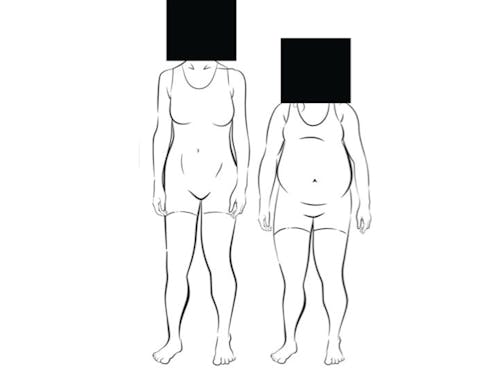
We randomly assigned participants to view one of four line drawings depicting a mother or father next to an 8-year-old daughter or son. We also included a short description of the parent and child.
In two of the line drawings and descriptions, the child was described and depicted as “healthy”-weight. In the other two, the child was depicted and described as having “obesity.” The parents were always depicted and described as being healthy-weight. This allowed us to conclude that study participants’ reactions to parents were due to their children’s weights, not the parents’.
We asked participants a few short questions about how good or bad a parent they thought the adult was. Participants also answered questions about what they believed influenced the child’s weight (as well as their academic performance and athleticism, to help obscure the focus of the study). Participants were given 100 “responsibility points” to allot to four factors that could be behind the child’s weight: parent behavior, child behavior, genetic factors and societal factors.
As expected, people who viewed the child with obesity assigned more responsibility points to parent behavior and saw that parent as a worse parent. We found parent and child gender made little difference, consistent with other work[28].
This is consistent with previous research[29] showing people blame parents for children’s obesity more than people blame society or the kids themselves.
We also tested whether providing alternative explanations for the child’s weight would decrease the amount of blame parents received for it. When we told participants the child had a thyroid condition that caused her excess weight, they stigmatized the mother less, holding her less responsible.
Next, our team is exploring how parents’ own weight, income and race/ethnicity influences the stigma directed toward them on account of their child’s excess weight.
References
- ^ Research Brief (theconversation.com)
- ^ blaming them for their children’s weights (doi.org)
- ^ our (scholar.google.com)
- ^ team (scholar.google.com)
- ^ psychologists (scholar.google.com)
- ^ view such parents as bad parents (doi.org)
- ^ even their pediatricians (www.nytimes.com)
- ^ might blame them, dislike them and think they are poor parents (doi.org)
- ^ about 1 in 3 children (www.hsph.harvard.edu)
- ^ grown during the COVID-19 pandemic (www.cdc.gov)
- ^ parental weight stigma (doi.org)
- ^ family courts (www.washingtonpost.com)
- ^ across the U.S. (www.cbsnews.com)
- ^ internationally (www.theguardian.com)
- ^ negative effects on children (socialchangenyu.com)
- ^ Our work (doi.org)
- ^ weight is not solely (www.ncbi.nlm.nih.gov)
- ^ under personal control (doi.org)
- ^ dieting can (doi.org)
- ^ cause weight gain (doi.org)
- ^ complex interplay of genes, environment, diet and activity (www.ncbi.nlm.nih.gov)
- ^ weight stigma is associated with pervasive negative consequences (psycnet.apa.org)
- ^ economic opportunities (doi.org)
- ^ worse medical outcomes importantly not simply due to one’s weight (doi.org)
- ^ might itself facilitate weight gain (doi.org)
- ^ roman023/iStock via Getty Images Plus (www.gettyimages.com)
- ^ three experiments with over 1,000 U.S. participants (doi.org)
- ^ consistent with other work (doi.org)
- ^ consistent with previous research (doi.org)
Read more https://theconversation.com/people-blame-and-judge-parents-for-childrens-heavier-weights-195263