What is a paraben and why are so many products advertised as 'paraben-free'?
- Written by: Oliver A.H. Jones, Professor, RMIT University
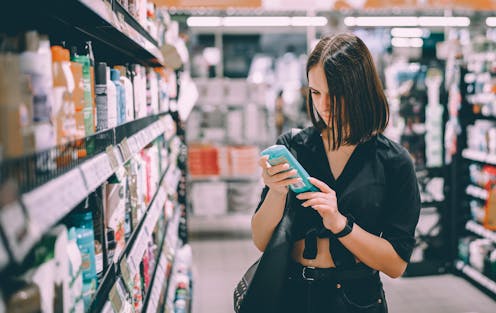
You might have noticed many skin and haircare products are advertised as “paraben-free”, or come across online influencers warning parabens are terrible for your health.
But what is a paraben? And could a minor ingredient in products that many of us use daily really be that bad for us?
Let’s take a closer look.
Read more: What does exposure to environmental chemicals mean for our health?[1]
What are parabens?
Chemically speaking, paraben is the collective name for a group of closely related compounds – the parahydroxybenzoates. The “para” refers to the positions of certain parts of the molecule (it’s also where the “para” in “paracetamol” comes from).
There are several different types of paraben, so you might see methylparaben, ethylparaben propylparaben, or butylparaben, in a product’s ingredient list. They may also be listed as a more formal chemical name. Methylparaben can be listed as 4-hydroxy methyl ester benzoic acid or methyl 4-hydroxybenzoate for example.
The shorter version is that parabens are a group of related molecules added in small amounts (less than 1%, usually lower) to food, drugs and cosmetics as preservatives.
They work by preventing the growth of harmful bacteria and fungi to improve product shelf life and safety. More than one paraben may be used, and they may be combined with other preservatives to protect against a broad range of microorganisms.
Parabens can be absorbed through the skin or ingested but are generally excreted quickly, usually via urine[2]. They have been in use for decades and no parabens have been banned in Australia[3].
Some studies[4] on cell cultures or animals have suggested parabens can affect the endocrine system (which controls our hormones) but it’s not clear how or even if this is relevant to humans[5].
The amounts used in some of those animal studies are much, much higher than you would find in make-up, for example. A lot of these studies[6] also involved feeding the chemicals to the animals or injecting them, rather than putting them on the skin (which results in much lower absorption into the body).
You might also have heard parabens are “oestrogenic” (meaning they can mimic or affect oestrogen in the body). In fact, parabens are far less oestrogenic[7] than natural oestrogen (that both males and females produce). They are also less oestrogenic than phytoestrogens[8], compounds produced naturally by many plants.
So, even though there have been studies raising concern, the overall risk in humans using parabens in normal doses is low. As the Australian Industrial Chemicals Introduction Scheme puts[9] it:
The available data do not indicate any risks associated with exposure to the chemicals in this group. The chemicals have been shown to have weak oestrogenic activity, but there are no established adverse outcome pathways for this effect.
The US Food and Drug Administration reached a similar conclusion, noting[10]
Studies have shown, however, that parabens have significantly less oestrogenic activity than the body’s naturally occurring oestrogen. Parabens have not been shown to be harmful as used in cosmetics, where they are present only in very small amounts.
Isn’t natural better? Aren’t human-made chemicals bad for you?
Whether something is natural or not tells you nothing about its safety.
Snake venom is natural, as is uranium, lead and mercury. I wouldn’t buy personal care products with these “natural” ingredients in them.
Many things we use every day without a second thought – like aspirin, nylon, and silicone cookware – are synthetic.
The name of a chemical also tells you nothing about risk. If I told you a substance contained ethyl butanoate, pentyl acetate, ethene and capric acid, would you eat it? Well, you probably already have; these are all found in bananas[11] and many other fruits.
So why are people worried about parabens, then?
This goes back to an often misinterpreted 2004 study that found parabens in breast tissue and breast cancers[12]. But this doesn’t mean much by itself and doesn’t justify claims parabens cause cancer.
Correlation is not causation. The presence of parabens in a tumour does not mean parabens caused the tumour.
In fact, the researchers in the 2004 study only looked at breast cancer tissue (and didn’t compare it with healthy tissue). They even found parabens in their blank samples (with no tissue in them at all). So, as others have noted[13], it’s hard to draw any real conclusion from it about the role parabens may or may not play in cancer risk.
A lot of the endocrine disruptor stuff you hear on social media about parabens is usually from someone trying to spruik a “natural” or “clean” alternative, so you might not be seeing the full picture.
And remember: the presence of something does not automatically mean it is harmful. Toxicology 101 is “the dose makes the poison”. Everything is toxic in the right amount, even water. We should not ask whether a chemical causes cancer or acts as an endocrine disruptor, but whether it does so at the levels to which we are exposed.
The scientific consensus from the US Food and Drug Administration[14], the Australian Industrial Chemicals Introduction Scheme[15] and the European Medicines Agency[16] and others is that for parabens at normal dosages, the health risk is very low.
So why are so many products marketed as ‘paraben-free’?
Going “paraben-free” has become a very effective marketing tool. If people want paraben-free products and will pay more for them, why not give them paraben-free products?
But paraben-free does not mean preservative-free, nor does it mean the products are safer (even if that’s what is implied).
If you remove parabens from a product, you need to add other preservatives, which may be less effective. This increases the risk of the product going off (some users of “clean” make-up brands have reported finding mould in products) and could even cause harm.
So what’s the verdict?
Ultimately, the choice to use products containing parabens is a personal one.
As a chemist I think parabens are well-researched, safe and and necessary, but if you are worried, you can opt for paraben-free products. Just be aware they will probably have a shorter shelf life, contain other (less effective) preservatives, and could well have other problems. I’d take a small amount of a well studied, and well-regulated[17], chemical in my skincare products over mould any day.
Read more: Health Check: is makeup bad for your skin?[18]
References
- ^ What does exposure to environmental chemicals mean for our health? (theconversation.com)
- ^ urine (www.ncbi.nlm.nih.gov)
- ^ Australia (www.choice.com.au)
- ^ Some studies (www.industrialchemicals.gov.au)
- ^ if this is relevant to humans (pubmed.ncbi.nlm.nih.gov)
- ^ studies (journals.sagepub.com)
- ^ far less oestrogenic (journals.sagepub.com)
- ^ phytoestrogens (www.ncbi.nlm.nih.gov)
- ^ puts (www.industrialchemicals.gov.au)
- ^ noting (www.fda.gov)
- ^ bananas (jameskennedymonash.wordpress.com)
- ^ breast tissue and breast cancers (pubmed.ncbi.nlm.nih.gov)
- ^ noted (www.youtube.com)
- ^ US Food and Drug Administration (www.fda.gov)
- ^ Australian Industrial Chemicals Introduction Scheme (www.industrialchemicals.gov.au)
- ^ European Medicines Agency (www.ema.europa.eu)
- ^ well-regulated (www.industrialchemicals.gov.au)
- ^ Health Check: is makeup bad for your skin? (theconversation.com)