More than 650 refugees arrived in this regional town. Locals' welcoming attitudes flipped the stereotype
- Written by: Sue Watt, Associate Professor in Psychology, University of New England
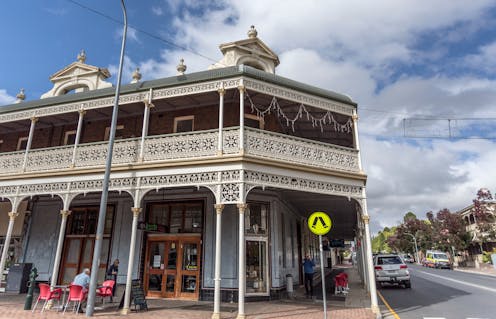
When we think of regional towns in Australia, some of us might think “close-knit”, “conservative”, or “resistant to change”.
Our new research[1] flips these stereotypes.
Over four years, we examined a regional town’s attitudes before and after hundreds of refugees settled in the area. Our surveys found residents of Armidale, in northeastern New South Wales, started out reasonably positive about the settlement program, and became even more so.
Over time, they had fewer concerns about the impact of refugees on the town, more contact with the refugees, and more positive attitudes towards refugees and the settlement program.
Read more: The regions can take more migrants and refugees, with a little help[2]
Welcoming communities
After a lengthy process, Armidale was chosen as a regional settlement location for Australia’s refugee program under the Turnbull government in 2017. Since 2018, the town has welcomed some 650 Ezidi refugees, boosting the town’s population by almost 3%.
Ezidis are a religious minority mostly from northern Iraq, Syria and Turkey, and are also known as Yazidis or Yezidis. They’ve faced persecution for centuries, including recently by Islamic State (or ISIS), who perpetrated genocide on the group[3] in the mid-2010s.
There are several elements in the equation for successful refugee settlement. Receptive, welcoming communities is one important part.
We documented shifts in the Armidale community’s attitudes towards refugee settlement through six successive surveys. Each surveyed about 200 residents, drawing a new sample each time.
Initially, the main concerns were whether there would be enough jobs, and whether local services were adequate.
Residents’ views changed significantly about how many refugees were OK to accept. The number of residents who believed the number was “too high” declined, and the number of people who thought it was “too low” increased.
But, of course, sentiment was not uniformly positive (or negative).
Residents’ views on the number of refugees coming to Armidale over time
We segmented the community to identify clusters of attitudes among like-minded people toward refugee settlement. Initially, there were four clusters, which we named “enthusiastic”, “positive”, “concerned” and “resistant”. Enthusiastic and positive formed the majority.
Over time, the positive clusters expanded, and the negative clusters reduced. By the final survey, our most negative cluster was, in fact, positive towards the refugees. We renamed it “cautious”.
Residents’ contact with Ezidis increased as time went on, and was overwhelmingly rated positively, with residents saying Ezidis were “friendly”, “grateful” and “polite”.
The final three surveys also re-interviewed participants from earlier surveys to examine changes in attitudes at the individual level. As with the community surveys, participants had more positive attitudes over time.
On average, the greatest change was among people who initially had reservations: those who started out negative became more positive. People who started out positive remained positive.
A model for regional settlement
It’s tempting to think of Armidale as an outlier in regional Australia. Local talk was that Armidale was “special” – highly educated, multicultural, welcoming.
But when we compared[5] Armidale with other similar areas in regional Australia, there were few differences.
Armidale was reasonably representative in socio-demographics and attitudes to immigration and multiculturalism. Contrary to expectations, Armidale actually rated slightly lower on social cohesion, and on having multicultural neighbourhoods. However, we found Armidale improved on all multiculturalism indicators during the settlement period.
Read more: Resettling refugees in other countries is not reliable, nor is it fair. So, why is Australia doing it?[6]
Our research showed Armidale progressively adapting and embracing the refugee settlement program, challenging stereotypes of regional Australia[7].
The study occurred during a time of disruption to the Armidale community through the impact of a severe drought followed by the COVID pandemic. Nonetheless, the community became increasingly positive, a result that speaks to the hard work of many people and organisations, and the efforts and strengths of Ezidis to settle as they build a new chapter of their lives in Australia.
Indeed, if Armidale is representative of inner regional Australia, which it appears to be, our results are promising for refugee settlement in other regional towns.
References
- ^ new research (www.ssi.org.au)
- ^ The regions can take more migrants and refugees, with a little help (theconversation.com)
- ^ perpetrated genocide on the group (www.dhi.health.nsw.gov.au)
- ^ University of New England and Settlement Services International (www.ssi.org.au)
- ^ compared (scanloninstitute.org.au)
- ^ Resettling refugees in other countries is not reliable, nor is it fair. So, why is Australia doing it? (theconversation.com)
- ^ stereotypes of regional Australia (doi.org)