what happened when Susan Johnson took her 85-year-old mother to live on a Greek island
- Written by: Jane Messer, Honorary Associate Professor in Creative Writing and Literature, Macquarie University
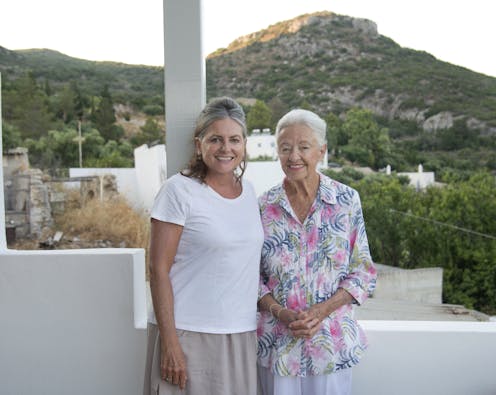
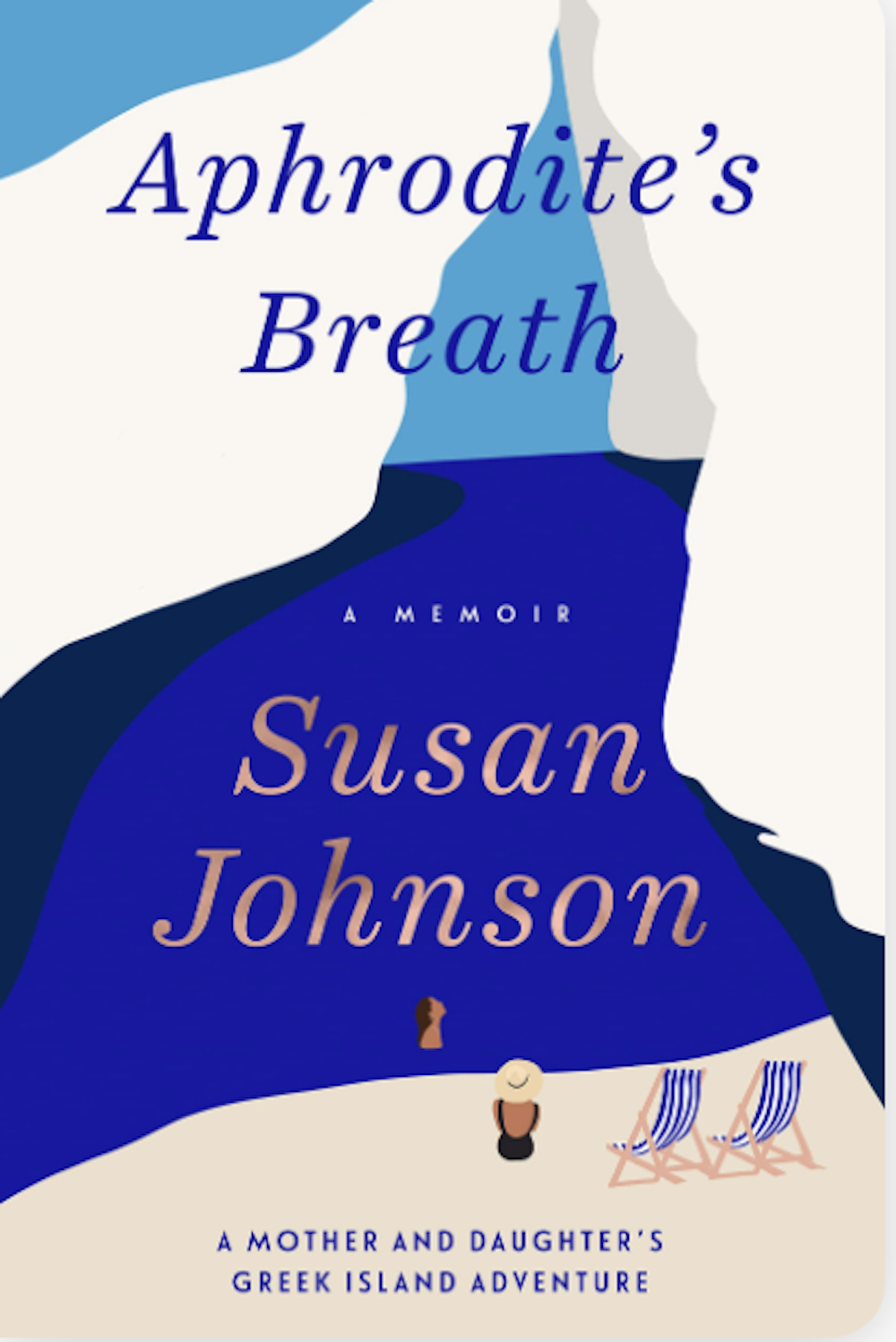
Have you ever dreamed of fleeing your current life and spending weeks or months or even a year living on an island in the Mediterranean? This is what Susan Johnson longed for and did, taking her mother with her to the Greek island of Kythera. Reading Johnson’s new memoir Aphrodite’s Breath while taking myself off for a month of writing near Naples was my second experience of living in a synchronicity of sorts with Johnson.
Johnson is just a few years older than me; a writer, mother and divorcee who has always – from a distance as we’re yet to meet – been well ahead of me with books, success and family. For a while we had the same literary agent and I’d hear of her latest publications and wish that I too had the tenacity and grit to finish my own books with such (deceptive) ease.
Review: Aphrodite’s Breath – Susan Johnson (Allen & Unwin)
I’d devoured her first memoir, A Better Woman[1], upon its publication in 1999. I read this postpartum memoir following the reassuringly uneventful births of my own children; as if a birth can ever not be momentous and harrowing, even when joyous. I too had been experiencing challenges in my own marriage, which I breathed not a word of to anyone, and was relieved and fascinated to read Johnson’s acute account of her first marriage.
A Better Woman still hasn’t found its equivalent in Australian memoir writing. Poetic, intelligent, gruelling, Johnson writes so well about the shock of the violence to her body from a childbirth that went horribly wrong, while trying to get manuscripts finished on time and retain some sense of herself as a writer, woman, mother, wife and lover. It’s both memoir and philosophy, as is Aphrodite’s Breath. You could consider A Better Woman as the first instalment of Aphrodite’s Breath “secret history of women”.
I and my writer and new-mother friends were all talking about it back then, and there’ll be many of us now talking about Aphrodite’s Breath: as daughters of ageing parents, as daughters to particular mothers, and as people who well understand Johnson’s longing for one last fling towards life lived with eros, filled with the breath of Aphrodite, before we are beset by our own ageing, enfeeblements, or pension poverty.
Johnson’s memoir opens in Brisbane. Her second marriage having ended, her sons grown and living overseas, the writer is wearied of the demands of full-time employment. She had lived on Kythera briefly in her late teens with Australian and Greek friends, and fallen in love with the place then.
There are other strings of narrative that tie her to the island. There are Kytherans in Australia whom she knows, and Australian Kytherans in Kythera, expats, migrants, children of migrants. Boldly, she quits her good job with its superannuation and holiday pay, gets herself a contract to write two books (the 2021 novel From Where I Fell[2], and this memoir) and, unwilling to leave her 85-year-old mother Barbara behind, encourages her to accompany her and to be part of the story.
Read more: Friday essay: a fresh perspective on Leonard Cohen and the island that inspired him[3]
‘I can’t see anything … I recognise’
This is very much the story of Kythera, and of being a daughter, a sometimes unsatisfactory daughter to a much loved but in many ways aloof mother.
Even here, I recognised something of my own relationship with my mother (is it generational?), a woman like Barbara, born in the 1930s. They don’t feel they have to like us, their daughters. Not that Barbara dislikes her daughter Susan; after all, they leave Brisbane to live on Kythera together for a year.
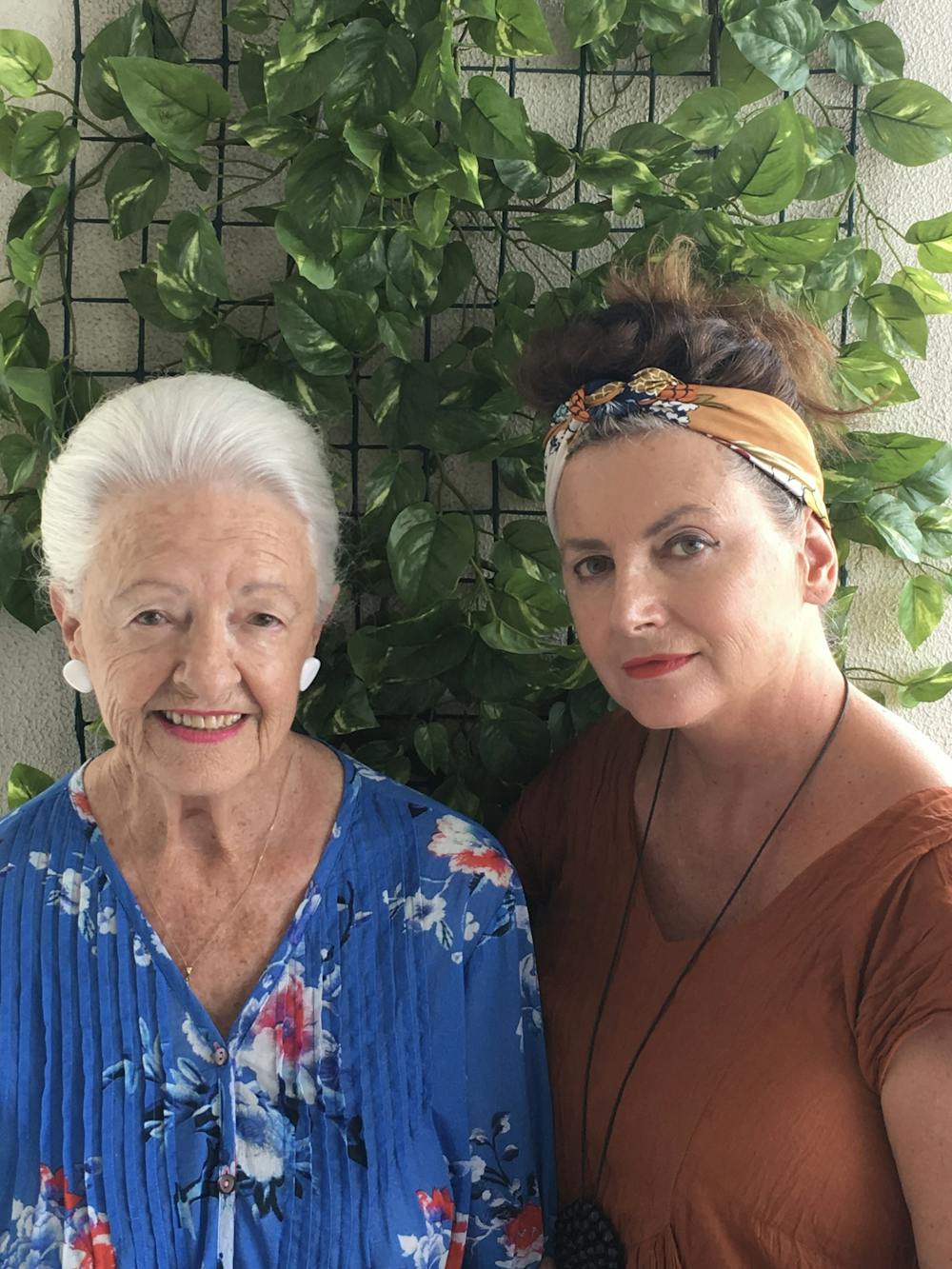
But it’s one of the many truths Johnson discovers on Kythera, that even while her mother defends her as a writer, always, she doesn’t always admire her as a person.
Barbara is fully aware that she will become one of the memoir’s threads of story. But frustratingly for Johnson, she does not embrace Kytheran life, or does so unpredictably. They arrive in winter to poor heating and a “ceaseless crying wind” that Barbara, a Queenslander through and through, understandably finds unbearable. After a while, Johnson locates a new house for them to live in: warmer, prettier, and with neighbours who become close friends.
She tries in so many ways to make Barbara comfortable.
If I have given the impression I was concerned for her welfare because she was the timid, pleasing sort, let me correct that.
Barbara often refuses to go with Johnson on walks, or into churches to view icons and other “sinful acts of idolatary”, or accompany her on other adventures across the island. She is uninterested in hearing from her daughter about the island’s ancient or recent history, its place in the great myths and legends. Frequently (but not reliably) she is wary and even dislikes their visitors and new friends, Kytheran and Australian. (Johnson says nothing to her about an hilarious affair with a foolish Frenchman.)
Barbara often sees strangeness where Johnson sees the marvellous. About the night sky, Barbara says, “I can’t see anything […] I recognise”.
Johnson starts to wonder if resistance is her mother’s intention:
Could it be that Mum was giving me nothing to write about? ‘My Mother Went to Greece and Watched Netflix’ was a title unlikely to race off the shelves.
Johnson cannot dismiss the friction between them. They argue, there are silences, but then things shift again. Spring begins, with “wild yellow crocuses spilling like sunshine down the hills”. Even still, they make the decision that Barbara will return to Australia earlier and Johnson will continue on her own.
Barbara’s response to the island is antithetical to Johnson’s. Ultimately she functions as an important foil to the author’s quest; the seeker in the story must encounter obstacles of mythic proportions, and Barbara is that. Barbara resists the whole notion of travel as a celebration of mobility, or as a rite of passage, or of the capacity of the self to colonise and reinvent itself in the new place. She steadfastly does not want to remake herself.
Read more: COVID changed travel writing. Maybe that's not a bad thing[4]
A new grief
The book has many chambers, many beating hearts. There is the story of a writer hard at work researching, note-taking, editing, writing; that is, earning a living. And through it all, the warm big heart of the island itself.
The first chapters are in places dense with historical minutiae, difficult to appreciate unless one is familiar with Kythera (which I am not). There is also the tragic story of Rosa Kasimati, the mother of a famous Kytheran, Lafcadio Hearn[5], who was separated from him when he was a young child. Johnson aims to give Kasimati a key place in the memoir, but Kasimati and Hearn both remain peripheral.
 Once the memoir settles into its rhythms, the island shimmers under Johnson’s prose. Johnson lives there through all the seasons, through deftly shared stories about new friendships, and the harvesting of olives, of parties and meals, of watching the fishing boats and ferries, of walks between villages, of dancing “down in the hidden cool of the springs” and feeling part of “a long line of dancers stretching into the limits of knowable time”.
The memoir doesn’t end on Kythera. Like other Kytheran Australians and expats, Johnson returns to Australia during the pandemic. The frequent flashes of humour are forgone. Soon there is a new grief to face with Barbara’s death, and acknowledgement that away from Kythera, Johnson now “could not comprehend the passage of time, or that a human life span had an ending”.
Johnson herself becomes seriously ill, and the gift of their shared time on Kythera is that she now understands “the sheer density of being — of the physical world and our bodies moving through it […] of the song of the world being recited by ordinary people.”
Reading this I paused, thinking about my own aged parents, reminded of the beauty and terror of our shared mortality. Aphrodite’s Breath is one of those sublime books that both pleases and pursues you with its imagery and thoughts, long after you’ve put the book down.
References^ A Better Woman (www.goodreads.com)^ From Where I Fell (www.goodreads.com)^ Friday essay: a fresh perspective on Leonard Cohen and the island that inspired him (theconversation.com)^ COVID changed travel writing. Maybe that's not a bad thing (theconversation.com)^ Lafcadio Hearn (en.wikipedia.org)
Once the memoir settles into its rhythms, the island shimmers under Johnson’s prose. Johnson lives there through all the seasons, through deftly shared stories about new friendships, and the harvesting of olives, of parties and meals, of watching the fishing boats and ferries, of walks between villages, of dancing “down in the hidden cool of the springs” and feeling part of “a long line of dancers stretching into the limits of knowable time”.
The memoir doesn’t end on Kythera. Like other Kytheran Australians and expats, Johnson returns to Australia during the pandemic. The frequent flashes of humour are forgone. Soon there is a new grief to face with Barbara’s death, and acknowledgement that away from Kythera, Johnson now “could not comprehend the passage of time, or that a human life span had an ending”.
Johnson herself becomes seriously ill, and the gift of their shared time on Kythera is that she now understands “the sheer density of being — of the physical world and our bodies moving through it […] of the song of the world being recited by ordinary people.”
Reading this I paused, thinking about my own aged parents, reminded of the beauty and terror of our shared mortality. Aphrodite’s Breath is one of those sublime books that both pleases and pursues you with its imagery and thoughts, long after you’ve put the book down.
References^ A Better Woman (www.goodreads.com)^ From Where I Fell (www.goodreads.com)^ Friday essay: a fresh perspective on Leonard Cohen and the island that inspired him (theconversation.com)^ COVID changed travel writing. Maybe that's not a bad thing (theconversation.com)^ Lafcadio Hearn (en.wikipedia.org)