Turkey's Erdogan is facing re-election to hold onto power – can a divided opposition oust the strongman?
- Written by: Khalid Al Bostanji, PhD candidate, Australian National University
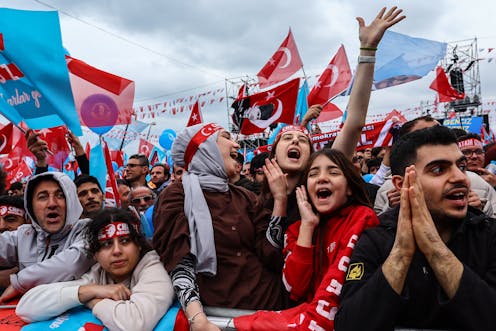
As Turkish voters head to polls for the presidential and parliamentary elections on May 14, the biggest question is whether President Recep Tayyip Erdogan’s two-decade-long grip on power[1] can be challenged.
Turkey’s main opposition parties have made a range of promises that include boosting the economy, democratising the political system, separating religion from state affairs and improving the country’s ties with the West.
However, it is increasingly clear there are significant differences in the positions of each party in the opposition coalition. Serious questions remain as to how much change one can expect to see, even if Erdogan is defeated.
Many Turkish citizens would like to see new policies to lift Turkey out of one of the most severe economic crises it has experienced in the last two decades. But the political issues are even more complex. Any issues related to the political system, secularism and foreign relations have become more polarised as Erdogan has consolidated his power in recent years.
A divided opposition
Turkey’s largest opposition party is the Republican People’s Party (the Turkish acronym for which is CHP). Formed by the founder of Turkey’s secular republic, Mustafa Kemal Ataturk, this party remains loyal to the ideology of Turkish nationalism and is considered to be in the centre-left of politics.
CHP has aligned itself with other nationalist and conservative forces[2] in a coalition called the Nation Alliance, whose combined shares of the vote might be enough to defeat Erdogan’s Justice and Development Party (also known as the AK Party).
Read more: Will the Turkish earthquakes affect how the country is governed?[3]
While there is widespread scepticism about polling in Turkey, the most recent surveys have showed that CHP’s position is relatively strong[4] in the presidential race. In the parliamentary elections, however, Erdogan’s conservative policies seem to be serving the AK Party well.
This is a problem for the opposition, which has not done enough to counter the conservative politics of the ruling alliance.
The leader of the opposition is Kemal Kilicdaroglu, whom the Nation Alliance has nominated as its presidential candidate. This is despite Kilicdaroglu’s relatively low credibility with the public, as compared to other CHP figures.
Kilicdaroglu has pledged to deport the large number of refugees who have sought shelter in Turkey since 2011 when the war began in Syria. The opposition has argued this is a primary reason why Turkey is suffering economically, despite the widely acknowledged role of Erdogan’s disastrous monetary policy[5].
Read more: Turkey's currency crisis is a textbook example of what not to do with interest rates[6]
However, other nationalist and left-leaning forces with significant public support have decided to stay outside the Nation Alliance.
On the nationalist side, the opposition candidate for the 2018 presidential elections (Muharrem Ince) is running on behalf of his new Homeland Party. Ultra-nationalists are also being represented by the Ancestral Alliance coalition, led by Sinan Ogan.
Parties on the left, on the other hand, have only been able to run in the parliamentary elections[7]. Potential candidates from Turkey’s large Kurdish minority have faced particular difficulty in nominating themselves for the presidential race. Many of them have been imprisoned[8] on charges of being linked to the outlawed Kurdistan Workers’ Party. Their only option is to back Kilicdaroglu, which some have done.
Erdogan is, of course, the AK Party’s candidate for president. The party has been in power since 2002 when it won a majority of seats in the parliamentary elections for the first time. Erdogan became prime minister in 2003, and then won the presidential election in 2014 before being reelected in 2018. If he is elected, this would be his final term.
The AK Party is a conservative party with Islamist origins, currently in a coalition with the far-right Nationalist Movement that has become fragmented and unpopular. Despite this unpopular coalition, Erdogan himself has managed to maintain somewhat favourable ratings with the public.
No checks on the president
One of the biggest pledges the Nation Alliance has made is to return Turkey’s presidential political system back to a parliamentary system[9]. Since Erdogan pushed through a referendum in 2017 to abolish the prime minister’s office, the president has been able to exercise an unprecedented level of power.
Many observers blame the referendum for removing crucial checks on presidential power[10].
In addition, the opposition has also assured voters it will mend fences with Europe[11] after ties deteriorated sharply under Erdogan’s rule. It would try to unfreeze Turkey’s European Union accession talks, which have been stalled since 2018 due to the country’s democratic backsliding. Turkey’s economic and political partnerships with Russia[12] have also been an issue for the EU.
Perhaps more importantly, in terms of foreign policy, the opposition is promising to foster better relations with countries in the Middle East. These ties have frayed because of Turkey’s aggressive foreign policy and incidents like the murder of journalist Jamal Khashoggi[13] at the Saudi consulate in Istanbul in 2018, which caused a rift between Turkey and Saudi Arabia.
The opposition is also pledging to expedite the country’s rapprochement with Israel, the Gulf states, Egypt and Syria.
Erdogan has yet to fully normalise relations with these states, as they are still wary of Turkey’s regional influence under the AK Party’s rule. Erdogan has positioned Turkey as a middle power with strategic influence in the Middle East and the wider region, particularly after the Arab Spring. This influence is unlikely to fade soon, regardless of the elections.
So, will a change in Turkish leadership transform Turkey and the region?
The answer is not simple. But it’s likely much will stay the same. Many key institutions in Turkey like the parliament, judicial system and press have lost their independence during the Erdogan era.
Erodgan’s party has become very influential in both domestic and foreign policy, which means his footprint will not disappear immediately, even if he is not re-elected. Rather, Erdogan will have a lasting social, economic and political legacy for both Turkey and its neighbours.
References
- ^ two-decade-long grip on power (apnews.com)
- ^ other nationalist and conservative forces (www.dohainstitute.org)
- ^ Will the Turkish earthquakes affect how the country is governed? (theconversation.com)
- ^ CHP’s position is relatively strong (www.euronews.com)
- ^ Erdogan’s disastrous monetary policy (www.economist.com)
- ^ Turkey's currency crisis is a textbook example of what not to do with interest rates (theconversation.com)
- ^ only been able to run in the parliamentary elections (newleftreview.org)
- ^ imprisoned (www.economist.com)
- ^ return Turkey’s presidential political system back to a parliamentary system (www.aljazeera.com)
- ^ removing crucial checks on presidential power (www.theguardian.com)
- ^ mend fences with Europe (www.politico.eu)
- ^ economic and political partnerships with Russia (foreignpolicy.com)
- ^ murder of journalist Jamal Khashoggi (www.theguardian.com)