Why exercising your 'good arm' can also help the one in a sling
- Written by: Ken Nosaka, Professor of Exercise and Sports Science, Edith Cowan University

Injured limbs need rest. They are often kept in a sling or cast to immobilise them as a way to promote healing. But that can mean smaller and weaker muscles several weeks later. It takes a long time to rehabilitate these muscles and muscle strength and function may not be fully restored[1] for some people.
Experts are learning more and more about the “cross-education effect[2]” where training one side of the body results in an increased strength of the opposite side of the body. Our recent study[3] shows it can also stop muscle wasting in the “unused” arm.
So, how can we harness that effect?
How it works
First discovered[4] 100 years ago, the mechanisms underpinning the cross-education effect have not been fully clarified yet. But it is likely associated[5] with neural adaptations in the motor cortex of the brain that controls movement in the body.
Researchers have reviewed[6] almost 100 studies and showed the average cross-body transfer ratio between the strength gain in the trained muscle to non-trained muscle ranged from 48% to 77%. So, if your trained arm strength increased by 20% after training the same muscle of your non-trained arm strength might increase by 10% even though you did nothing with that arm.
Such changes could be due[7] to increased cortical excitability (the brain activity to control movement), reduced cortical inhibition (the signal to stop movements), reduced inter-hemispheric inhibition (the signals that direct movement instructions to one side of the body but not the other), changes in voluntary activation or new brain regions getting switched on.
It appears the type of muscle contraction in the training affects the extent of the cross-education effect.
There are three types of muscle contractions:
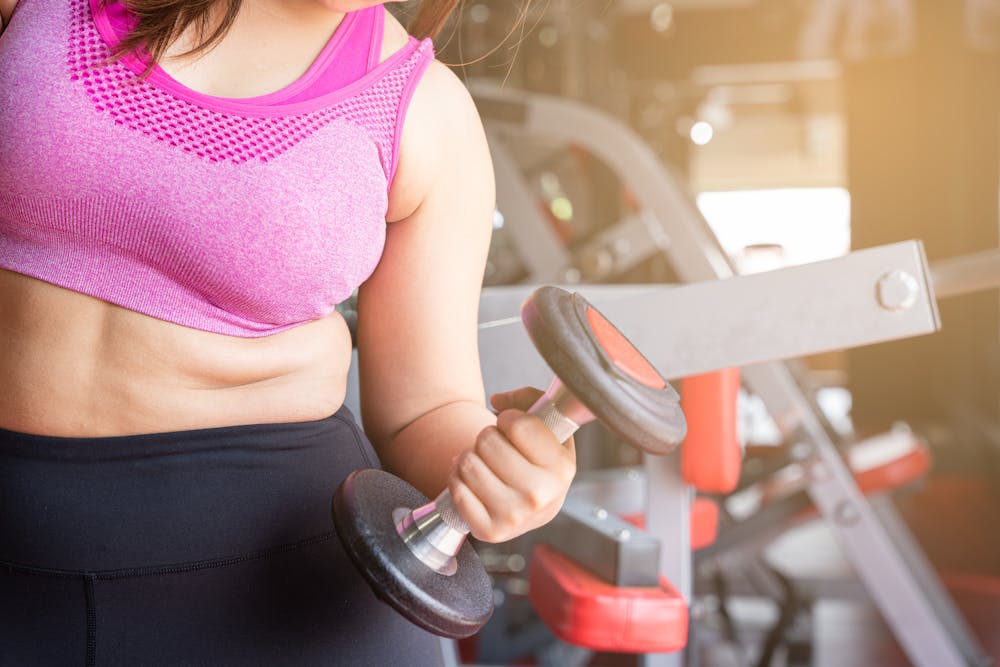
- isometric (static) where the force produced by a muscle is equal to the load to the muscle, such as holding a dumbbell
- concentric (shortening) in which force is greater than load, such as lifting a dumbbell
- eccentric (lengthening) in which force is less than load, such as lowering a dumbbell.
Muscles can produce greater force during eccentric than isometric or concentric contractions. And less fatigue is induced during eccentric than other contractions. Resistance exercises[8] – when muscles work against a weight or force – increase muscular strength and endurance using these types of muscle contractions.
Several studies[9] report exercise consisting of eccentric-only muscle contractions[10] (say, lowering a dumbbell but not lifting it) produces greater cross-education effect[11] than exercise consisting of concentric-only (lifting only) or concentric-eccentric contractions (lifting and lowering).
One study[12] showed eccentric exercise training affected brain-spine responses and stopping (inhibition) signals of the untrained limb to a greater extent than concentric training.
Read more: Is foam rolling effective for muscle pain and flexibility? The science isn't so sure[14]
What we studied
In 2021, we compared[15] eccentric and concentric resistance exercise training for cross-education effect in which 18 young people (aged 20–23) performed progressive elbow flexor resistance training with one arm twice a week for five weeks using a dumbbell.
Both eccentric (lengthening) and concentric (shortening) training groups increased muscle strength similarly after the training (by 23 to 26%) for the trained arm. But the non-trained arm showed greater strength increase after eccentric (23%) than concentric training (12%). The cross-body transfer ratio (the correspondence between the strength gain in both sides) was much greater (91%) for eccentric training when participants lowered a dumbbell only compared to concentric training (49%) when they lifted it.
This tallies with our previous study[16] that showed greater strength gains and cross-education effect from eccentric training.
Published in February, our most recent study involved 12 young men and showed[17] how training one arm can prevent weakening of the other. No training saw muscle strength and size of the inactive arm reduced by up to 17%. Concentric training reduced the loss to to 4%. But eccentric training increased the immobilised arm strength by 4% and completely abolished atrophy (muscle wasting).
Read more: Four reasons swimming should be your next workout[18]
What to ask your physio
These findings support the recommendation of resistance training using eccentric or lengthening movements of the non-immobilised limb to prevent muscle strength loss and atrophy in real injuries such as ligament sprains and tears or bone fractures and after surgery.
This type of training has not been used extensively in rehabilitation so far. Further investigation into the mechanisms at play is needed but our findings could inform changes to how rehabilitation is implemented.
If you’re injured and or have had surgery and have an arm or leg immobilised, it’s worth discussing with your doctor, surgeon or physio whether exercising the corresponding limb on your good side – especially with lengthening movements against resistance or with a weight – could be worth trying.
Read more: Hot pack or cold pack: which one to reach for when you're injured or in pain[19]
References
- ^ may not be fully restored (link.springer.com)
- ^ cross-education effect (theconversation.com)
- ^ study (pubmed.ncbi.nlm.nih.gov)
- ^ discovered (vlp-new.ur.de)
- ^ likely associated (pubmed.ncbi.nlm.nih.gov)
- ^ reviewed (www.tandfonline.com)
- ^ could be due (pubmed.ncbi.nlm.nih.gov)
- ^ Resistance exercises (www.betterhealth.vic.gov.au)
- ^ studies (pubmed.ncbi.nlm.nih.gov)
- ^ eccentric-only muscle contractions (pubmed.ncbi.nlm.nih.gov)
- ^ greater cross-education effect (pubmed.ncbi.nlm.nih.gov)
- ^ study (pubmed.ncbi.nlm.nih.gov)
- ^ Shutterstock (www.shutterstock.com)
- ^ Is foam rolling effective for muscle pain and flexibility? The science isn't so sure (theconversation.com)
- ^ compared (bmcsportsscimedrehabil.biomedcentral.com)
- ^ study (pubmed.ncbi.nlm.nih.gov)
- ^ showed (journals.lww.com)
- ^ Four reasons swimming should be your next workout (theconversation.com)
- ^ Hot pack or cold pack: which one to reach for when you're injured or in pain (theconversation.com)
Read more https://theconversation.com/why-exercising-your-good-arm-can-also-help-the-one-in-a-sling-200167