Flip-flopping magnetic fields hint at a solution for puzzling fast radio bursts from space
- Written by: Shi Dai, ARC DECRA Fellow, Western Sydney University
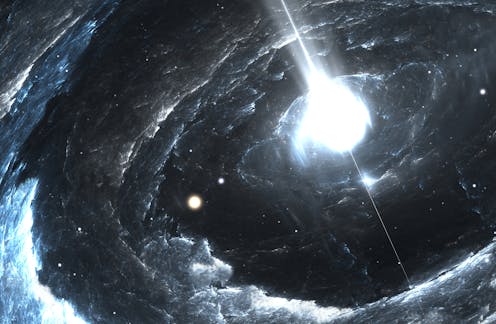
Fast radio bursts – intense, milliseconds-long flashes of radio energy from outer space – have puzzled astronomers[1] since they were first spotted in 2007. A single burst can emit as much energy in its brief life as the Sun does in a few days.
The great majority of the short-lived pulses originate outside our Milky Way galaxy. We don’t know what produces most of them, or how.
In new research published in Science[2], we observed a repeating fast radio burst for more than a year and discovered signs it is surrounded by a strong but highly changeable magnetic field.
Our results suggest the source of this cosmic explosion may be a binary system made up of a neutron star whirling through winds of dense, magnetised plasma produced by a massive companion star or even a black hole.
A fast radio burst that never stops repeating
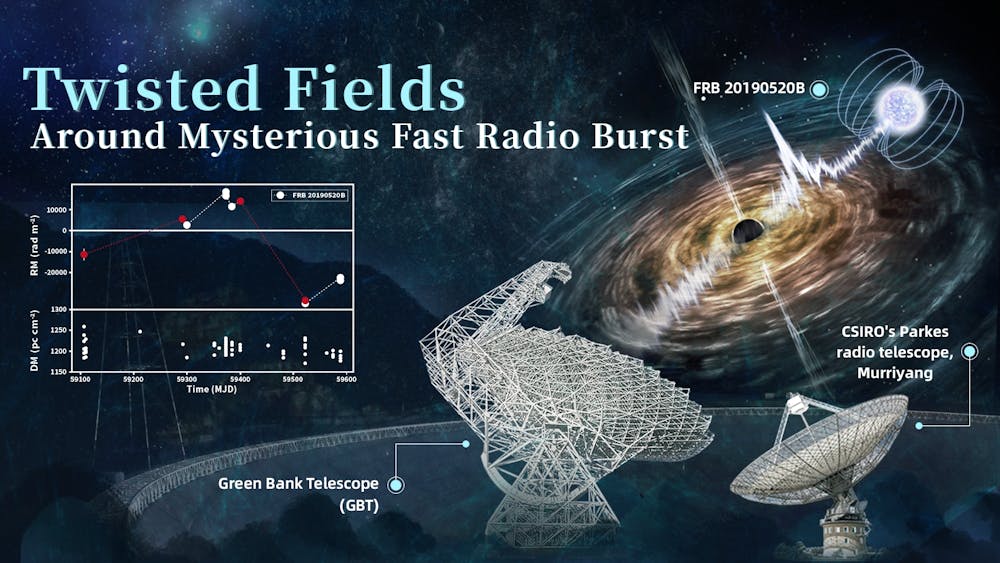
The repeating burst known as FRB 20190520B was discovered in 2022[3] by astronomers at the Five-hundred-meter Aperture Spherical radio Telescope (FAST) in China. Repeating fast radio bursts are rare, but FRB 20190520B is the rarest of all: it is the only one that never rests, producing radio bursts a few times an hour, sometimes at multiple radio frequencies.
After this intriguing object was first found, astronomers rushed to follow up the initial observation using other radio wavelengths.
Read more: More 'bright' fast radio bursts revealed, but where do they all come from?[4]
Further investigation showed FRB 20190520B resides in an extremely dense environment in a dwarf galaxy 3.9 billion light years away. There are also materials surrounding the FRB source that produce strong, persistent radio emissions.
This led to suggestions that the bursting source is a young neutron star in a complex environment.
Powerful magnetic fields
What else can we learn about this intergalactic firecracker and its environment? We carried out observations of FRB 20190520B using CSIRO’s Parkes radio telescope, Murriyang, in New South Wales and the Green Bank Telescope in the United States.
To our surprise, FRB 20190520B turned out to produce strong signals at relatively high radio frequencies. These high-frequency signals turned out to be highly polarised - which means the electromagnetic waves are “waving” much more strongly in one direction than in others.
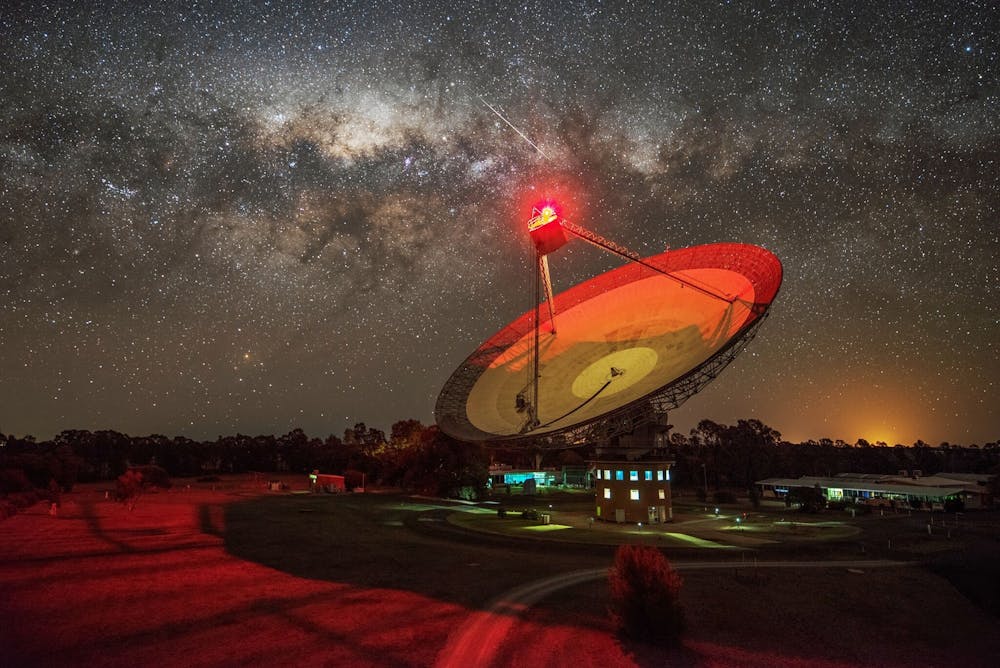 The study used data from CSIRO’s Parkes radio telescope, Murriyang, in NSW (pictured), and Green Bank Telescope in the US.
CSIRO via AAP
The study used data from CSIRO’s Parkes radio telescope, Murriyang, in NSW (pictured), and Green Bank Telescope in the US.
CSIRO via AAP
We found the direction of this polarisation changes at different frequencies. Measuring how much it changes tells us about the strength of the magnetic field the signal has travelled through.
As it turns out, this polarisation measure suggests the environment around FRB 20190520B is highly magnetised. And what’s more, the strength of the magnetic field appeared to vary over the 16 months we observed the source – and even flipped direction entirely twice.
This change in direction of the magnetic field around a fast radio burst has never been observed before.
Filling in the picture
What does this tell us about FRB 20190520B? Most popular theories to explain recent observations of repeating fast radio bursts involve binary systems made up of a neutron star and either another massive star or a black hole.
While we cannot rule out other hypotheses yet, our results favour the massive star scenario.
Read more: A brief history: what we know so far about fast radio bursts across the universe[5]
Massive stars are known to have strong stellar winds with organised magnetic fields around them. If the source of the bursts were moving in and out of the stellar wind region as it travels through its orbit, we would expect the observed magnetic field direction to reverse.
The time scale of the magnetic field reversal, the measured variability in the apparent field strength, and the dense plasma surrounding the burst source all fit into this picture.
What’s next?
Our observations might provide crucial evidence to support the hypothesis that sources of repeating fast radio bursts have a massive companion capable of producing highly magnetised plasma.
More importantly, the binary hypothesis gives us a prediction for the future. If it is correct, the changes in polarisation of the radio signals from FRB 20190520B should rise and fall over longer periods of time.
So we will be watching. Future observations with Murriyang and the Green Bank Telescope will reveal whether FRB 20190520B is truly in a binary system – or whether the Universe will surprise us once again.
References
- ^ puzzled astronomers (www.pnas.org)
- ^ new research published in Science (www.science.org)
- ^ discovered in 2022 (www.nature.com)
- ^ More 'bright' fast radio bursts revealed, but where do they all come from? (theconversation.com)
- ^ A brief history: what we know so far about fast radio bursts across the universe (theconversation.com)